
Pulp Fiction, 1925 · page 10 of 196
Adventure Magazine Cover — page 10: what you’re looking at
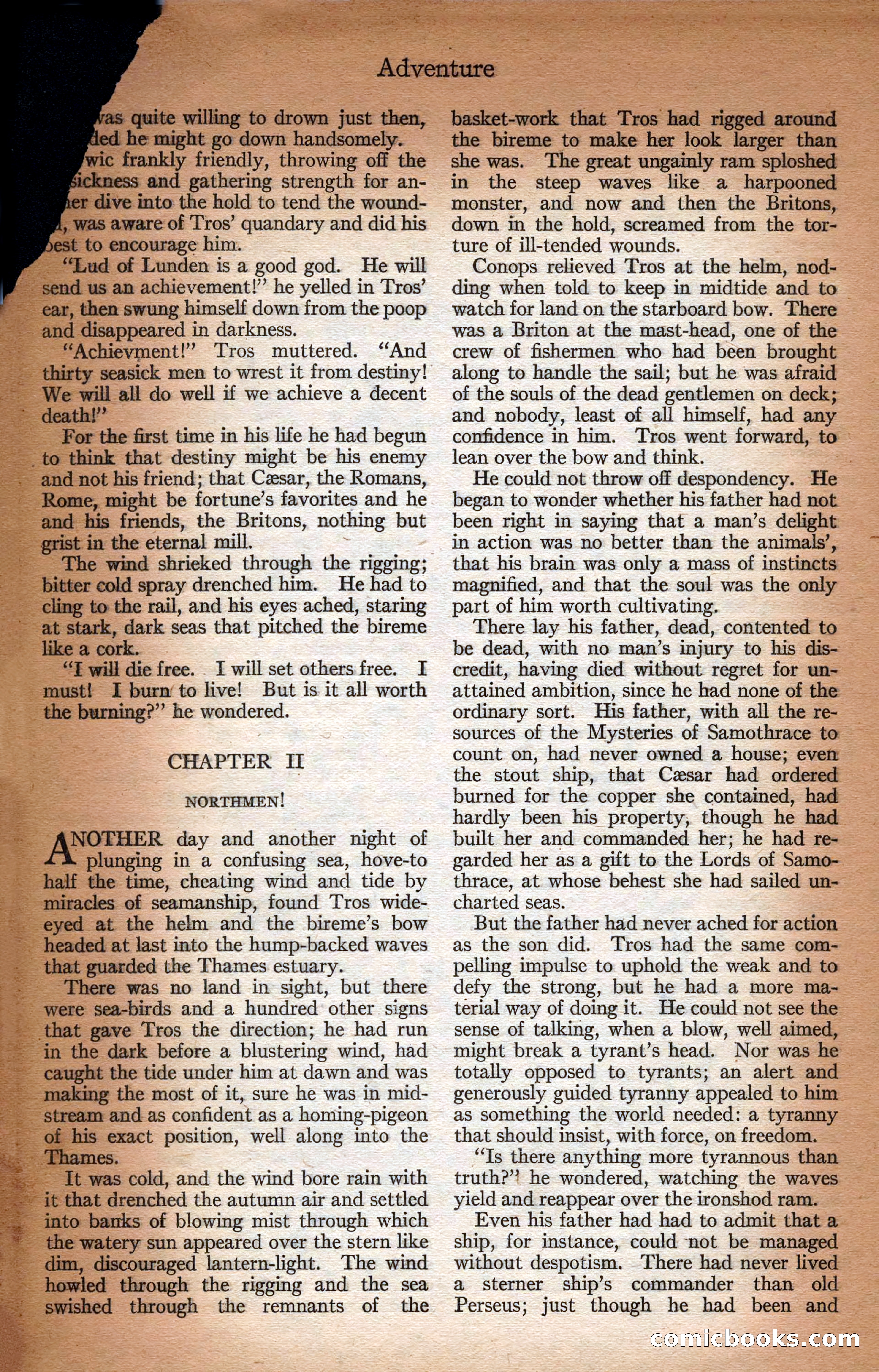
A restored page from Pulp Fiction, 1925. Page through the whole issue in the reader above.
📄 Transcribed text from this page (OCR, searchable)
Machine-transcribed from the original scan — historical spelling and the odd misread are preserved.
as quite willing to drown just then, Hed he might go down handsomely. wic frankly friendly, throwing off the sickness and gathering strength for an- ter dive into the hold to tend the wound- h, Was aware of Tros’ quandary and did his hest to encourage him. “Lud of Lunden is a good god. He will send us an achievement!”’ he yelled in Tros’ ear, then swung himself down from the poop and disappeared in darkness. “Achievment!” Tros muttered. “And thirty seasick men to wrest it from destiny! We will all do well if we achieve a decent ~ death!” For the first time in his life he had begun _to think that destiny might be his enemy and not his friend; that Cesar, the Romans, Rome, might be fortune’s favorites and he and his friends, the Britons, nothing but grist in the eternal mill. The wind shrieked through the rigging; bitter cold spray drenched him. He had to cling to the rail, and his eyes ached, staring at stark, dark seas that pitched the bireme like a cork. “T will die free. I will set others free. I must! I burn to live! But is it all worth the burning?” he wondered. CHAPTER II NORTHMEN! NOTHER day and another night of plunging in a confusing sea, hove-to half the time, cheating wind and tide by miracles of seamanship, found Tros wide- eyed at the helm and the bireme’s bow headed at last into the hump-backed waves that guarded the Thames estuary. There was no land in sight, but there were sea-birds and a hundred other signs that gave Tros the direction; he had run in the dark before a blustering wind, had caught the tide under him at dawn and was making the most of it, sure he was in mid- stream and as confident as a homing-pigeon of his exact position, well. along into the Thames. It was cold, and the wind bore rain with it that drenched the autumn air and settled into banks of blowing mist through which the watery sun appeared over the stern like dim, discouraged lantern-light. The wind howled through the rigging and the sea swished through the remnants of the Adventure basket-work that Tros had rigged around the bireme to make her look larger than she was. The great ungainly ram sploshed in the steep waves like a harpooned monster, and now and then the Britons, down in the hold, screamed from the tor- ture of ill-tended wounds. Conops relieved Tros at the helm, nod- ding when told to keep in midtide and to watch for land on the starboard bow. There was a Briton at the mast-head, one of the crew of fishermen who had been brought along to handle the sail; but he was afraid of the souls of the dead gentlemen on deck; and nobody, least of all himself, had any confidence in him. Tros went forward, to lean over the bow and think. He could not throw off despondency. He began to wonder whether his father had not been right in saying that a man’s delight in action was no better than the animals’, that his brain was only a mass of instincts magnified, and that the soul was the only part of him worth cultivating. There lay his father, dead, contented to be dead, with no man’s injury to his dis- credit, having died without regret for un- attained ambition, since he had none of the ordinary sort. His father, with all the re- sources of the Mysteries of Samothrace to count on, had never owned a house; ever the stout ship, that Cesar had ordered burned for the copper she contained, had hardly been his property, though he had built her and commanded her; he had re- garded her as a gift to the Lords of Samo- thrace, at whose behest she had sailed un- charted seas. But the father had never ached for action as the son did. Tros had the same com- pelling impulse to uphold the weak and to defy the strong, but he had a more ma- terial way of doing it. He could not see the sense of talking, when a blow, well aimed, might break a tyrant’s head. Nor was he totally opposed to tyrants; an alert and generously guided tyranny appealed to him as something the world needed: a tyranny that should insist, with force, on freedom. “Ts there anything more tyrannous than truth?’? he wondered, watching the waves yield and reappear over the ironshod ram. Even his father had had to admit that a ship, for instance, could not be managed without despotism. There had never lived a sterner ship’s commander than old Perseus; just though he had been and ecomicbooks.com