
Pulp Fiction, 1925 · page 80 of 212
Adventure Magazine Cover, March 20, 1925 — page 80: what you’re looking at
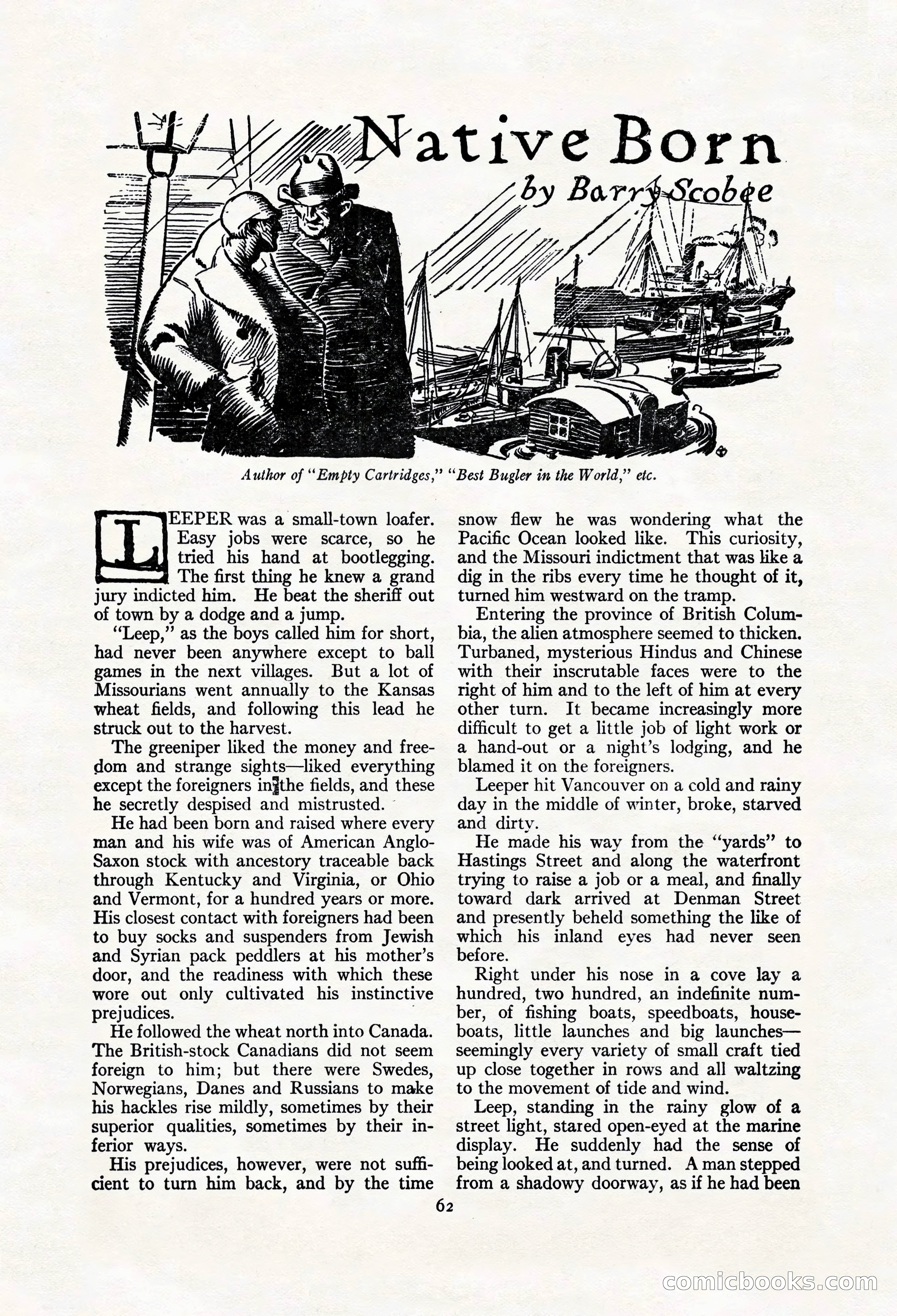
A restored page from Pulp Fiction, 1925. Page through the whole issue in the reader above.
📄 Transcribed text from this page (OCR, searchable)
Machine-transcribed from the original scan — historical spelling and the odd misread are preserved.
eas Author of “Empty Cariridyes “Best Bugler in the World, : EEPER was a small-town loafer. Easy jobs were scarce, so he tried his hand at bootlegging. The first thing he knew a grand jury indicted him. He beat the sheriff out of town by a dodge and a jump. “Leep,”’ as the boys called him for short, had never been anywhere except to ball games in the next villages. But a lot of Missourians went annually to the Kansas wheat fields, and following this lead he struck out to the harvest. The greeniper liked the money and free- dom and strange sights—liked everything except the foreigners ingthe fields, and these he secretly despised and mistrusted. © He had been born and raised where every man and his wife was of American Anglo- Saxon stock with ancestory traceable back through Kentucky and Virginia, or Ohio and Vermont, for a hundred years or more. His closest contact with foreigners had been to buy socks and suspenders from Jewish and Syrian pack peddlers at his mother’s door, and the readiness with which these wore out only cultivated his instinctive prejudices. He followed the wheat north into Canada. The British-stock Canadians did not seem foreign to him; but there were Swedes, Norwegians, Danes and Russians to make his hackles rise mildly, sometimes by their superior qualities, sometimes by their in- ferior ways. His prejudices, however, were not suff- cient to turn him back, and by the time 62 snow flew he was wondering what the Pacific Ocean looked like. This curiosity, and the Missouri indictment that was lke a dig in the ribs every time he thought of it, turned him westward on the tramp. Entering the province of British Colum- bia, the alien atmosphere seemed to thicken. Turbaned, mysterious Hindus and Chinese with their inscrutable faces were to the right of him and to the left of him at every other turn. It became increasingly more difficult to get a little job of light work or a hand-out or a night’s lodging, and he blamed it on the foreigners. Leeper hit Vancouver on a cold and rainy day in the middle of winter, broke, starved and dirty. He made his way from the “yards” Hastings Street and along the waterfront trying to raise a job or a meal, and finally toward dark arrived at Denman Street and presently beheld something the like of which his inland eyes had never seen before. Right under his nose in a cove lay a hundred, two hundred, an indefinite num- ber, of fishing boats, speedboats, house- boats, little launches and big launches— seemingly every variety of small craft tied up close together in rows and all waltzing to the movement of tide and wind. Leep, standing in the rainy glow of a street light, stared open-eyed at the marine display. He suddenly had the sense of being looked at, and turned. A man stepped from a shadowy doorway, as if he had been ANICLOO© (©