
Pulp Fiction, 1925 · page 79 of 212
Adventure Magazine Cover, March 20, 1925 — page 79: what you’re looking at
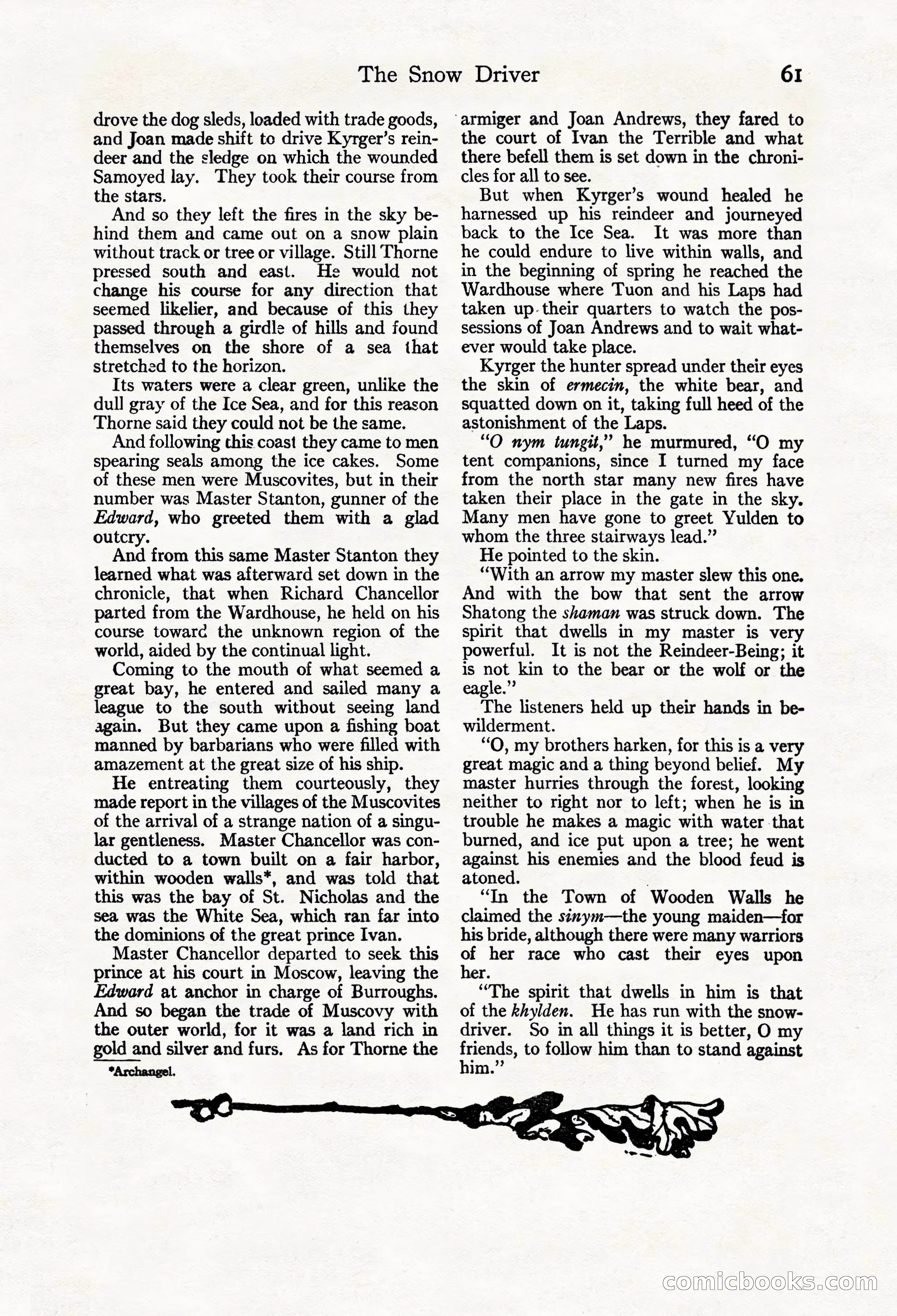
A restored page from Pulp Fiction, 1925. Page through the whole issue in the reader above.
📄 Transcribed text from this page (OCR, searchable)
Machine-transcribed from the original scan — historical spelling and the odd misread are preserved.
The Snow Driver drove the dog sleds, loaded with trade goods, and Joan made shift to drive Kyrger’s rein- deer and the sledge on which the wounded Samoyed lay. They took their course from the stars. And so they left the fires in the sky be- hind them and came out on a snow plain without track or tree or village. Still Thorne pressed south and east. He would not change his course for any direction that seemed likelier, and because of this they passed through a girdle of hills and found themselves on the shore of a sea that stretched to the horizon. Its waters were a clear green, unlike the dull gray of the Ice Sea, and for this reason Thorne said they could not be the same. And following this coast they came to men spearing seals among the ice cakes. Some of these men were Muscovites, but in their number was Master Stanton, gunner of the Edward, who greeted them with a glad outcry. And from this same Master Stanton they learned what was afterward set down in the chronicle, that when Richard Chancellor parted from the Wardhouse, he held on his course toward the unknown region of the world, aided by the continual light. Coming to the mouth of what seemed a great bay, he entered and sailed many a league to the south without seeing land again. But they came upon a fishing boat manned by barbarians who were filled with amazement at the great size of his ship. He entreating them courteously, they made report in the villages of the Muscovites of the arrival of a strange nation of a singu- lar gentleness. Master Chancellor was con- ducted to a town built on a fair harbor, within wooden walls*, and was told that this was the bay of St. Nicholas and the sea was the White Sea, which ran far into the dominions of the great prince Ivan. Master Chancellor departed to seek this prince at his court in Moscow, leaving the Edward at anchor in charge of Burroughs. And so began the trade of Muscovy with the outer world, for it was a land rich in gold and silver and furs. As for Thorne the “Archangel. 61 ‘armiger and Joan Andrews, they fared to the court of Ivan the Terrible and what there befell them is set down in the chroni- cles for all to see. But when Kyrger’s wound healed he harnessed up his reindeer and journeyed back to the Ice Sea. It was more than he could endure to live within walls, and in the beginning of spring he reached the Wardhouse where Tuon and his Laps had taken up-their quarters to watch the pos- sessions of Joan Andrews and to wait what- ever would take place. Kyrger the hunter spread under their eyes the skin of ermecin, the white bear, and squatted down on it, taking full heed of the astonishment of the Laps. “O nym tungit,” he murmured, “O my tent companions, since I turned my face from the north star many new fires have taken their place in the gate in the sky. Many men have gone to greet Yulden to whom the three stairways lead.” He pointed to the skin. “With an arrow my master slew this one. And with the bow that sent the arrow Shatong the shaman was struck down. The spirit that dwells in my master is very powerful. It is not the Reindeer-Being; it is not kin to the bear or the wolf or the eagle.” The listeners held up their hands in be- wilderment. “O, my brothers harken, for this is a very great magic and a thing beyond belief. My master hurries through the forest, looking neither to right nor to left; when he is in trouble he makes a magic with water that burned, and ice put upon a tree; he went against his enemies and the blood feud is atoned. “In the Town of Wooden Walls he claimed the sinym—the young maiden—for his bride, although there were many warriors . her race who cast their eyes upon er. “The spirit that dwells in him is that of the khylden. He has run with the snow- driver. So in all things it is better, O my friends, to follow him than to stand against him.” OO) (©