
Pulp Fiction, 1925 · page 105 of 212
Adventure Magazine Cover, March 20, 1925 — page 105: what you’re looking at
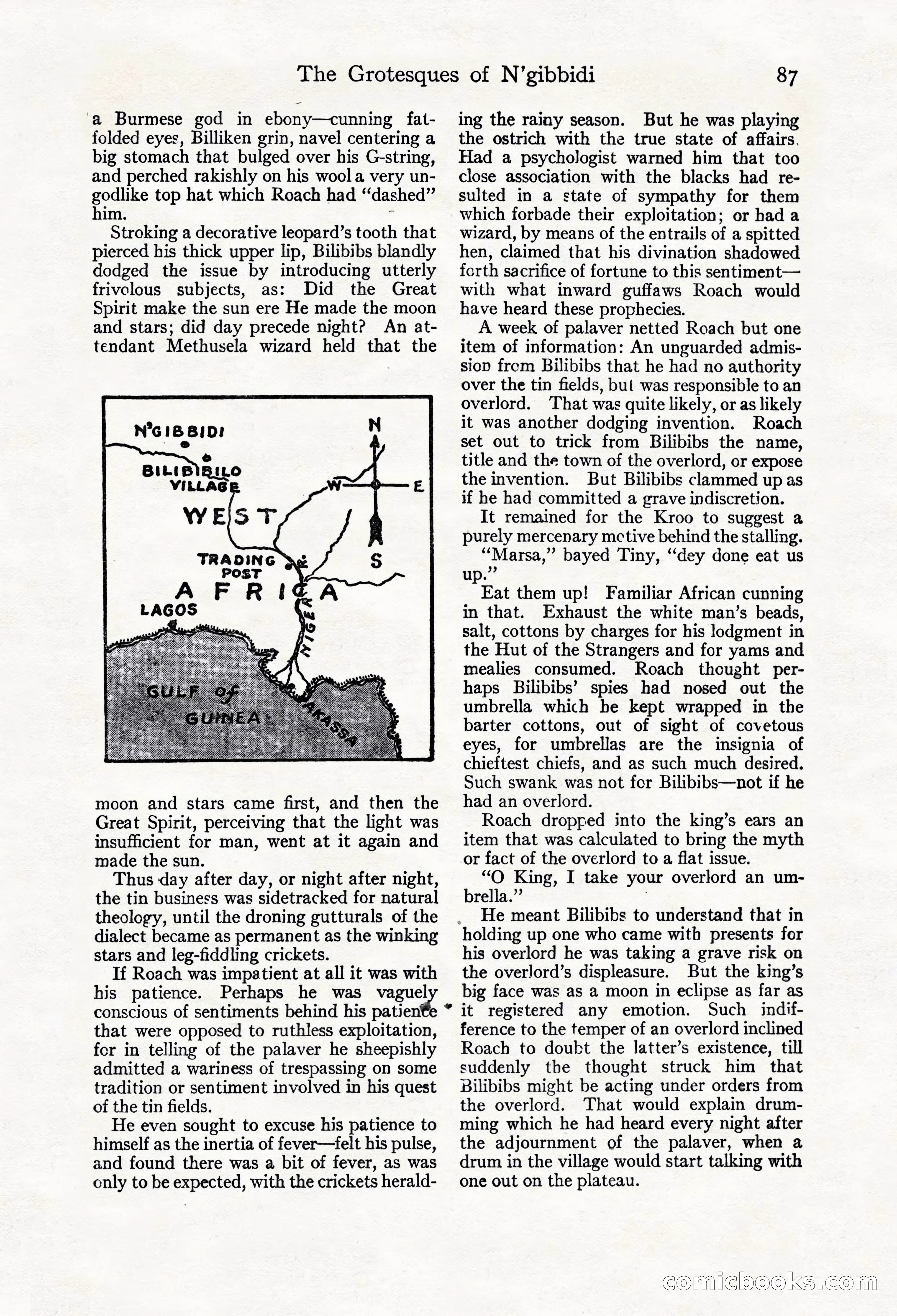
A restored page from Pulp Fiction, 1925. Page through the whole issue in the reader above.
📄 Transcribed text from this page (OCR, searchable)
Machine-transcribed from the original scan — historical spelling and the odd misread are preserved.
The Grotesques of N’gibbidi a Burmese god in ebony—cunning fat- folded eyes, Billiken grin, navel centering a big stomach that bulged over his G-string, and perched rakishly on his woola very un- godlike top hat which Roach had ‘‘dashed”’ him. : Stroking a decorative leopard’s tooth that pierced his thick upper lip, Bilibibs blandly dodged the issue by introducing utterly frivolous subjects, as: Did the Great Spirit make the sun ere He made the moon and stars; did day precede night? An at- tendant Methusela wizard held that the N°G!B BID? _ @ BILIBIBILO vi ee moon and stars came first, and then the Great Spirit, perceiving that the light was insufficient for man, went at it again and made the sun. Thus day after day, or night after night, the tin business was sidetracked for natural theology, until the droning gutturals of the dialect became as permanent as the winking stars and leg-fiddling crickets. If Roach was impatient at all it was with his patience. Perhaps he was vaguel conscious of sentiments behind his patien that were opposed to ruthless exploitation, for in telling of the palaver he sheepishly admitted a wariness of trespassing on some tradition or sentiment involved in his quest of the tin fields. He even sought to excuse his patience to himself as the inertia of fever—felt his pulse, and found there was a bit of fever, as was only to be expected, with the crickets herald- i 87 ing the rainy season. But he was playing the ostrich with the true state of affairs. Had a psychologist warned him that too close association with the blacks had re- sulted in a state of sympathy for them which forbade their exploitation; or had a wizard, by means of the entrails of a spitted hen, claimed that his divination shadowed forth sacrifice of fortune to this sentiment— with what inward guffaws Roach would have heard these prophecies. A week of palaver netted Roach but one item of information: An unguarded admis- siop from Bilibibs that he had no authority over the tin fields, but was responsible to an overlord. That was quite likely, or as likely it was another dodging invention. Roach set out to trick from Bilibibs the name, title and the town of the overlord, or expose the invention. But Bilibibs clammed up as if he had committed a grave indiscretion. It remained for the Kroo to suggest a purely mercenary mctive behind the stalling. ““Marsa,” bayed Tiny, ‘‘dey done eat us up.” Eat them up! Familiar African cunning in that. Exhaust the white man’s beads, salt, cottons by charges for his lodgment in the Hut of the Strangers and for yams and mealies consumed. Roach thought per- haps Bilibibs’ spies had nosed out the umbrella which he kept wrapped in the barter cottons, out of sight of covetous eyes, for umbrellas are the insignia of chieftest chiefs, and as such much desired. Such swank was not for Bilibibs—not if he had an overlord. Roach dropped into the king’s ears an item that was calculated to bring the myth or fact of the overlord to a flat issue. “O King, I take your overlord an um- brella.”’ : He meant Bilibibs to understand that in holding up one who came with presents for his overlord he was taking a grave risk on the overJord’s displeasure. But the king’s big face was as a moon in eclipse as far as it registered any emotion. Such _ indif- ference to the temper of an overlord inclined Roach to doubt the latter’s existence, till suddenly the thought struck him that Bilibibs might be acting under orders from the overlord. That would explain drum- ming which he had heard every night after the adjournment of the palaver, when a drum in the village would start talking with one out on the plateau. CORnNIECLO© (©