
Pulp Fiction, 1925 · page 104 of 212
Adventure Magazine Cover, March 20, 1925 — page 104: what you’re looking at
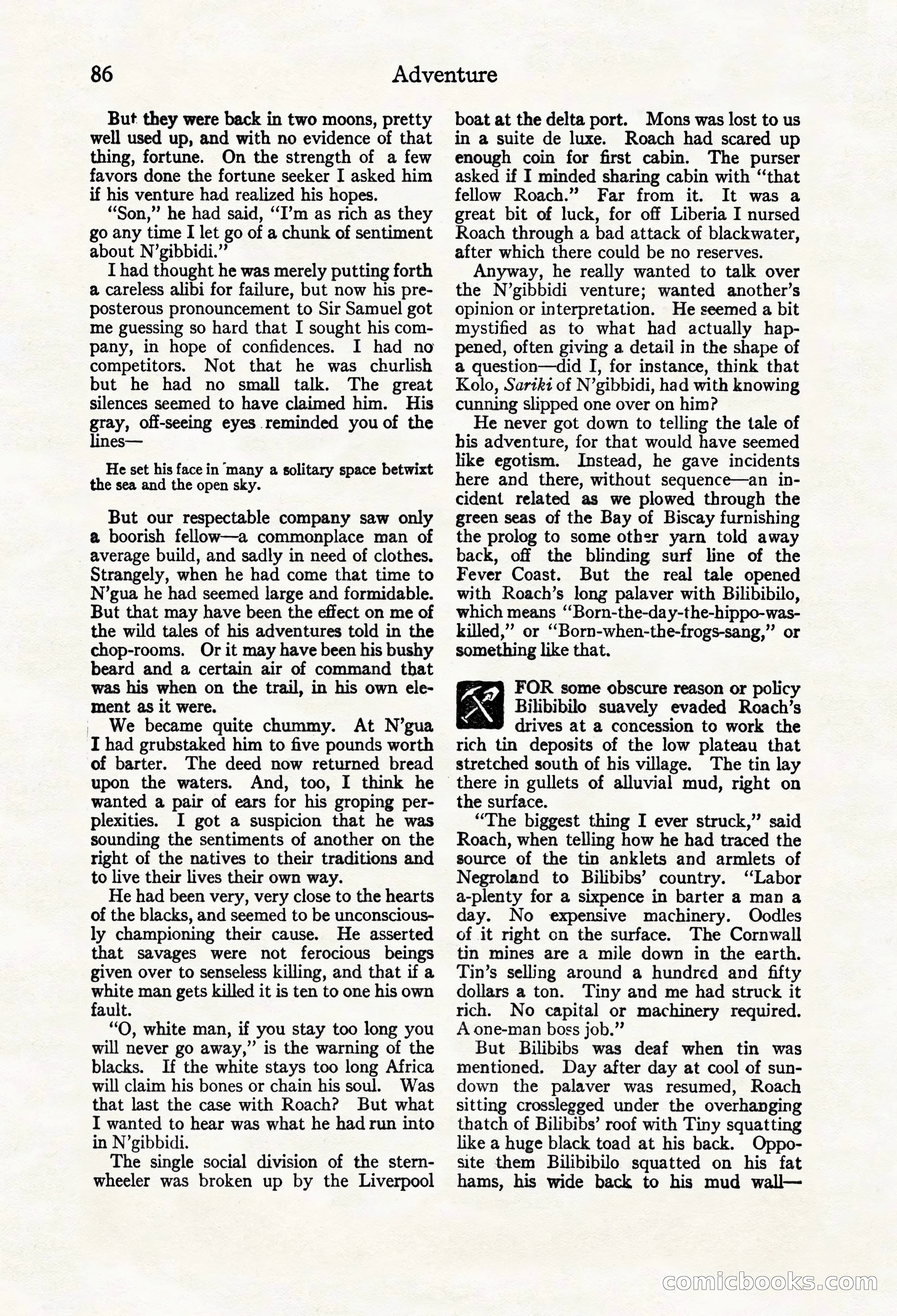
A restored page from Pulp Fiction, 1925. Page through the whole issue in the reader above.
📄 Transcribed text from this page (OCR, searchable)
Machine-transcribed from the original scan — historical spelling and the odd misread are preserved.
86 But they were back in two moons, pretty well used up, and with no evidence of that thing, fortune. On the strength of a few favors done the fortune seeker I asked him if his venture had realized his hopes. “Son,” he had said, ‘I’m as rich as they go any time I let go of a chunk of sentiment about N’gibbidi.” I had thought he was merely putting forth a careless alibi for failure, but now his pre- posterous pronouncement to Sir Samuel got me guessing so hard that I sought his com- pany, in hope of confidences. I had no competitors. Not that he was churlish but he had no small talk. The great silences seemed to have claimed him. His gray, off-seeing eyes reminded you of the nes— He set his face in ‘many a solitary space betwixt the sea and the open sky. But our respectable company saw only a boorish fellow—a commonplace man of average build, and sadly in need of clothes. Strangely, when he had come that time to N’gua he had seemed large and formidable. But that may have been the effect on me of the wild tales of his adventures told in the chop-rooms. Or it may have been his bushy beard and a certain air of command that was his when on the trail, in his own ele- ment as it were. _ We became quite chummy. At N’gua I had grubstaked him to five pounds worth of barter. The deed now returned bread upon the waters. And, too, I think he wanted a pair of ears for his groping per- plexities. I got a suspicion that he was sounding the sentiments of another on the right of the natives to their traditions and to live their lives their own way. He had been very, very close to the hearts of the blacks, and seemed to be unconscious- ly championing their cause. He asserted that savages were not ferocious beings given over to senseless killing, and that if a white man gets killed it is ten to one his own fault. “O, white man, if you stay too long you will never go away,” is the warning of the blacks. If the white stays too long Africa will claim his bones or chain his soul. Was that last the case with Roach? But what I wanted to hear was what he had run into in N’gibbidi. The single social division of the stern- wheeler was broken up by the Liverpool Adventure boat at the delta port. Mons was lost to us in a suite de luxe. Roach had scared up enough coin for first cabin. The purser asked if I minded sharing cabin with “that fellow Roach.” Far from it. It was a great bit of luck, for off Liberia I nursed Roach through a bad attack of blackwater, after which there could be no reserves. Anyway, he really wanted to talk over the N’gibbidi venture; wanted another’s opinion or interpretation. He seemed a bit mystified as to what had actually hap- pened, often giving a detail in the shape of a question—did I, for instance, think that Kolo, Sartkt of N’gibbidi, had with knowing cunning slipped one over on him? He never got down to telling the tale of his adventure, for that would have seemed like egotism. Instead, he gave incidents here and there, without sequence—an in- cident related as we plowed through the green seas of the Bay of Biscay furnishing the prolog to some other yarn told away back, off the blinding surf line of the Fever Coast. But the real tale opened with Roach’s long palaver with Bilibibilo, which means ‘“‘Born-the-day-the-hippo-was- killed,” or “Born-when-the-frogs-sang,” or something like that. Fe) FOR some obscure reason or policy Bate Bilibibilo suavely evaded Roach’s drives at a concession to work the rich tin deposits of the low plateau that stretched south of his village. The tin lay there in gullets of alluvial mud, right on the surface. “The biggest thing I ever struck,” said Roach, when telling how he had traced the source of the tin anklets and armlets of Negroland to Bilibibs’ country. ‘Labor a-plenty for a sixpence in barter a man a day. No expensive machinery. Oodles of it right on the surface. The Cornwall tin mines are a mile down in the earth. Tin’s selling around a hundred and fifty dollars a ton. Tiny and me had struck it rich. No capital or machinery required. A one-man boss job.” But Bilibibs was deaf when tin was mentioned. Day after day at cool of sun- down the palaver was resumed, Roach sitting crosslegged under the overhanging thatch of Bilibibs’ roof with Tiny squatting like a huge black toad at his back. Oppo- site them Bilibibilo squatted on his fat hams, his wide back to his mud wall— CORnnICLOe CO