
Pulp Fiction, 1924 · page 62 of 216
Adventure Magazine, December 10, 1924 — page 62: what you’re looking at
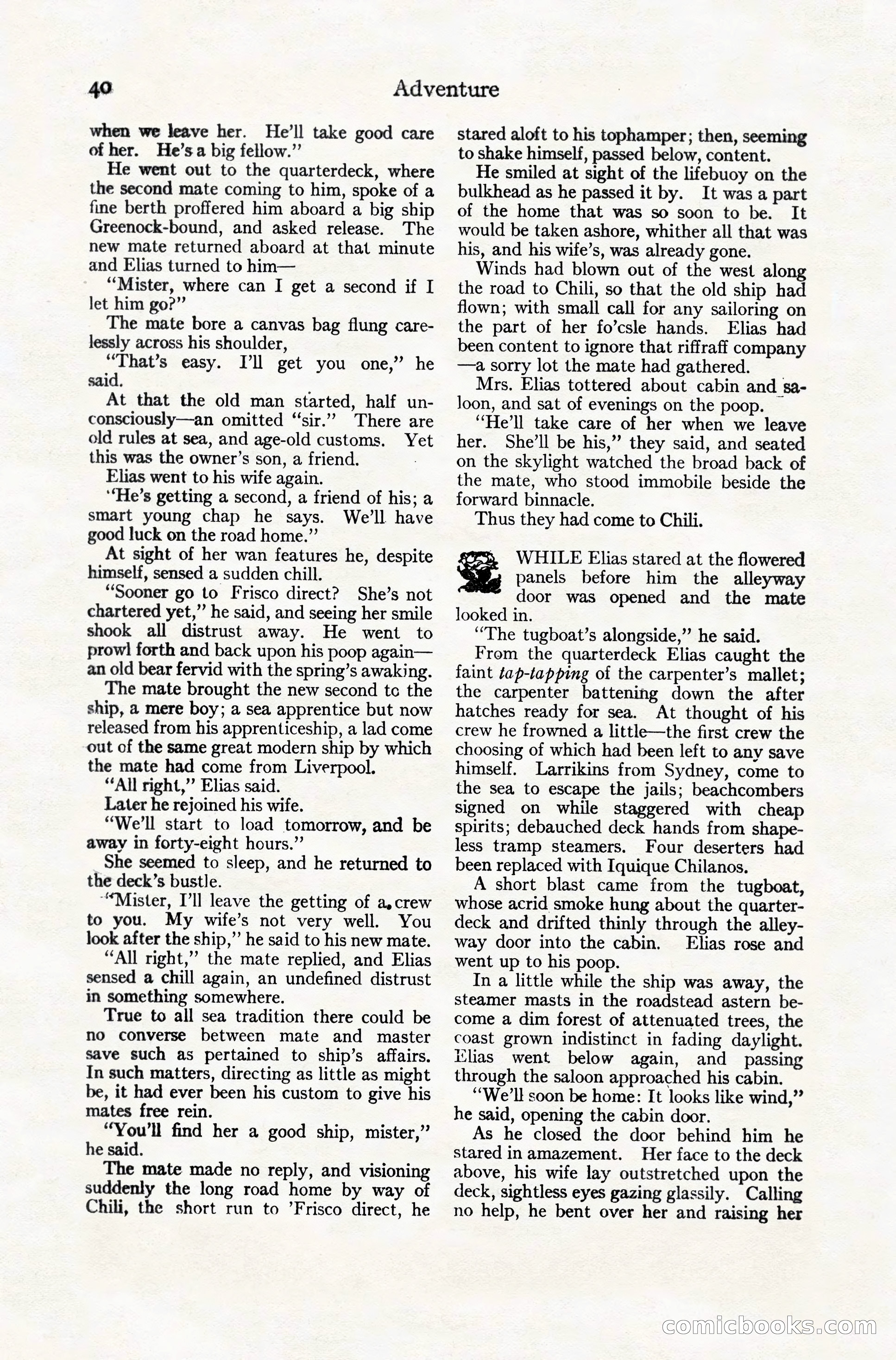
A restored page from Pulp Fiction, 1924. Page through the whole issue in the reader above.
📄 Transcribed text from this page (OCR, searchable)
Machine-transcribed from the original scan — historical spelling and the odd misread are preserved.
40 when we leave her. He'll take good care of her. He’sa big fellow.”’ He went out to the quarterdeck, where the second mate coming to him, spoke of a fine berth proffered him aboard a big ship Greenock-bound, and asked release. The new mate returned aboard at that minute and Elias turned to him— ‘Mister, where can I get a second if I let him go?” The mate bore a canvas bag flung care- lessly across his shoulder, ‘“That’s easy. Jl get you one,” he said. At that the old man started, half un- consciously—an omitted “sir.” There are old rules at sea, and age-old customs. Yet this was the owner’s son, a friend. Elias went to his wife again. ‘‘He’s getting a second, a friend of his; a smart young chap he says. We’ll have good luck on the road home.”’ At sight of her wan features he, despite himself, sensed a sudden chill. “Sooner go to Frisco direct? She’s not chartered yet,” he said, and seeing her smile shook all distrust away. He went to prowl forth and back upon his poop again— an old bear fervid with the spring’s awaking. The mate brought the new second tc the ship, a mere boy; a sea apprentice but now released from his apprenticeship, a lad come out of the same great modern ship by which the mate had come from Liverpool. “All right,” Elias said. Later he rejoined his wife. “We'll start to load tomorrow, and be away in forty-eight hours.” She seemed to sleep, and he returned to the deck’s bustle. “Mister, I'll leave the getting of a,crew to you. My wife’s not very well. You look after the ship,”’ he said to his new mate. ‘All right,” the mate replied, and Elias sensed a chill again, an undefined distrust in something somewhere. True to all sea tradition there could be no converse between mate and master save such as pertained to ship’s affairs. In such matters, directing as little as might be, it had ever been his custom to give his mates free rein. “You'll find her a good ship, mister,” he said. The mate made no reply, and visioning suddenly the long road home by way of Chili, the short run to ’Frisco direct, he Adventure stared aloft to his tophamper; then, seeming to shake himself, passed below, content. He smiled at sight of the lifebuoy on the bulkhead as he passed it by. It was a part of the home that was so soon to be. It would be taken ashore, whither all that was his, and his wife’s, was already gone. Winds had blown out of the west along the road to Chili, so that the old ship had flown; with small call for any sailoring on the part of her fo’csle hands. Elias had been content to ignore that riffraff company —a sorry lot the mate had gathered. Mrs. Elias tottered about cabin and sa- Joon, and sat of evenings on the poop. ‘He'll take care of her when we leave her. She’ll be his,”’ they said, and seated on the skylight watched the broad back of the mate, who stood immobile beside the forward binnacle. Thus they had come to Chili. WHILE Elias stared at the flowered panels before him the alleyway door was opened and the mate looked in. ‘The tugboat’s alongside,” he said. From the quarterdeck Elias caught the faint tap-tapping of the carpenter’s mallet; the carpenter battening down the after hatches ready for sea. At thought of his crew he frowned a little—the first crew the choosing of which had been left to any save himself. Larrikins from Sydney, come to the sea to escape the jails; beachcombers signed on while staggered with cheap spirits; debauched deck hands from shape- less tramp steamers. Four deserters had been replaced with Iquique Chilanos. A short blast came from the tugboat, whose acrid smoke hung about the quarter- deck and drifted thinly through the alley- way door into the cabin. Elias rose and went up to his poop. In a little while the ship was away, the steamer masts in the roadstead astern be- come a dim forest of attenuated trees, the coast grown indistinct in fading daylight. itlas went below again, and_ passing through the saloon approached his cabin. ‘“We’ll soon be home: It looks like wind,” he said, opening the cabin door. As he closed the door behind him he stared in amazement. Her face to the deck above, his wife lay outstretched upon the deck, sightless eyes gazing glassily. Calling no help, he bent over her and raising her CoOMmicbhook A) CO 5}