
Pulp Fiction, 1924 · page 61 of 216
Adventure Magazine, December 10, 1924 — page 61: what you’re looking at
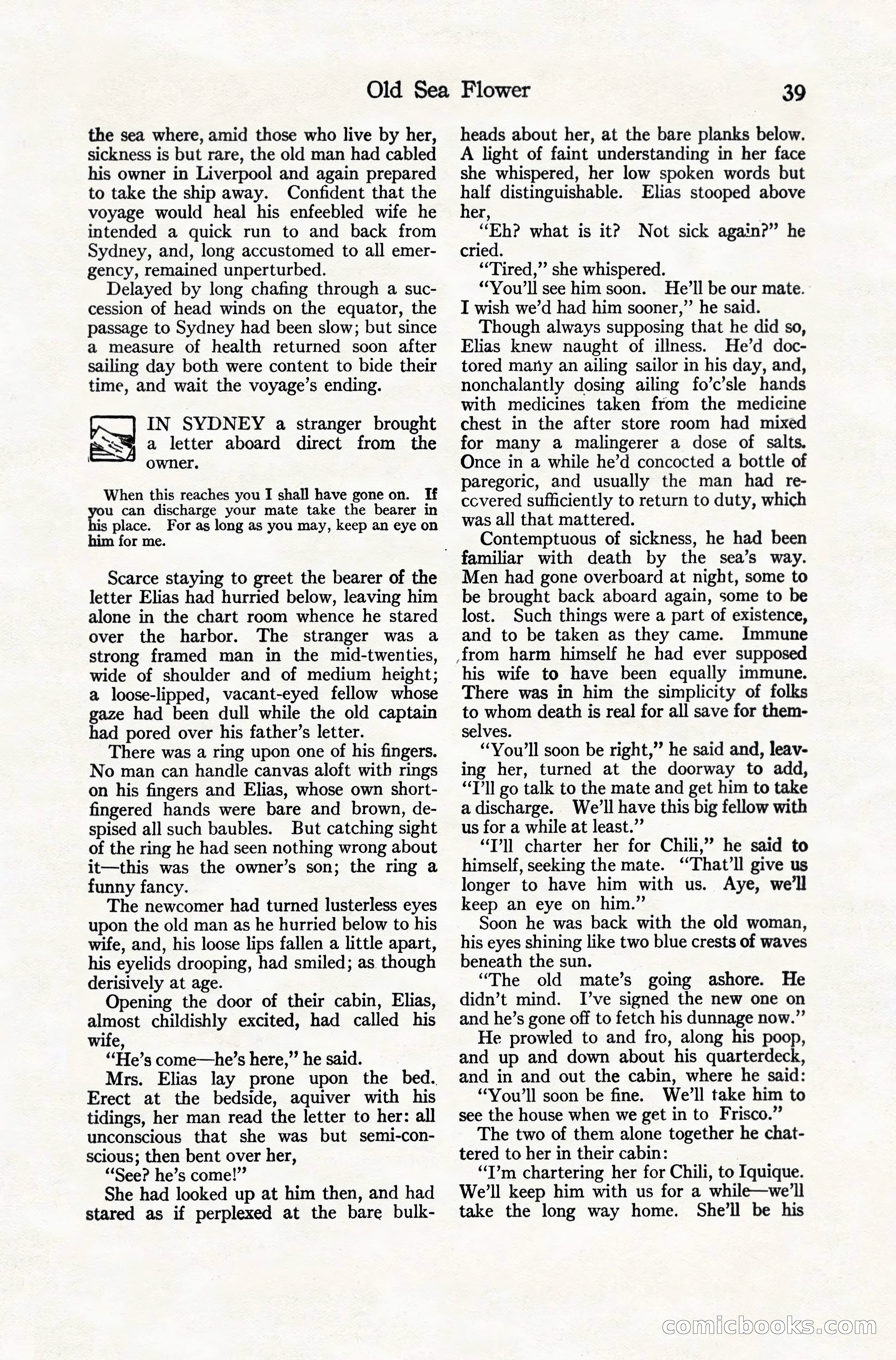
A restored page from Pulp Fiction, 1924. Page through the whole issue in the reader above.
📄 Transcribed text from this page (OCR, searchable)
Machine-transcribed from the original scan — historical spelling and the odd misread are preserved.
Old Sea Flower the sea where, amid those who live by her, sickness is but rare, the old man had cabled his owner in Liverpool and again prepared to take the ship away. Confident that the voyage would heal his enfeebled wife he intended a quick run to and back from Sydney, and, long accustomed to all emer- gency, remained unperturbed. Delayed by long chafing through a suc- cession of head winds on the equator, the passage to Sydney had been slow; but since a measure of health returned soon after sailing day both were content to bide their time, and wait the voyage’s ending. IN SYDNEY a stranger brought SS! a letter aboard direct from the owner. When this reaches you I shall have gone on. If you can discharge your mate take the bearer in his place. For as long as you may, keep an eye on him for me. Scarce staying to greet the bearer of the letter Elias had hurried below, leaving him alone in the chart room whence he stared over the harbor. The stranger was a strong framed man in the mid-twenties, wide of shoulder and of medium height; a loose-lipped, vacant-eyed fellow whose gaze had been dull while the old captain had pored over his father’s letter. There was a ring upon one of his fingers. No man can handle canvas aloft with rings on his fingers and Elias, whose own short- fingered hands were bare and brown, de- spised all such baubles. But catching sight of the ring he had seen nothing wrong about it—this was the owner’s son; the ring a funny fancy. The newcomer had turned lusterless eyes upon the old man as he hurried below to his wife, and, his loose lips fallen a little apart, his eyelids drooping, had smiled; as though derisively at age. Opening the door of their cabin, Elias, almost childishly excited, had called his wife, “‘He’s come—he’s here,” he said. Mrs. Elias lay prone upon the bed. Erect at the bedside, aquiver with his tidings, her man read the letter to her: all unconscious that she was but semi-con- scious; then bent over her, “See? he’s come!”’ She had looked up at him then, and had stared as if perplexed at the bare bulk- 39 heads about her, at the bare planks below. A light of faint understanding in her face she whispered, her low spoken words but nee distinguishable. Elias stooped above er, “Eh? what is it? Not sick again?” he cried. ‘‘Tired,”’ she whispered. “You’ll see him soon. He’ll be our mate. I wish we’d had him sooner,” he said. Though always supposing that he did so, Elias knew naught of illness. He’d doc- tored many an ailing sailor in his day, and, nonchalantly dosing ailing fo’c’sle hands with medicines taken from the medicine chest in the after store room had mixed for many a malingerer a dose of salts. Once in a while he’d concocted a bottle of paregoric, and usually the man had re- ccvered sufficiently to return to duty, which was all that mattered. Contemptuous of sickness, he had been ' familiar with death by the sea’s way. Men had gone overboard at night, some to be brought back aboard again, some to be lost. Such things were a part of existence, and to be taken as they came. Immune from harm himself he had ever supposed his wife to have been equally immune. There was in him the simplicity of folks to whom death is real for all save for them- selves. “You'll soon be right,” he said and, leav- ing her, turned at the doorway to add, “T’ll go talk to the mate and get him to take a discharge. We'll have this big fellow with us for a while at least.” “T’ll charter her for Chili,” he said to himself, seeking the mate. ‘“That’ll give us longer to have him with us. Aye, we'll keep an eye on him.” Soon he was back with the old woman, his eyes shining like two blue crests of waves beneath the sun. “The old mate’s going ashore. He didn’t mind. I’ve signed the new one on and he’s gone off to fetch his dunnage now.” He prowled to and fro, along his poop, and up and down about his quarterdeck, and in and out the cabin, where he said: “You'll soon be fine. We'll take him to see the house when we get in to Frisco.” The two of them alone together he chat- tered to her in their cabin: 7 “I’m chartering her for Chili, to Iquique. We’ll keep him with us for a while—we’ll take the long way home. She'll be his CoMmiclbool< Wh) © 5}