
Pulp Fiction, 1924 · page 199 of 216
Adventure Magazine, December 10, 1924 — page 199: what you’re looking at
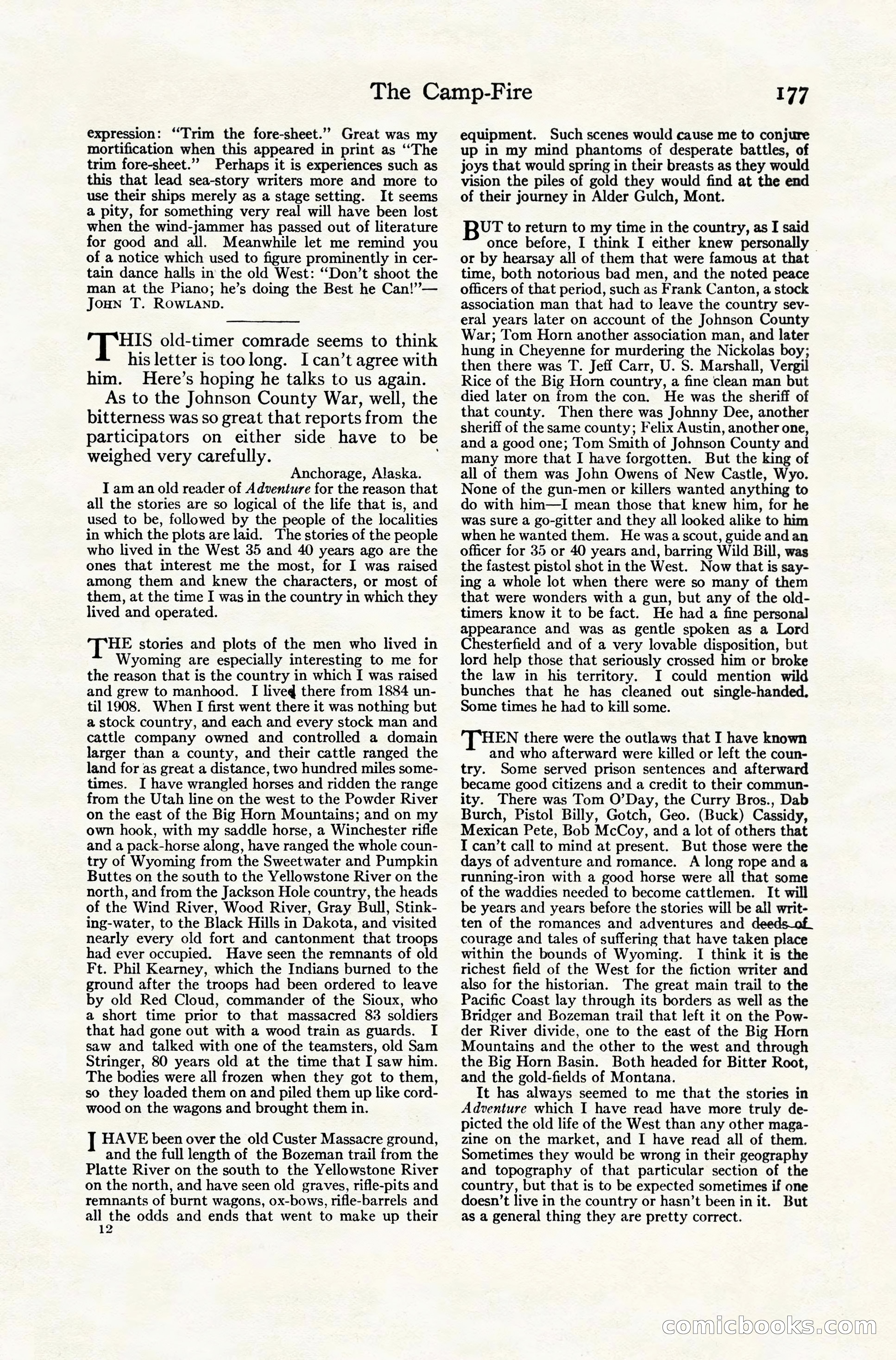
A restored page from Pulp Fiction, 1924. Page through the whole issue in the reader above.
📄 Transcribed text from this page (OCR, searchable)
Machine-transcribed from the original scan — historical spelling and the odd misread are preserved.
The Camp-Fire expression: ‘Trim the fore-sheet.’”’ Great was my mortification when this appeared in print as “The trim fore-sheet.”” Perhaps it is experiences such as this that lead sea-story writers more and more to use their ships merely as a stage setting. It seems a pity, for something very real will have been lost when the wind-jammer has passed out of literature for good and all. Meanwhile let me remind you of a notice which used to figure prominently in cer- tain dance halls in the old West: “Don’t shoot the man at the Piano; he’s doing the Best he Can!’’— JoHN T. ROWLAND. HIS old-timer comrade seems to think his letter is toolong. I can’t agree with him. Here’s hoping he talks to us again. As to the Johnson County War, well, the bitterness was so great that reports from the participators on either side have to be weighed very carefully. Anchorage, Alaska. I am an old reader of Adventure for the reason that all the stories are so logical of the life that is, and used to be, followed by the people of the localities in which the plots are laid. The stories of the people who lived in the West 35 and 40 years ago are the ones that interest me the most, for I was raised among them and knew the characters, or most of them, at the time I was in the country in which they lived and operated. THE stories and plots of the men who lived in Wyoming are especially interesting to me for the reason that is the country in which I was raised and grew to manhood. I lived there from 1884 un- til 1908. When I first went there it was nothing but a stock country, and each and every stock man and cattle company owned and controlled a domain larger than a county, and their cattle ranged the land for as great a distance, two hundred miles some- times. I have wrangled horses and ridden the range from the Utah line on the west to the Powder River on the east of the Big Horn Mountains; and on my own hook, with my saddle horse, a Winchester rifle and a pack-horse along, have ranged the whole coun- try of Wyoming from the Sweetwater and Pumpkin Buttes on the south to the Yellowstone River on the north, and from the Jackson Hole country, the heads of the Wind River, Wood River, Gray Bull, Stink- ing-water, to the Black Hills in Dakota, and visited nearly every old fort and cantonment that troops had ever occupied. Have seen the remnants of old Ft. Phil Kearney, which the Indians burned to the ground after the troops had been ordered to leave by old Red Cloud, commander of the Sioux, who a short time prior to that massacred 83 soldiers that had gone out with a wood train as guards. I saw and talked with one of the teamsters, old Sam Stringer, 80 years old at the time that I saw him. The bodies were all frozen when they got to them, so they loaded them on and piled them up like cord- wood on the wagons and brought them in. I HAVE been over the old Custer Massacre ground, and the full length of the Bozeman trail from the Platte River on the south to the Yellowstone River on the north, and have seen old graves, rifle-pits and remnants of burnt wagons, ox-bows, rifle-barrels and all the odds and ends that went to make up their 2 177 equipment. Such scenes would cause me to conjure up in my mind phantoms of desperate battles, of joys that would spring in their breasts as they would vision the piles of gold they would find at the end of their journey in Alder Gulch, Mont. UT to return to my time in the country, as I said once before, I think I either knew personally or by hearsay all of them that were famous at that time, both notorious bad men, and the noted peace officers of that period, such as Frank Canton, a stock association man that had to leave the country sev- eral years later on account of the Johnson County War; Tom Horn another association man, and later hung in Cheyenne for murdering the Nickolas boy; then there was T. Jeff Carr, U. S. Marshall, Vergil Rice of the Big Horn country, a fine clean man but died later on from the con. He was the sheriff of that county. Then there was Johnny Dee, another sheriff of the same county; Felix Austin, another one, and a good one; Tom Smith of Johnson County and many more that I have forgotten. But the king of all of them was John Owens of New Castle, Wyo. None of the gun-men or killers wanted anything to do with him—I mean those that knew him, for he was sure a go-gitter and they all looked alike to him when he wanted them. He was a scout, guide and an officer for 35 or 40 years and, barring Wild Bill, was the fastest pistol shot in the West. Now that is say- ing a whole lot when there were so many of them that were wonders with a gun, but any of the old- timers know it to be fact. He had a fine personal appearance and was as gentle spoken as a Lord Chesterfield and of a very lovable disposition, but lord help those that seriously crossed him or broke the law in his territory. I could mention wild bunches that he has cleaned out single-handed, Some times he had to kill some. EN there were the outlaws that I have known and who afterward were killed or left the coun- try. Some served prison sentences and afterward became good citizens and a credit to their commun- ity. There was Tom O’Day, the Curry Bros., Dab Burch, Pistol Billy, Gotch, Geo. (Buck) Cassidy, Mexican Pete, Bob McCoy, and a lot of others that I can’t call to mind at present. But those were the days of adventure and romance. A long rope and a running-iron with a good horse were all that some of the waddies needed to become cattlemen. It will be years and years before the stories will be all writ- ten of the romances and adventures and deeds_of_ courage and tales of suffering that have taken place within the bounds of Wyoming. I think it is the richest field of the West for the fiction writer and also for the historian. The great main trail to the Pacific Coast lay through its borders as well as the Bridger and Bozeman trail that left it on the Pow- der River divide, one to the east of the Big Horn Mountains and the other to the west and through the Big Horn Basin. Both headed for Bitter Root, and the gold-fields of Montana. It has always seemed to me that the stories in Adventure which I have read have more truly de- picted the old life of the West than any other maga- zine on the market, and I have read all of them. Sometimes they would be wrong in their geography and topography of that particular section of the country, but that is to be expected sometimes if one doesn’t live in the country or hasn’t been init. But as a general thing they are pretty correct. CO Ebooks 5}