
Pulp Fiction, 1924 · page 198 of 216
Adventure Magazine, December 10, 1924 — page 198: what you’re looking at
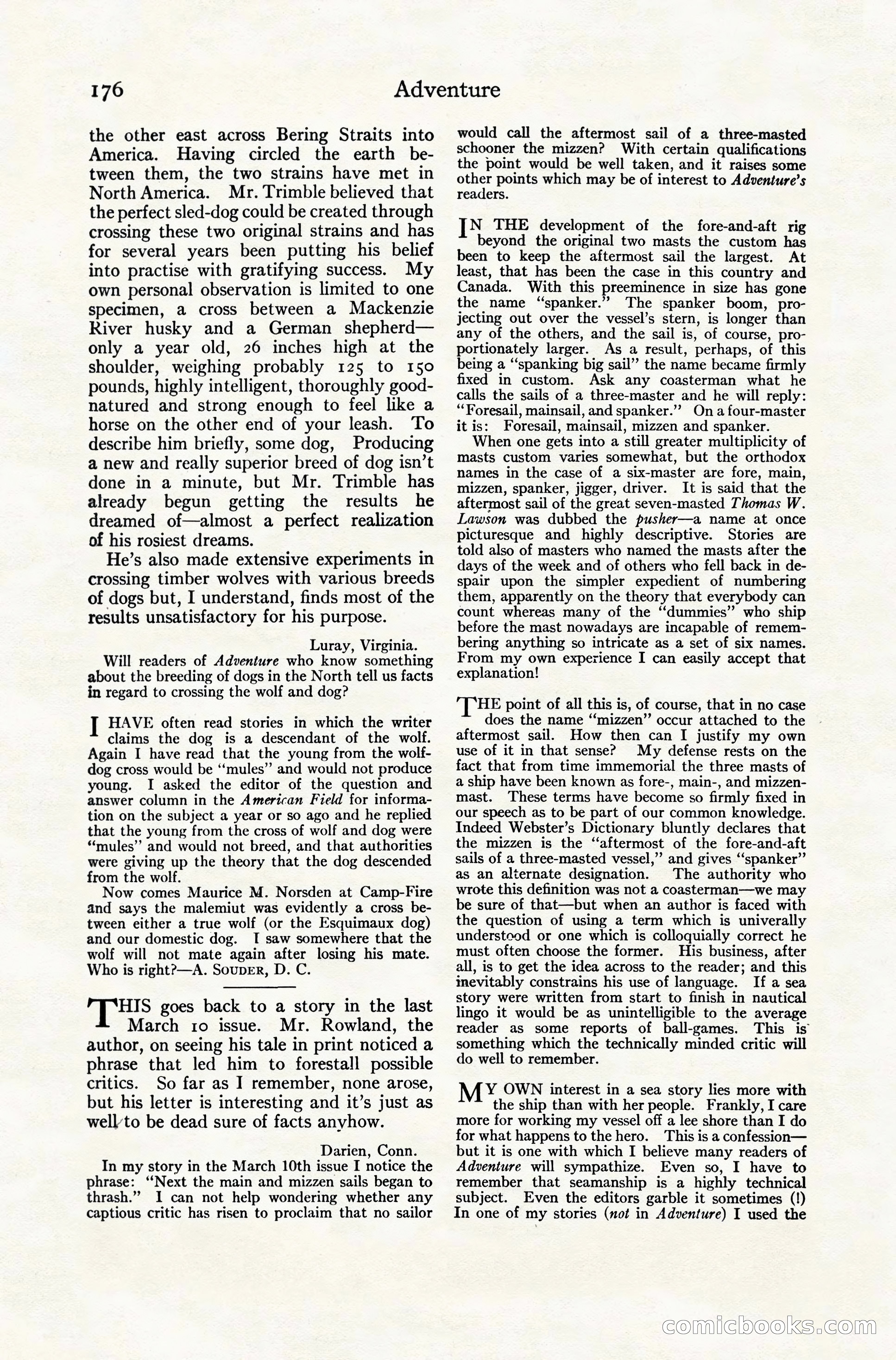
A restored page from Pulp Fiction, 1924. Page through the whole issue in the reader above.
📄 Transcribed text from this page (OCR, searchable)
Machine-transcribed from the original scan — historical spelling and the odd misread are preserved.
176 the other east across Bering Straits into America. Having circled the earth be- tween them, the two strains have met in North America. Mr. Trimble believed that the perfect sled-dog could be created through crossing these two original strains and has for several years been putting his belief into practise with gratifying success. My own personal observation is limited to one specimen, a cross between a Mackenzie River husky and a German shepherd— only a year old, 26 inches high at the shoulder, weighing probably 125 to 150 pounds, highly intelligent, thoroughly good- natured and strong enough to feel like a horse on the other end of your leash. To describe him briefly, some dog, Producing a new and really superior breed of dog isn’t done in a minute, but Mr. Trimble has already begun getting the results he dreamed of—almost a perfect realization of his rosiest dreams. He’s also made extensive experiments in crossing timber wolves with various breeds of dogs but, I understand, finds most of the results unsatisfactory for his purpose. Luray, Virginia. Will readers of Adventure who know something about the breeding of dogs in the North tell us facts in regard to crossing the wolf and dog? HAVE often read stories in which the writer claims the dog is a descendant of the wolf. Again I have read that the young from the wolf- dog cross would be ‘“‘mules” and would not produce young. I asked the editor of the question and answer column in the American Field for informa- tion on the subject a year or so ago and he replied that the young from the cross of wolf and dog were “mules’’ and would not breed, and that authorities were giving up the theory that the dog descended from the wolf. Now comes Maurice M. Norsden at Camp-Fire and says the malemiut was evidently a cross be- tween either a true wolf (or the Esquimaux dog) and our domestic dog. I saw somewhere that the wolf will not mate again after losing his mate. Who is right?p—A. SoupeErR, D. C. “| ae goes back to a story in the last March 1o issue. Mr. Rowland, the author, on seeing his tale in print noticed a phrase that led him to forestall possible critics. So far as I remember, none arose, but his letter is interesting and it’s just as well'to be dead sure of facts anyhow. Darien, Conn. In my story in the March 10th issue I notice the phrase: “Next the main and mizzen sails began to thrash.” 1 can not help wondering whether any captious critic has risen to proclaim that no sailor Adventure would call the aftermost sail of a three-masted schooner the mizzen? With certain qualifications the point would be well taken, and it raises some other points which may be of interest to Adventure’s readers. IN THE development of the fore-and-aft rig beyond the original two masts the custom has been to keep the aftermost sail the largest. At least, that has been the case in this country and Canada. With this preeminence in size has gone the name “spanker.’”’ The spanker boom, pro- jecting out over the vessel’s stern, is longer than any of the others, and the sail is, of course, pro- portionately larger. As a result, perhaps, of this being a “spanking big sail’’ the name became firmly fixed in custom. Ask any coasterman what he calls the sails of a three-master and he will reply: “‘Foresail, mainsail, and spanker.’’ Ona four-master itis: Foresail, mainsail, mizzen and spanker. When one gets into a still greater multiplicity of masts custom varies somewhat, but the orthodox names in the case of a six-master are fore, main, mizzen, spanker, jigger, driver. It is said that the aftermost sail of the great seven-masted Thomas W. Lawson was dubbed the pusher—a name at once picturesque and highly descriptive. Stories are told also of masters who named the masts after the days of the week and of others who fell back in de- spair upon the simpler expedient of numbering them, apparently on the theory that everybody can count whereas many of the “dummies” who ship before the mast nowadays are incapable of remem- bering anything so intricate as a set of six names. From my own experience I can easily accept that explanation! HE point of all this is, of course, that in no case does the name “‘mizzen”’ occur attached to the aftermost sail. How then can I justify my own use of it in that sense? My defense rests on the fact that from time immemorial the three masts of a ship have been known as fore-, main-, and mizzen- mast. These terms have become so firmly fixed in our speech as to be part of our common knowledge. Indeed Webster’s Dictionary bluntly declares that the mizzen is the ‘‘aftermost of the fore-and-aft sails of a three-masted vessel,’”’ and gives “‘spanker’’ as an alternate designation. The authority who wrote this definition was not a coasterman—we may be sure of that—but when an author is faced with the question of using a term which is univerally understood or one which is colloquially correct he must often choose the former. His business, after all, is to get the idea across to the reader; and this mevitably constrains his use of language. If a sea story were written from start to finish in nautical lingo it would be as unintelligible to the average reader as some reports of ball-games. This is something which the technically minded critic will do well to remember. Y OWN interest in a sea story lies more with the ship than with her people. Frankly, I care more for working my vessel off a lee shore than I do for what happens to the hero. This is a confession— but it is one with which I believe many readers of Adventure will sympathize. Even so, I have to remember that seamanship is a highly technical subject. Even the editors garble it sometimes (!) In one of my stories (not in Adventure) I used the COMmiclhoo = 5}