
Pulp Fiction, 1924 · page 192 of 194
Adventure Magazine Cover, November 10, 1924 — page 192: what you’re looking at
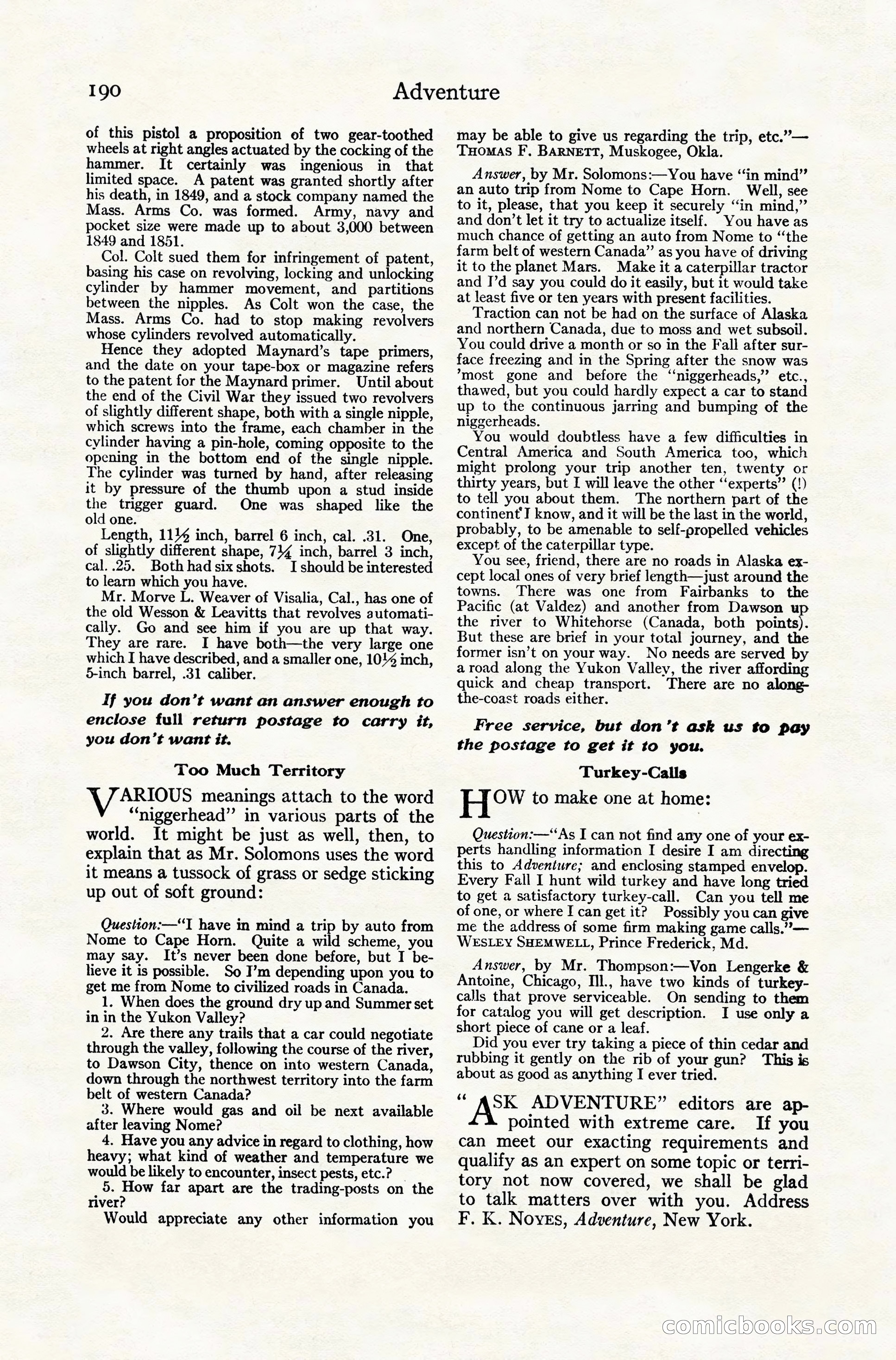
A restored page from Pulp Fiction, 1924. Page through the whole issue in the reader above.
📄 Transcribed text from this page (OCR, searchable)
Machine-transcribed from the original scan — historical spelling and the odd misread are preserved.
190 of this pistol a proposition of two gear-toothed wheels at right angles actuated by the cocking of the hammer. It certainly was ingenious in that limited space. A patent was granted shortly after his death, in 1849, and a stock company named the Mass. Arms Co. was formed. Army, navy and pocket size were made up to about 3,000 between 1849 and 1851. Col. Colt sued them for infringement of patent, basing his case on revolving, locking and unlocking cylinder by hammer movement, and partitions between the nipples. As Colt won the case, the Mass. Arms Co. had to stop making revolvers whose cylinders revolved automatically. Hence they adopted Maynard’s tape primers, and the date on your tape-box or magazine refers to the patent for the Maynard primer. Until about the end of the Civil War they issued two revolvers of slightly different shape, both with a single nipple, which screws into the frame, each chamber in the cylinder having a pin-hole, coming opposite to the opening in the bottom end of the single nipple. The cylinder was turned by hand, after releasing it by pressure of the thumb upon a stud inside the trigger guard. One was shaped like the old one. Length, 1114 inch, barrel 6 inch, cal. .31. One, of slightly different shape, 714 inch, barrel 3 inch, cal. .25. Both had six shots. I should be interested to learn which you have. Mr. Morve L. Weaver of Visalia, Cal., has one of the old Wesson & Leavitts that revolves automati- cally. Go and see him if you are up that way. They are rare. I have both—the very large one which I have described, and a smaller one, 1014 inch, 5-inch barrel, .31 caliber. If you don’t want an answer enough to enclose full return postage to carry it, you don’t want it. Too Much Territory ARIOUS meanings attach to the word “niggerhead” in various parts of the world. It might be just as well, then, to explain that as Mr. Solomons uses the word it means a tussock of grass or sedge sticking up out of soft ground: Question: —“TI have in mind a trip by auto from Nome to Cape Horn. Quite a wild scheme, you may say. It’s never been done before, but I be- lieve it is possible. So I’m depending upon you to get me from Nome to civilized roads in Canada. 1. When does the ground dry up and Summer set in in the Yukon Valley? 2. Are there any trails that a car could negotiate through the valley, following the course of the river, to Dawson City, thence on into western Canada, down through the northwest territory into the farm belt of western Canada? 3. Where would gas and oil be next available after leaving Nome? 4. Have you any advice in regard to clothing, how heavy; what kind of weather and temperature we would be likely to encounter, insect pests, etc.? | 5. How far apart are the trading-posts on the river? Would appreciate any other information you Adventure may be able to give us regarding the trip, etc.”— Tuomas F, BARNETT, Muskogee, Okla. Answer, by Mr. Solomons:—You have “in mind” an auto trip from Nome to Cape Horn. Well, see to it, please, that you keep it securely “in mind,” and don’t let it try to actualize itself. You have as much chance of getting an auto from Nome to “the farm belt of western Canada” as you have of driving it to the planet Mars. Make it a caterpillar tractor and I’d say you could do it easily, but it would take at least five or ten years with present facilities. Traction can not be had on the surface of Alaska and northern Canada, due to moss and wet subsoil. You could drive a month or so in the Fall after sur- face freezing and in the Spring after the snow was ’most gone and before the ‘‘niggerheads,’’ etc., thawed, but you could hardly expect a car to stand up to the continuous jarring and bumping of the niggerheads. You would doubtless have a few difficulties in Central America and South America too, which might prolong your trip another ten, twenty or thirty years, but I will leave the other “‘experts’’ (!) to tell you about them. The northern part of the continent I know, and it will be the last in the world, probably, to be amenable to self-propelled vehicles except of the caterpillar type. You see, friend, there are no roads in Alaska ex- cept local ones of very brief length—just around the towns. There was one from Fairbanks to the Pacific (at Valdez) and another from Dawson up the river to Whitehorse (Canada, both points). But these are brief in your total journey, and the former isn’t on your way. No needs are served by a road along the Yukon Valley, the river affording quick and cheap transport. There are no along- the-coast roads either. Free service, but don’t ask us to pay the postage to get it to you. Turkey-Calls Hew to make one at home: Question: —“‘As I can not find any one of your ex- perts handling information I desire I am directing this to Adventure; and enclosing stamped envelop. Every Fall I hunt wild turkey and have long tried to get a satisfactory turkey-call. Can you tell me of one, or where I can get it? Possibly you can give me the address of some firm making game calls.”— WESLEY SHEMWELL, Prince Frederick, Md. Answer, by Mr. Thompson:—Von Lengerke & Antoine, Chicago, Ill., have two kinds of turkey- calls that prove serviceable. On sending to them for catalog you will get description. I use only a short piece of cane or a leaf. Did you ever try taking a piece of thin cedar and rubbing it gently on the rib of your gun? This is about as good as anything I ever tried. “ ASK ADVENTURE” editors are ap- pointed with extreme care. If you can meet our exacting requirements and qualify as an expert on some topic or terri- tory not now covered, we shall be glad to talk matters over with you. Address F. K. Noyes, Adventure, New York. CoOMmiclhoo 5}