
Pulp Fiction, 1924 · page 191 of 194
Adventure Magazine Cover, November 10, 1924 — page 191: what you’re looking at
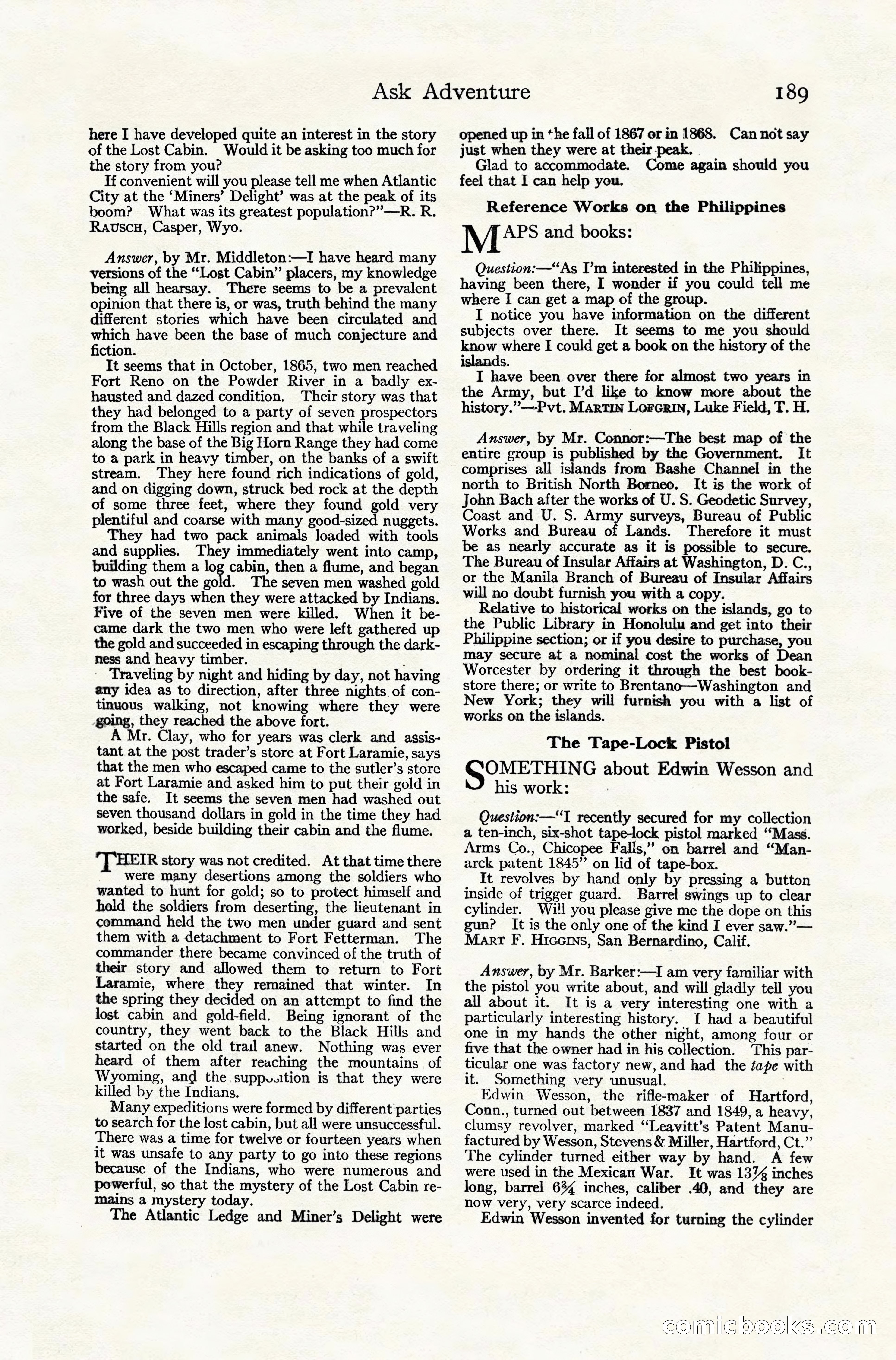
A restored page from Pulp Fiction, 1924. Page through the whole issue in the reader above.
📄 Transcribed text from this page (OCR, searchable)
Machine-transcribed from the original scan — historical spelling and the odd misread are preserved.
Ask Adventure here I have developed quite an interest in the story of the Lost Cabin. Would it be asking too much for the story from you? If convenient will you please tell me when Atlantic City at the ‘Miners’ Delight’ was at the peak of its boom? What was its greatest population?’’—R. R. Rauscu, Casper, Wyo. Answer, by Mr. Middleton:—I have heard many versions of the “Lost Cabin” placers, my knowledge being all hearsay. There seems to be a prevalent opinion that there is, or was, truth behind the many different stories which have been circulated and which have been the base of much conjecture and fiction. It seems that in October, 1865, two men reached Fort Reno on the Powder River in a badly ex- hausted and dazed condition. Their story was that they had belonged to a party of seven prospectors from the Black Hills region and that while traveling along the base of the Big Horn Range they had come to a park in heavy timber, on the banks of a swift stream. They here found rich indications of gold, and on digging down, struck bed rock at the depth of some three feet, where they found gold very plentiful and coarse with many good-sized nuggets. They had two pack animals loaded with tools and supplies. They immediately went into camp, building them a log cabin, then a flume, and began to wash out the gold. The seven men washed gold for three days when they were attacked by Indians. Five of the seven men were killed. When it be- came dark the two men who were left gathered up the gold and succeeded in escaping through the dark- ness and heavy timber. - Traveling by night and hiding by day, not having any idea as to direction, after three nights of con- tinuous walking, not knowing where they were going, they reached the above fort. A Mr. Clay, who for years was clerk and assis- tant at the post trader’s store at Fort Laramie, says that the men who escaped came to the sutler’s store at Fort Laramie and asked him to put their gold in the safe. It seems the seven men had washed out seven thousand dollars in gold in the time they had worked, beside building their cabin and the flume. "T HEIR story was not credited. At that time there were many desertions among the soldiers who wanted to hunt for gold; so to protect himself and hold the soldiers from deserting, the lieutenant in command held the two men under guard and sent them with a detachment to Fort Fetterman. The commander there became convinced of the truth of their story and allowed them to return to Fort Laramie, where they remained that winter. In the spring they decided on an attempt to find the lost cabin and gold-field. Being ignorant of the country, they went back to the Black Hills and started on the old trail anew. Nothing was ever heard of them after reaching the mountains of Wyoming, and the suppv.ition is that they were killed by the Indians. Many expeditions were formed by different parties to search for the lost cabin, but all were unsuccessful. There was a time for twelve or fourteen years when it was unsafe to any party to go into these regions because of the Indians, who were numerous and powerful, so that the mystery of the Lost Cabin re- mains a mystery today. The Atlantic Ledge and Miner’s Delight were 189 opened up in the fall of 1867 or in 1868. Cannot say just when they were at their: Glad to accommodate. Come again should you feel that I can help you. Reference Works on the Philippines MAPS and books: Question: —“As I’m interested in the Philippines, having been there, I wonder if you could tell me where I can get a map of the group. I notice you have information on the different subjects over there. It seems to me you should know where I could get a book on the history of the islands. I have been over there for almost two years in the Army, but I’d like to know more about the history.”—-Pvt. Martin Lorcrin, Luke Field, T. H. Answer, by Mr. Connor:—The best map of the entire group is published by the Government. It comprises all islands from Bashe Channel in the north to British North Borneo, It is the work of John Bach after the works of U. S. Geodetic Survey, Coast and U. S. Army surveys, Bureau of Public Works and Bureau of Lands. Therefore it must be as nearly accurate as it is possible to secure. The Bureau of Insular Affairs at Washington, D. C., or the Manila Branch of Bureau of Insular Affairs will no doubt furnish you with a copy. Relative to historical works on the islands, go to the Public Library in Honolulu and get into their Philippine section; or if you desire to purchase, you may secure at a nominal cost the works of Dean Worcester by ordering it through the best book- store there; or write to Brentano—Washington and New York; they will furnish you with a list of works on the islands. The Tape-Lock Pistol OMETHING about Edwin Wesson and his work: Question: —“T recently secured for my collection a ten-inch, six-shot tape-lock pistol marked “Mass. Arms Co., Chicopee Falls,” on barrel and ‘“Man- arck patent 1845” on lid of tape-box. It revolves by hand only by pressing a button inside of trigger guard. Barrel swings up to clear cylinder. Will you please give me the dope on this gun? It is the only one of the kind I ever saw.”— Mart F. Hiccins, San Bernardino, Calif. Answer, by Mr. Barker:—I am very familiar with the pistol you write about, and will gladly tell you all about it. It is a very interesting one with a particularly interesting history. { had a beautiful one in my hands the other night, among four or five that the owner had in his collection. This par- ticular one was factory new, and had the fape with it. Something very unusual. ; Edwin Wesson, the rifle-maker of Hartford, Conn., turned out between 1837 and 1849, a heavy, clumsy revolver, marked ‘“Leavitt’s Patent Manu- factured by Wesson, Stevens & Miller, Hartford, Ct.” The cylinder turned either way by hand. A few were used in the Mexican War. It was 137% inches long, barrel 634 inches, caliber .40, and they are now very, very scarce indeed. Edwin Wesson invented for turning the cylinder Comicbook =