
Pulp Fiction, 1924 · page 181 of 194
Adventure Magazine Cover, November 10, 1924 — page 181: what you’re looking at
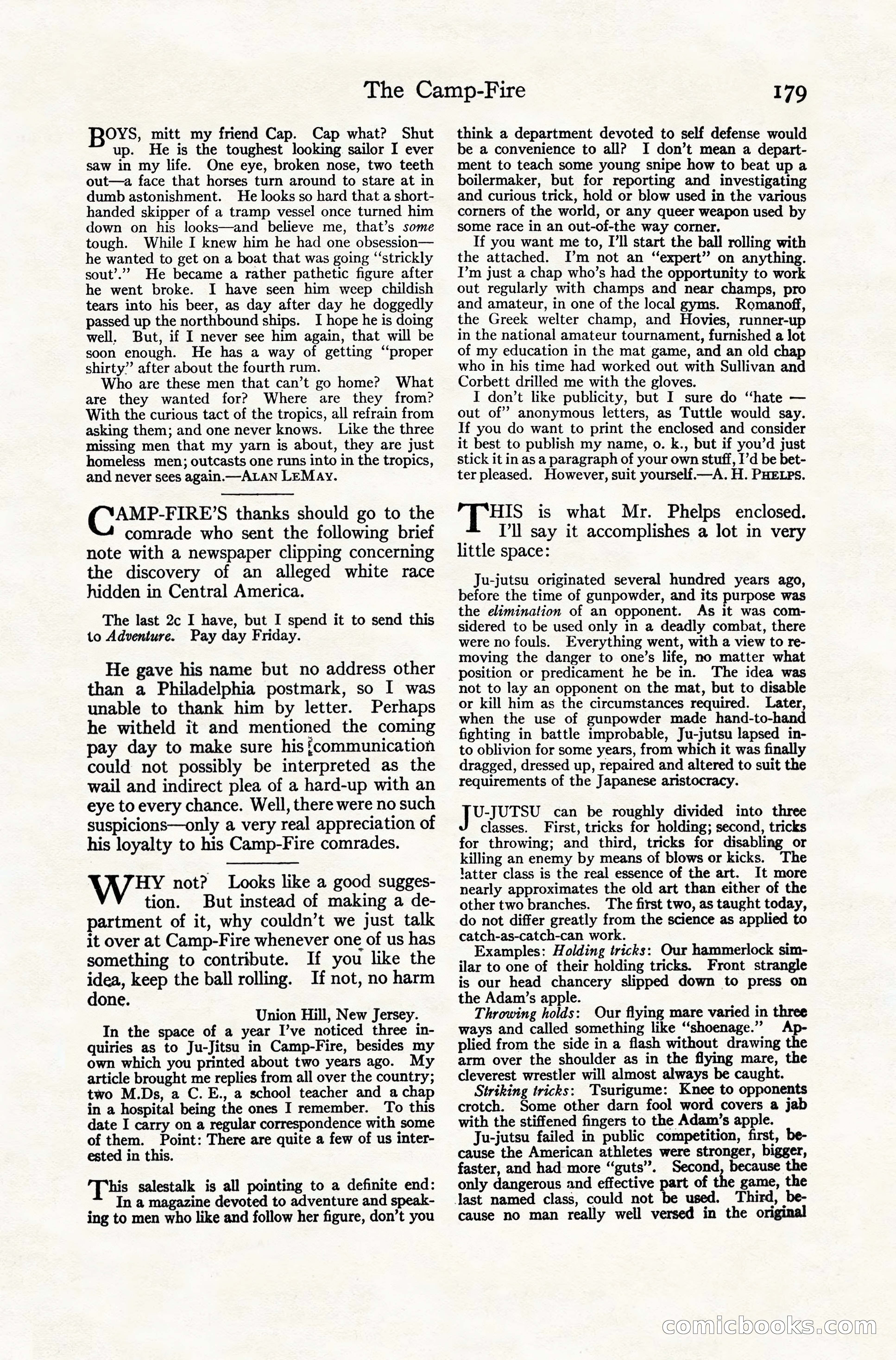
A restored page from Pulp Fiction, 1924. Page through the whole issue in the reader above.
📄 Transcribed text from this page (OCR, searchable)
Machine-transcribed from the original scan — historical spelling and the odd misread are preserved.
The Camp-Fire BOYS, mitt my friend Cap. Cap what? Shut up. He is the toughest looking sailor I ever saw in my life. One eye, broken nose, two teeth out—a face that horses turn around to stare at in dumb astonishment. He looks so hard that a short- handed skipper of a tramp vessel once turned him down on his looks—and believe me, that’s some tough. While I knew him he had one obsession— he wanted to get on a boat that was going ‘‘strickly sout’.””? He became a rather pathetic figure after he went broke. I have seen him weep childish tears into his beer, as day after day he doggedly passed up the northbound ships. I hope he is doing well. But, if I never see him again, that will be soon enough. He has a way of getting “proper shirty” after about the fourth rum. Who are these men that can’t go home? What are they wanted for? Where are they from? With the curious tact of the tropics, all refrain from asking them; and one never knows. Like the three missing men that my yarn is about, they are just homeless men; outcasts one runs into in the tropics, and never sees again.—ALAN LEMAy. Ce thanks should go to the comrade who sent the following brief note with a newspaper clipping concerning the discovery of an alleged white race hidden in Central America. The last 2c I have, but I spend it to send this to Adventure. Pay day Friday. He gave his name but no address other than a Philadelphia postmark, so I was unable to thank him by letter. Perhaps he witheld it and mentioned the coming pay day to make sure his communication could not possibly be interpreted as the wail and indirect plea of a hard-up with an eye to every chance. Well, there were no such suspicions—only a very real appreciation of his loyalty to his Camp-Fire comrades. HY not? Looks like a good sugges- tion. But instead of making a de- partment of it, why couldn’t we just talk it over at Camp-Fire whenever one of us has something to contribute. If you like the idea, keep the ball rolling. If not, no harm done. Union Hill, New Jersey. In the space of a year I’ve noticed three in- quiries as to Ju-Jitsu in Camp-Fire, besides my own which you printed about two years ago. My article brought me replies from all over the country; two M.Ds, a C.E., a school teacher and a chap in a hospital being the ones I remember. To this date I carry on a regular correspondence with some of them. Point: There are quite a few of us inter- ested in this. "This salestalk is all pointing to a definite end: In a magazine devoted to adventure and speak- ing to men who like and follow her figure, don’t you 179 think a department devoted to self defense would be a convenience to allPp I don’t mean a depart- ment to teach some young snipe how to beat up a boilermaker, but for reporting and investigating and curious trick, hold or blow used in the various corners of the world, or any queer weapon used by some race in an out-of-the way corner. If you want me to, Ill start the ball rolling with the attached. I’m not an “expert” on anything. I’m just a chap who’s had the opportunity to work out regularly with champs and near champs, pro and amateur, in one of the local gyms. Romanoff, the Greek welter champ, and Hovies, runner-up in the national amateur tournament, furnished a lot of my education in the mat game, and an old chap who in his time had worked out with Sullivan and Corbett drilled me with the gloves. I don’t like publicity, but I sure do “hate — out of’? anonymous letters, as Tuttle would say. If you do want to print the enclosed and consider it best to publish my name, o. k., but if you’d just stick it in as a paragraph of your own stuff, I’d be bet- ter pleased. However, suit yourself—A. H. PHELPS. HIS is what Mr. Phelps enclosed. I'll say it accomplishes a lot in very little space: Ju-jutsu originated several hundred years ago, before the time of gunpowder, and its purpose was the elimination of an opponent. As It was com- sidered to be used only in a deadly combat, there were no fouls. Everything went, with a view to re- moving the danger to one’s life, no matter what position or predicament he be in. The idea was not to lay an opponent on the mat, but to disable or kill him as the circumstances required. Later, when the use of gunpowder made hand-to-hand fighting in battle improbable, Ju-jutsu lapsed in- to oblivion for some years, from which it was finally dragged, dressed up, repaired and altered to suit the requirements of the Japanese aristocracy. BU TUTSU can be roughly divided into three classes. First, tricks for holding; second, tricks for throwing; and third, tricks for disabling or killing an enemy by means of blows or kicks. The latter class is the real essence of the art. It more nearly approximates the old art than either of the other two branches. The first two, as taught today, do not differ greatly from the science as applied to catch-as-catch-can work. Examples: Holding tricks: Our hammerlock sim- ilar to one of their holding tricks. Front strangle is our head chancery slipped down to press on the Adam’s apple. Throwing holds: Our flying mare varied in three ways and called something like “‘shoenage.” ‘a plied from the side in a flash without drawing the arm over the shoulder as in the flying mare, the cleverest wrestler will almost always be caught. Striking tricks: Tsurigume: Knee to opponents crotch. Some other darn fool word covers a jab with the stiffened fingers to the Adam’s apple. Ju-jutsu failed in public competition, first, be- cause the American athletes were stronger, bigger, faster, and had more “guts”. Second, because the only dangerous and effective part of the game, the Jast named class, could not be used. Third, be- cause no man really well versed in the original cComicloooks 5}