
Pulp Fiction, 1924 · page 180 of 194
Adventure Magazine Cover, November 10, 1924 — page 180: what you’re looking at
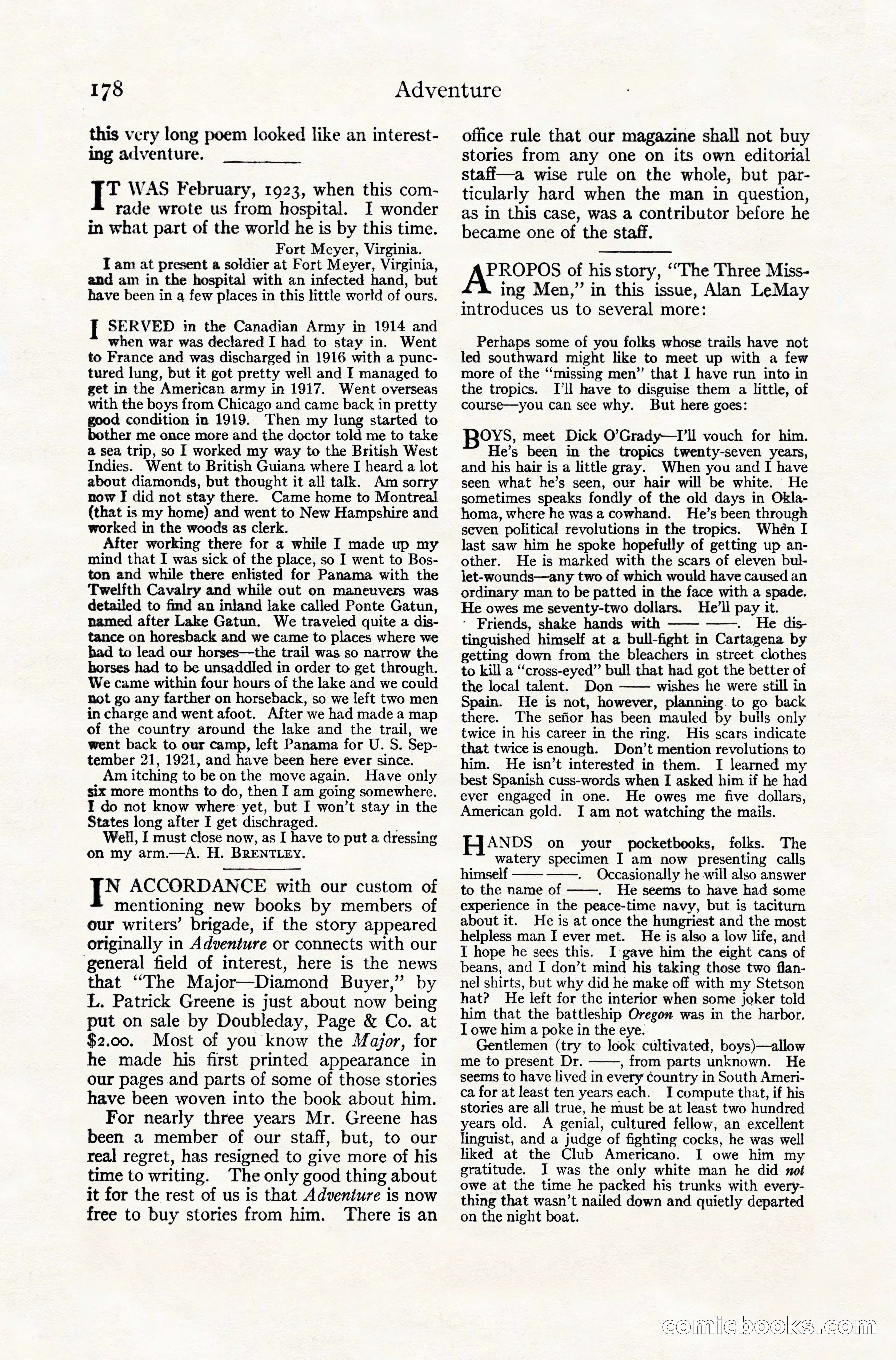
A restored page from Pulp Fiction, 1924. Page through the whole issue in the reader above.
📄 Transcribed text from this page (OCR, searchable)
Machine-transcribed from the original scan — historical spelling and the odd misread are preserved.
178 this very long poem looked like an interest- ing adventure. T WAS February, 1923, when this com- rade wrote us from hospital. I wonder in what part of the world he is by this time. Fort Meyer, Virginia. I am at present a soldier at Fort Meyer, Virginia, and am in the hospital with an infected hand, but have been in a few places in this little world of ours. I SERVED im the Canadian Army in 1914 and when war was declared I had to stay in. Went to France and was discharged in 1916 with a punc- tured lung, but it got pretty well and I managed to get in the American army in 1917. Went overseas with the boys from Chicago and came back in pretty good condition in 1919. Then my lung started to bother me once more and the doctor told me to take a sea trip, so I worked my way to the British West Indies. Went to British Guiana where I heard a lot about diamonds, but thought it all talk. Am sorry now | did not stay there. Came home to Montreal (that is my home) and went to New Hampshire and worked in the woods as clerk. After working there for a while I made up my mind that I was sick of the place, so I went to Bos- ton and while there enlisted for Panama with the Twelfth Cavalry and while out on maneuvers was detailed to find an inland lake called Ponte Gatun, named after Lake Gatun. We traveled quite a dis- tance on horesback and we came to places where we had to lead our horses—the trail was so narrow the horses had to be unsaddled in order to get through. We came within four hours of the lake and we could not go any farther on horseback, so we left two men in charge and went afoot. After we had made a map of the country around the lake and the trail, we went back to our camp, left Panama for U. S. Sep- tember 21, 1921, and have been here ever since. Am itching to be on the move again. Have only six more months to do, then I am going somewhere. I do not know where yet, but I won’t stay in the States long after I get dischraged. ; Well, I must close now, as I have to put a dressing on my arm.—A. H. BRENTLEy. N ACCORDANCE with our custom of mentioning new books by members of our writers’ brigade, if the story appeared originally in Adventure or connects with our general field of interest, here is the news that “The Major—Diamond Buyer,” by L. Patrick Greene is just about now being put on sale by Doubleday, Page & Co. at $2.00. Most of you know the Major, for he made his first printed appearance in our pages and parts of some of those stories have been woven into the book about him. For nearly three years Mr. Greene has been a member of our staff, but, to our real regret, has resigned to give more of his time to writing. The only good thing about it for the rest of us is that Adventure is now free to buy stories from him. There is an Adventure office rule that our magazine shall not buy stories from any one on its own editorial staff—a wise rule on the whole, but par- ticularly hard when the man in question, as in this case, was a contributor before he became one of the staff. PROPOS of his story, ‘“The Three Miss- ing Men,” in this issue, Alan LeMay introduces us to several more: Perhaps some of you folks whose trails have not led southward might like to meet up with a few more of the ‘‘missing men” that I have run into in the tropics. I’ll have to disguise them a little, of course—you can see why. But here goes: BeYS, meet Dick O’Grady—I’ll vouch for him. He’s been in the tropics twenty-seven years, and his hair is a little gray. When you and I have seen what he’s seen, our hair will be white. He sometimes speaks fondly of the old days in Okla- homa, where he was a cowhand. He’s been through seven political revolutions in the tropics. Wheén I last saw him he spoke hopefully of getting up an- other. He is marked with the scars of eleven bul- let-wounds—any two of which would have caused an ordinary man to be patted in the face with a spade. He owes me seventy-two dollars. He'll pay it. ' Friends, shake hands with ——- ——. He dis- tinguished himself at a bull-fight in Cartagena by getting down from the bleachers in street clothes to kill a “cross-eyed” bull that had got the better of the local talent. Don —— wishes he were still in Spain. He is not, however, planning. to go back there. The sefor has been mauled by bulls only twice in his career in the ring. His scars indicate that twice isenough. Don’t mention revolutions to him. He isn’t interested in them. I learned my best Spanish cuss-words when I asked him if he had ever engaged in one. He owes me five dollars, American gold. I am not watching the mails. ANDS on _ your pocketbooks, folks. The watery specimen I am now presenting calls himself Occasionally he will also answer to the name of He seems to have had some experience in the peace-time navy, but is taciturn about it. He is at once the hungriest and the most helpless man I ever met. He is also a low life, and I hope he sees this. I gave him the eight cans of beans, and I don’t mind his taking those two flan- nel shirts, but why did he make off with my Stetson hat? He left for the interior when some joker told him that the battleship Oregon was in the harbor. I owe him a poke in the eye. Gentlemen (try to look cultivated, boys)—allow me to present Dr. , from parts unknown. He seems to have lived in every country in South Ameri- ca for at least ten years each. I compute that, if his stories are all true, he must be at least two hundred years old. A genial, cultured fellow, an excellent linguist, and a judge of fighting cocks, he was well liked at the Club Americano. I owe him my gratitude. I was the only white man he did noi owe at the time he packed his trunks with every- thing that wasn’t nailed down and quietly departed on the night boat. COMmiclhoo =