
Pulp Fiction, 1924 · page 141 of 194
Adventure Magazine Cover, November 10, 1924 — page 141: what you’re looking at
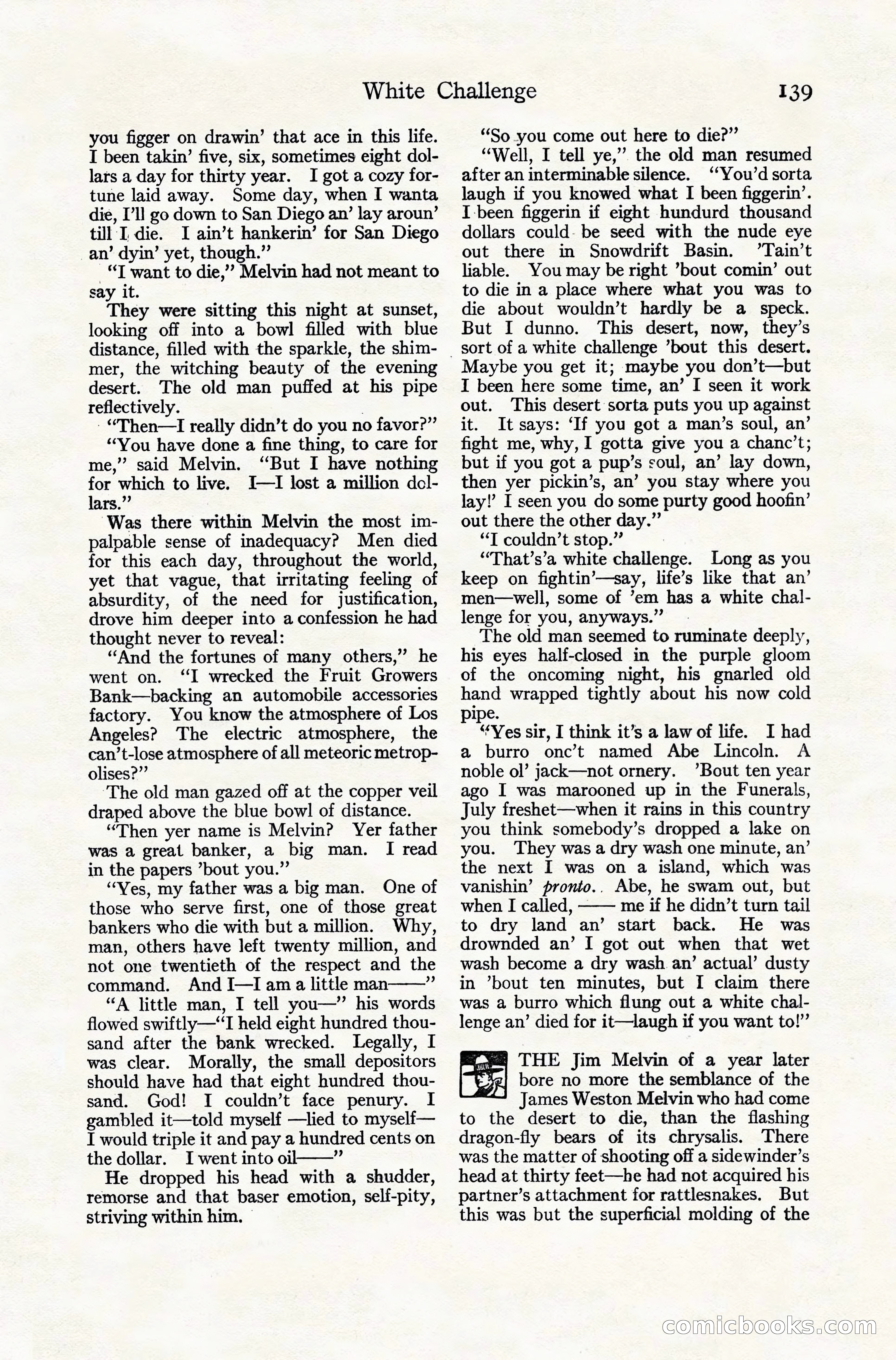
A restored page from Pulp Fiction, 1924. Page through the whole issue in the reader above.
📄 Transcribed text from this page (OCR, searchable)
Machine-transcribed from the original scan — historical spelling and the odd misread are preserved.
White Challenge you figger on drawin’ that ace in this life. I been takin’ five, six, sometimes eight dol- lars a day for thirty year. I got a cozy for- tune laid away. Some day, when I[ wanta die, I’ll go down to San Diego an’ lay aroun’ till I. die. I ain’t hankerin’ for San Diego an’ dyin’ yet, though.” _“T want to die,” Melvin had not meant to say it. They were sitting this night at sunset, looking off into a bowl filled with blue distance, filled with the sparkle, the shim- mer, the witching beauty of the evening desert. The old man puffed at his pipe reflectively. -“Then—I really didn’t do you no favor?”’ “Vou have done a fine thing, to care for me,” said Melvin. ‘But I have nothing for which to live. I—I lost a million dcl- lars.” : ‘Was there within Melvin the most im- palpable sense of inadequacy? Men died for this each day, throughout the world, yet that vague, that irritating feeling of absurdity, of the need for justification, drove him deeper into a confession he had thought never to reveal: ‘“‘And the fortunes of many others,’ he went on. “I wrecked the Fruit Growers Bank—backing an automobile accessories factory. You know the atmosphere of Los Angeles? The electric atmosphere, the can’t-lose atmosphere of all meteoric metrop- olises?”’ ‘The old man gazed off at the copper veil draped above the blue bowl of distance. “Then yer name is Melvin? Yer father was a great banker, a big man. I read in the papers ’bout you.” “Ves, my father was a big man. One of those who serve first, one of those great bankers who die with but a million. Why, man, others have left twenty million, and not one twentieth of the respect and the command. And I—I ama little man i! “A little man, I tell you—” his words flowed swiftly —“I held eight hundred thou- sand after the bank wrecked. Legally, I was clear. Morally, the small depositors should have had that eight hundred thou- sand. God! I couldn’t face penury. I gambled it—told myself —lied to myself— I would triple it and pay a hundred cents on the dollar. I went into oil——” He dropped his head with a shudder, remorse and that baser emotion, self-pity, striving within him. © 139 “So you come out here to die?”’ “Well, I tell ye,” the old man resumed after an interminable silence. ‘‘You’d sorta laugh if you knowed what I been figgerin’. I-been figgerin if eight hundurd thousand dollars could- be seed with the nude eye out there in Snowdrift Basin. ’Tain’t liable. You may be right ’bout comin’ out to die in a place where what you was to die about wouldn’t hardly be a speck. But I dunno. This desert, now, they’s _ sort of a white challenge ’bout this desert. Maybe you get it; maybe you don’t—but I been here some time, an’ I seen it work out. This desert sorta puts you up against it. It says: ‘If you got a man’s soul, an’ fight me, why, I gotta give you a chanc’t; but if you got a pup’s soul, an’ lay down, then yer pickin’s, an’ you stay where you lay!’ I seen you do some purty good hoofin’ out there the other day.”’ “T couldn’t stop.” “That’s’a white challenge. Long as you keep on fightin’—say, life’s like that an’ men—well, some of ’em has a white chal- lenge for you, anyways.” - The old man seemed to ruminate deeply, his eyes half-closed in the purple gloom of the oncoming night, his gnarled old hand wrapped tightly about his now cold pipe. “Yes sir, I think it’s a law of life. I had a burro onc’t named Abe Lincoln. A noble ol’ jack—not ornery. ‘Bout ten year ago I was marooned up in the Funerals, July freshet—when it rains in this country you think somebody’s dropped a lake on you. They was a dry wash one minute, an’ the next I was on a island, which was vanishin’ pronto.. Abe, he swam out, but when I called, —— me if he didn’t turn tail to dry land an’ start back. He was drownded an’ I got out when that wet wash become a dry wash. an’ actual’ dusty in ’bout ten minutes, but I claim there was a burro which flung out a white chal- lenge an’ died for it—laugh if you want to!’’ (wal THE Jim Melvin of a year later bore no more the semblance of the James Weston Melvin who had come to the desert to die, than the flashing dragon-fly bears of its chrysalis. There was the matter of shooting off a sidewinder’s head at thirty feet—he had not acquired his partner’s attachment for rattlesnakes. But this was but the superficial molding of the Comicbook (© =