
Pulp Fiction, 1924 · page 140 of 194
Adventure Magazine Cover, November 10, 1924 — page 140: what you’re looking at
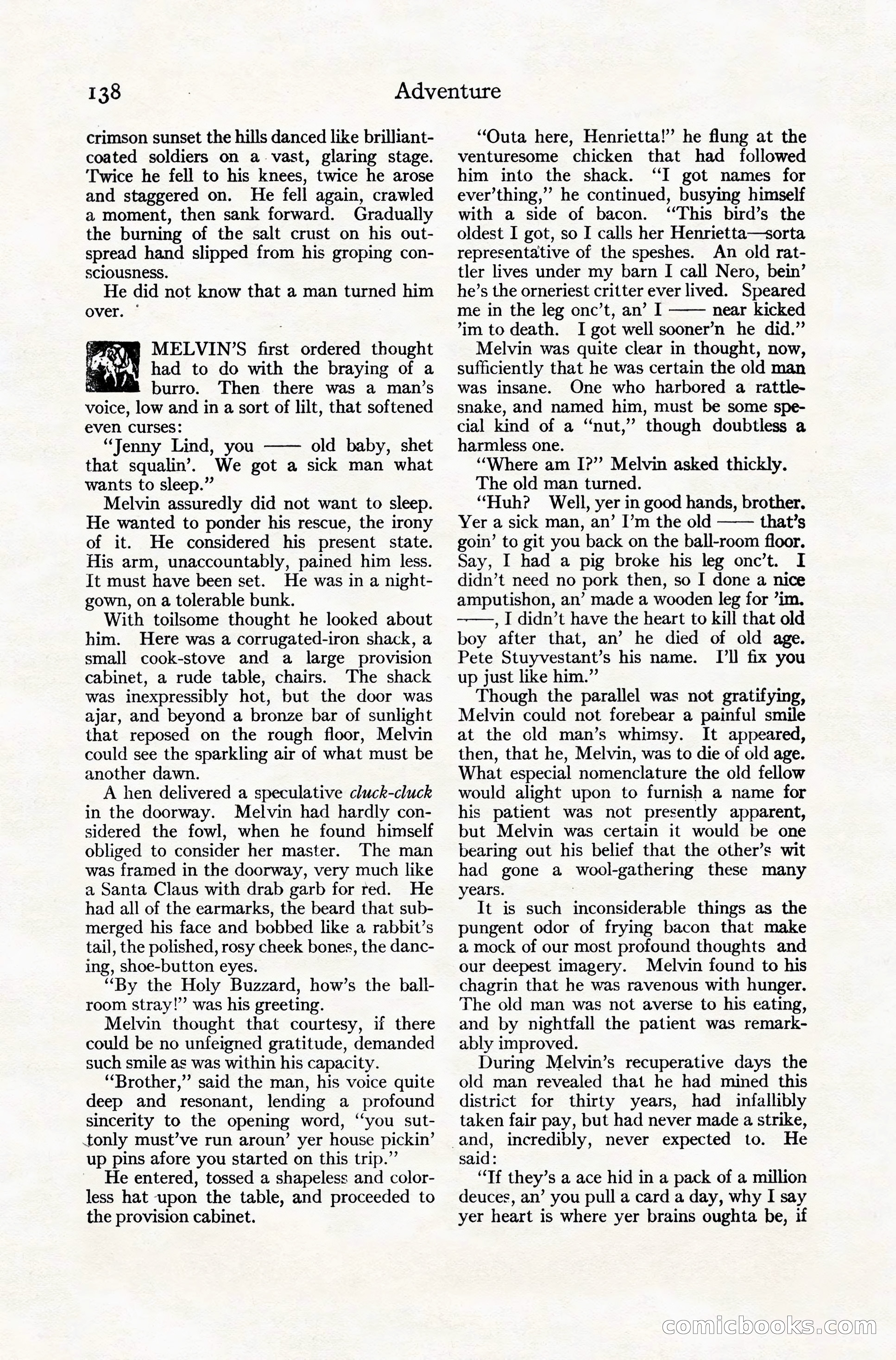
A restored page from Pulp Fiction, 1924. Page through the whole issue in the reader above.
📄 Transcribed text from this page (OCR, searchable)
Machine-transcribed from the original scan — historical spelling and the odd misread are preserved.
138 crimson sunset the hills danced like brilliant- coated soldiers on a vast, glaring stage. Twice he fell to his knees, twice he arose and staggered on. He fell again, crawled a moment, then sank forward. Gradually the burning of the salt crust on his out- spread hand slipped from his groping con- sciousness. He did not know that a man turned him over. © Rexfe MELVIN’S first ordered thought ty had to do with the braying of a a burro. Then there was a man’s voice, low and in a sort of lilt, that softened even curses: “Jenny Lind, you —— old baby, shet that squalin’. We got a sick man what wants to sleep.” Melvin assuredly did not want to sleep. He wanted to ponder his rescue, the irony of it. He considered his present state. His arm, unaccountably, pained him less. It must have been set. He was in a night- gown, on a tolerable bunk. With toilsome thought he looked about him. Here was a corrugated-iron shack, a small cook-stove and a large provision cabinet, a rude table, chairs. The shack was inexpressibly hot, but the door was ajar, and beyond a bronze bar of sunlight that reposed on the rough floor, Melvin could see the sparkling air of what must be another dawn. A hen delivered a speculative cluck-cluck in the doorway. Melvin had hardly con- sidered the fowl, when he found himself obliged to consider her master. The man was framed in the doorway, very much like a Santa Claus with drab garb for red. He had all of the earmarks, the beard that sub- merged his face and bobbed like a rabbit’s tail, the polished, rosy cheek bones, the danc- ing, shoe-button eyes. “By the Holy Buzzard, how’s the ball- room stray!” was his greeting. Melvin thought that courtesy, if there could be no unfeigned gratitude, demanded such smile as was within his capacity. “Brother,” said the man, his voice quite deep and resonant, lending a profound sincerity to the opening word, ‘“‘you sut- tonly must’ve run aroun’ yer house pickin’ up pins afore you started on this trip.”’ He entered, tossed a shapeless and color- less hat upon the table, and proceeded to the provision cabinet. and, Adventure “Outa here, Henrietta!’ he flung at the venturesome chicken that had followed him into the shack. “I got names for ever’thing,” he continued, busying himself with a side of bacon. ‘This bird’s the oldest I got, so I calls her Henrietta—sorta representative of the speshes. An old rat- tler lives under my barn I call Nero, bein’ he’s the orneriest critter ever lived. Speared me in the leg onc’t, an’ I near kicked "im to death. I got well sooner’n he did.” Melvin was quite clear in thought, now, sufficiently that he was certain the old man was insane. One who harbored a rattle- snake, and named him, must be some spe- cial kind of a “nut,” though doubtless a harmless one. ‘‘Where am I?” Melvin asked thickly. The old man turned. “Huh? Well, yer in good hands, brother. Yer a sick man, an’ |’ goin’ to git you back on the ball-room floor. Say, I had a pig broke his leg onc’t. I didn’t need no pork then, so I done a nice amputishon, an’ made a wooden leg for ’im. , | didn’t have the heart to kill that old boy after that, an’ he died of old age. Pete Stuyvestant’s his name. I'll fix you up just like him.” Though the parallel was not gratifying, Melvin could not forebear a painful smile at the old man’s whimsy. It appeared, then, that he, Melvin, was to die of old age. What especial nomenclature the old fellow would alight upon to furnish a name for his patient was not presently apparent, but Melvin was certain it would be one bearing out his belief that the other’s wit had gone a wool-gathermg these many years. It is such Gnconsiderable things as the pungent odor of frying bacon that make a mock of our most profound thoughts and our deepest imagery. Melvin found to his chagrin that he was ravenous with hunger. The old man was not averse to his eating, and by nightfall the patient was remark- ably improved. During Melvin’s recuperative days the old man revealed that he had mined this district for thirty years, had infallibly taken fair pay, but had never made a strike, incredibly, never expected to. He said: “Tf they’s a ace hid in a pack of a million deuces, an’ you pull a card a day, why I say yer heart is where yer brains oughta be, if CoOMmichooolk Wh) (© 5}