
Pulp Fiction, 1924 · page 16 of 204
Adventure Magazine Cover, October 30, 1924 — page 16: what you’re looking at
A restored page from Pulp Fiction, 1924. Page through the whole issue in the reader above.
📄 Transcribed text from this page (OCR, searchable)
Machine-transcribed from the original scan — historical spelling and the odd misread are preserved.
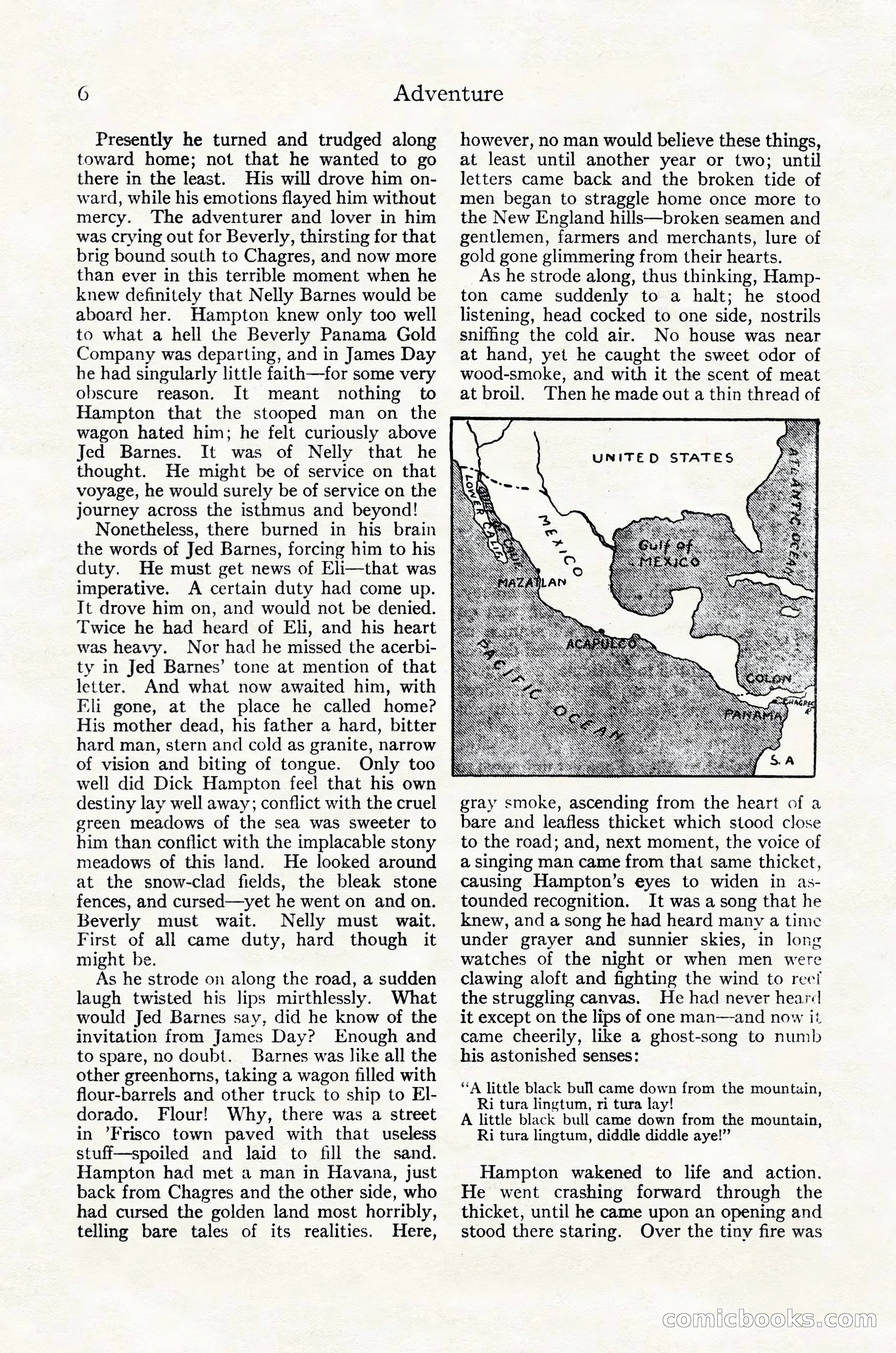
6 Adventure Presently he turned and trudged along toward home; not that he wanted to go there in the least. His will drove him on- ward, while his emotions flayed him without mercy. The adventurer and lover in him was crying out for Beverly, thirsting for that brig bound south to Chagres, and now more than ever in this terrible moment when he knew definitely that Nelly Barnes would be aboard her. Hampton knew only too well to what a hell the Beverly Panama Gold Company was departing, and in James Day he had singularly little faith—for some very obscure reason. It meant nothing to Hampton that the stooped man on the wagon hated him; he felt curiously above Jed Barnes. It was of Nelly that he thought. He might be of service on that voyage, he would surely be of service on the journey across the isthmus and beyond! Nonetheless, there burned in his brain the words of Jed Barnes, forcing him to his duty. He must get news of Eli—that was imperative. A certain duty had come up. It drove him on, and would not be denied. Twice he had heard of Eli, and his heart was heavy. Nor had he missed the acerbi- ty in Jed Barnes’ tone at mention of that letter. And what now awaited him, with Fli gone, at the place he called home? His mother dead, his father a hard, bitter hard man, stern and cold as granite, narrow of vision and biting of tongue. Only too well did Dick Hampton feel that his own destiny lay well away; conflict with the cruel green meadows of the sea was sweeter to him than conflict with the implacable stony meadows of this land. He looked around at the snow-clad fields, the bleak stone fences, and cursed—yet he went on and on. Beverly must wait. Nelly must wait. First of all came duty, hard though it might be. As he strode on along the road, a sudden laugh twisted his lips mirthlessly. What would Jed Barnes say, did he know of the invitation from James Day? Enough and to spare, no doubt. Barnes was like all the other greenhorns, taking a wagon filled with flour-barrels and other truck to ship to El- dorado. Flour! Why, there was a street in ’Frisco town paved with that useless stuff—spoiled and laid to fill the sand. Hampton had met a man in Havana, just back from Chagres and the other side, who had cursed the golden land most horribly, telling bare tales of its realities. Here, however, no man would believe these things, at least until another year or two; until letters came back and the broken tide of men began to straggle home once more to the New England hills—broken seamen and gentlemen, farmers and merchants, lure of gold gone glimmering from their hearts. As he strode along, thus thinking, Hamp- ton came suddenly to a halt; he stood listening, head cocked to one side, nostrils sniffing the cold air. No house was near at hand, yet he caught the sweet odor of wood-smoke, and with it the scent of meat at broil. Then he made out a thin thread of UNITED STATES \ “ s y RRMA VVVRVAVAVA> SS SS ‘ NS RRA Q°*«q4$zn:9N \ AMX \ SS WA ~ é gray smoke, ascending from the heart of a bare and leafless thicket which stood close to the road; and, next moment, the voice of a singing man came from that same thicket, causing Hampton’s eyes to widen in as- tounded recognition. It was a song that he knew, and a song he had heard many a time under grayer and sunnier skies, in long watches of the night or when men were clawing aloft and fighting the wind to reef the struggling canvas. He had never hearel it except on the lips of one man—and now it came cheerily, like a ghost-song to numb his astonished senses: **A little black bull came down from the mountuin, Ri tura lingtum, ri tura lay! A little black bull came down from the mountain, Ri tura lingtum, diddle diddle aye!” Hampton wakened to life and action. He went crashing forward through the thicket, until he came upon an opening and stood there staring. Over the tiny fire was COMmiclbooks