
Pulp Fiction, 1924 · page 15 of 204
Adventure Magazine Cover, October 30, 1924 — page 15: what you’re looking at
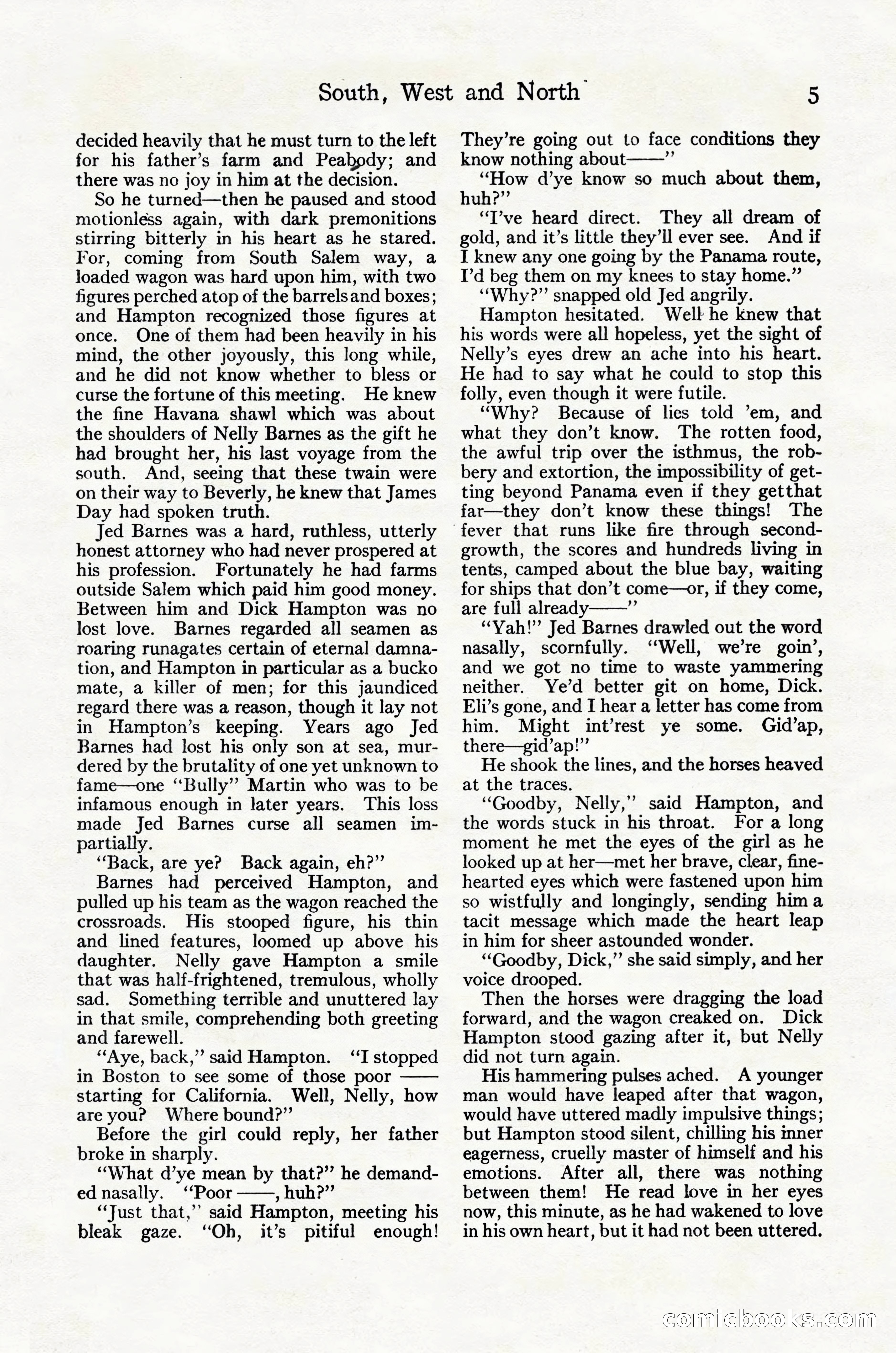
A restored page from Pulp Fiction, 1924. Page through the whole issue in the reader above.
📄 Transcribed text from this page (OCR, searchable)
Machine-transcribed from the original scan — historical spelling and the odd misread are preserved.
South, West and North 5 decided heavily that he must turn to the left for his father’s farm and Peabody; and there was no joy in him at the decision. So he turned—then he paused and stood motionless again, with dark premonitions stirring bitterly in his heart as he stared. For, coming from South Salem way, a loaded wagon was hard upon him, with two figures perched atop of the barrelsand boxes; and Hampton recognized those figures at once. One of them had been heavily in his mind, the other joyously, this long while, and he did not know whether to bless or curse the fortune of this meeting. He knew the fine Havana shawl which was about the shoulders of Nelly Barnes as the gift he had brought her, his last voyage from the south. And, seeing that these twain were on their way to Beverly, he knew that James Day had spoken truth. Jed Barnes was a hard, ruthless, utterly honest attorney who had never prospered at his profession. Fortunately he had farms outside Salem which paid him good money. Between him and Dick Hampton was no lost love. Barnes regarded all seamen as roaring runagates certain of eternal damna- tion, and Hampton in particular as a bucko mate, a killer of men; for this jaundiced regard there was a reason, though it lay not in Hampton’s keeping. Years ago Jed Barnes had lost his only son at sea, mur- dered by the brutality of one yet unknown to fame—one ‘‘Bully’’ Martin who was to be infamous enough in later years. This loss made Jed Barnes curse all seamen im- partially. “Back, are ye? Back again, eh?” Barnes had perceived Hampton, and pulled up his team as the wagon reached the crossroads. His stooped figure, his thin and lined features, loomed up above his daughter. Nelly gave Hampton a smile that was half-frightened, tremulous, wholly sad. Something terrible and unuttered lay in that smile, comprehending both greeting and farewell. ‘fAye, back,” said Hampton. “I stopped in Boston to see some of those poor starting for California. Well, Nelly, how are your Where bound?” Before the girl could reply, her father broke in sharply. ‘‘What d’ye mean by that?” he demand- ed nasally. ‘Poor , huh?” “Just that,’’ said Hampton, meeting his bleak gaze. ‘Oh, it’s pitiful enough! They’re going out to face conditions they know nothing about——”’ “How d’ye know so much about them, huh?” “T’ve heard direct. They all dream of gold, and it’s little they’ll ever see. And if I knew any one going by the Panama route, I’d beg them on my knees to stay home.” ‘‘Why?”’ snapped old Jed angrily. Hampton hesitated. Well he knew that his words were all hopeless, yet the sight of Nelly’s eyes drew an ache into his heart. He had to say what he could to stop this folly, even though it were futile. “Why? Because of lies told ’em, and what they don’t know. The rotten food, the awful trip over the isthmus, the rob- bery and extortion, the impossibility of get- ting beyond Panama even if they getthat far—they don’t know these things! The ‘fever that runs like fire through second- growth, the scores and hundreds living in tents, camped about the blue bay, waiting for ships that don’t come—r, if they come, are full already sf ‘“‘Vah!”’ Jed Barnes drawled out the word nasally, scornfully. ‘Well, we’re goin’, and we got no time to waste yammering neither. Ye’d better git on home, Dick. Eli’s gone, and I hear a letter has come from him. Might int’rest ye some. Gid’ap, there—gid’ap!”’ He shook the lines, and the horses heaved at the traces. “Goodby, Nelly,’’ said Hampton, and the words stuck in his throat. For a long moment he met the eyes of the girl as he looked up at her—met her brave, clear, fine- hearted eyes which were fastened upon him so wistfully and longingly, sending him a tacit message which made the heart leap in him for sheer astounded wonder. ‘Goodby, Dick,’’ she said simply, and her voice drooped. Then the horses were dragging the load forward, and the wagon creaked on. Dick Hampton stood gazing after it, but Nelly did not turn again. His hammering pulses ached. A younger man would have leaped after that wagon, would have uttered madly impulsive things; but Hampton stood silent, chilling his mner eagerness, cruelly master of himself and his emotions. After all, there was nothing between them! He read love in her eyes now, this minute, as he had wakened to love in his own heart, but it had not been uttered. COMmMiclbooks C© in