
Pulp Fiction, 1924 · page 57 of 196
Adventure Magazine Cover — page 57: what you’re looking at
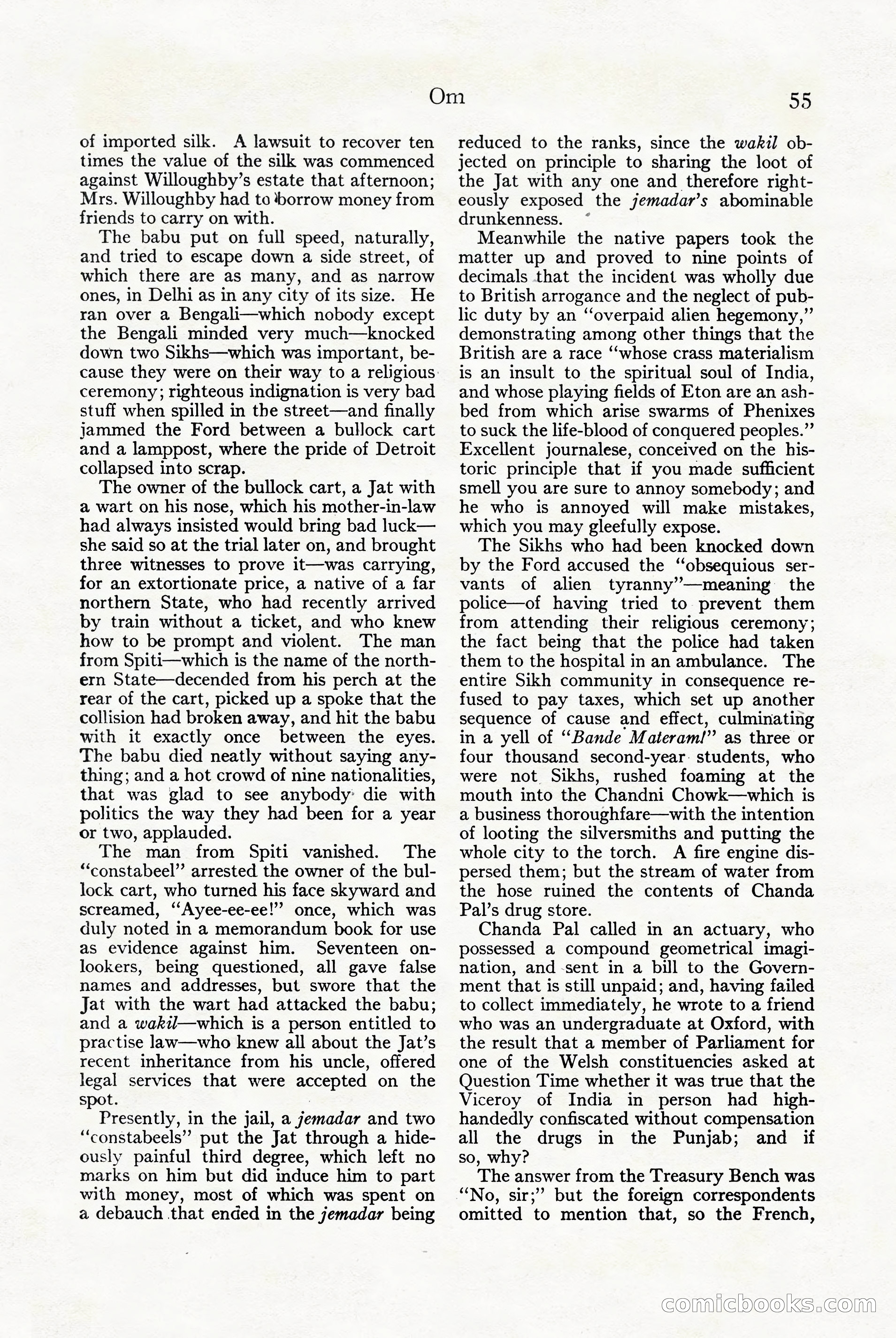
A restored page from Pulp Fiction, 1924. Page through the whole issue in the reader above.
📄 Transcribed text from this page (OCR, searchable)
Machine-transcribed from the original scan — historical spelling and the odd misread are preserved.
Om of imported silk. A lawsuit to recover ten times the value of the silk was commenced against Willoughby’s estate that afternoon; Mrs. Willoughby had to borrow money from friends to carry on with. The babu put on full speed, naturally, and tried to escape down a side street, of which there are as many, and as narrow ones, in Delhi as in any city of its size. He ran over a Bengali—which nobody except the Bengali minded very much—knocked down two Sikhs—which was important, be- cause they were on their way to a religious: ceremony; righteous indignation is very bad stuff when spilled in the street—and finally jammed the Ford between a bullock cart and a lamppost, where the pride of Detroit collapsed into scrap. The owner of the bullock cart, a Jat with a wart on his nose, which his mother-in-law had always insisted would bring bad luck— she said so at the trial later on, and brought three witnesses to prove it—was carrying, for an extortionate price, a native of a far northern State, who had recently arrived by train without a ticket, and who knew how to be prompt and violent. The man from Spiti—which is the name of the north- ern State—decended from his perch at the rear of the cart, picked up a spoke that the collision had broken away, and hit the babu with it exactly once between the eyes. The babu died neatly without saying any- thing; and a hot crowd of nine nationalities, that was glad to see anybody’ die with politics the way they had been for a year or two, applauded. The man from Spiti vanished. The “‘constabeel” arrested the owner of the bul- lock cart, who turned his face skyward and screamed, ‘‘Ayee-ee-ee!”? once, which was duly noted in a memorandum book for use as evidence against him. Seventeen on- lookers, being questioned, all gave false names and addresses, but swore that the Jat with the wart had attacked the babu; and a waki/—which is a person entitled to practise law—who knew all about the Jat’s recent inheritance from his uncle, offered legal services that were accepted on the spot. ) Presently, in the jail, a jemadar and two “constabeels” put the Jat through a hide- ously painful third degree, which left no marks on him but did induce him to part with money, most of which was spent on a debauch that ended in the jemadar being 35 reduced to the ranks, since the wakil ob- jected on principle to sharing the loot of the Jat with any one and therefore right- eously exposed the jemadar’s abominable drunkenness. Meanwhile the native papers took the matter up and proved to nine points of decimals that the incident was wholly due to British arrogance and the neglect of pub- lic duty by an “‘overpaid alien hegemony,”’ demonstrating among other things that the British are a race “‘whose crass materialism is an insult to the spiritual soul of India, and whose playing fields of Eton are an ash- bed from which arise swarms of Phenixes to suck the life-blood of conquered peoples.” Excellent journalese, conceived on the his- toric principle that if you made sufficient smell you are sure to annoy somebody; and he who is annoyed will make mistakes, which you may gleefully expose. The Sikhs who had been knocked down by the Ford accused the ‘‘obsequious ser- vants of alien tyranny’”—meaning the police—of having tried to prevent them from attending their religious ceremony; the fact being that the police had taken them to the hospital in an ambulance. The entire Sikh community in consequence re- fused to pay taxes, which set up another sequence of cause and effect, culminating in a yell of ““Bande Materam!’’ as three or four thousand second-year: students, who were not. Sikhs, rushed foaming at the mouth into the Chandni Chowk—which is a business thoroughfare—with the intention of looting the silversmiths and putting the whole city to the torch. A fire engine dis- persed them; but the stream of water from the hose ruined the contents of Chanda Pal’s drug store. Chanda Pal called in an actuary, who possessed a compound geometrical imagi- nation, and -sent in a bill to the Govern- ment that is still unpaid; and, having failed to collect immediately, he wrote to a friend who was an undergraduate at Oxford, with the result that a member of Parliament for one of the Welsh constituencies asked at Question Time whether it was true that the Viceroy of India in person had _ high- handedly confiscated without compensation all the drugs in the Punjab; and if so, why? The answer from the Treasury Bench was “No, sir; but the foreign correspondents omitted to mention that, so the French, MICLOOOK C© inn