
Pulp Fiction, 1924 · page 56 of 196
Adventure Magazine Cover — page 56: what you’re looking at
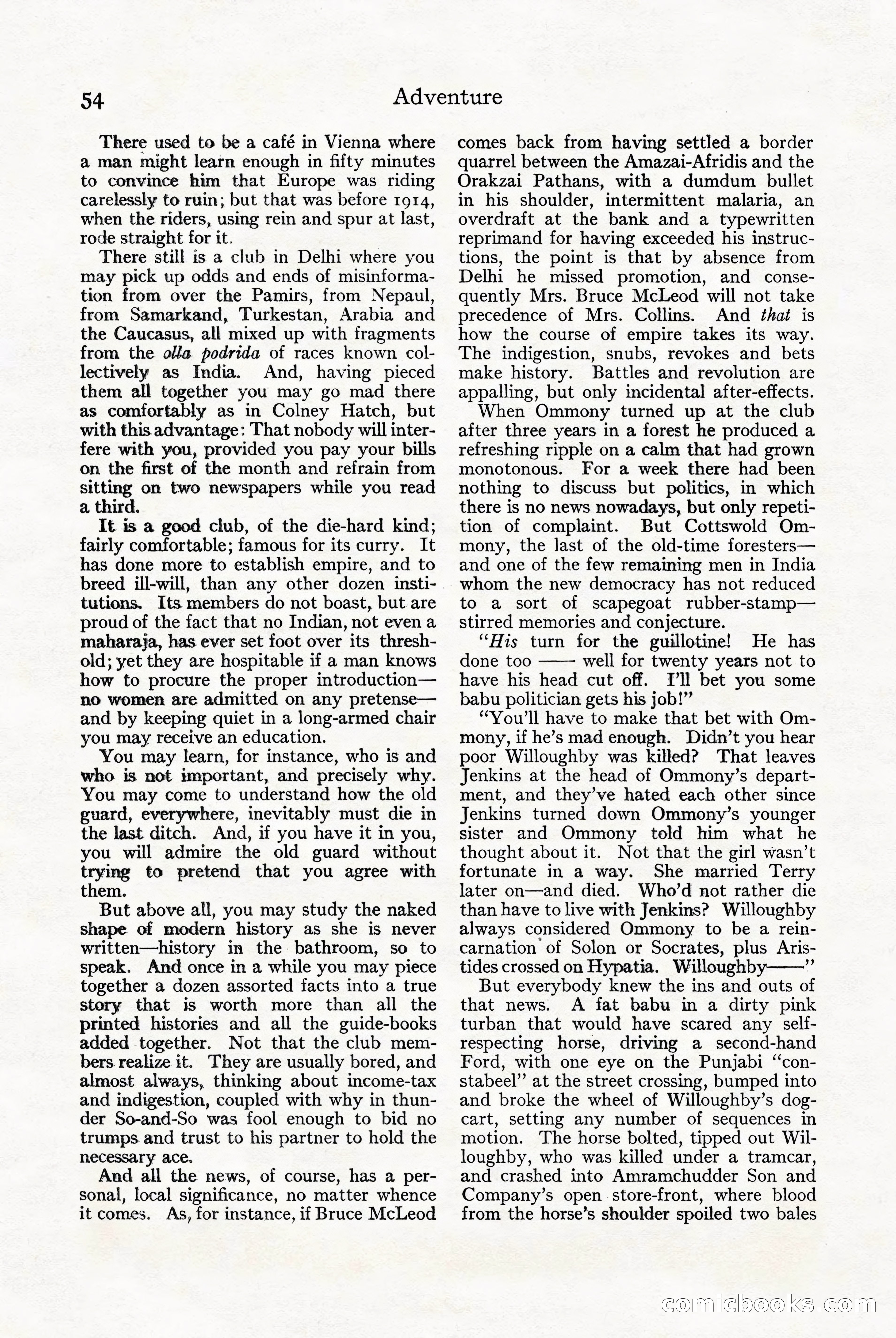
A restored page from Pulp Fiction, 1924. Page through the whole issue in the reader above.
📄 Transcribed text from this page (OCR, searchable)
Machine-transcribed from the original scan — historical spelling and the odd misread are preserved.
34 There used to be a café in Vienna where a man might learn enough in fifty minutes to convince him that Europe was riding carelessly to ruin; but that was before 1914, when the riders, using rein and spur at last, rode straight for it. , There still is a club in Delhi where you may pick up odds and ends of misinforma- tion from over the Pamirs, from Nepaul, from Samarkand, Turkestan, Arabia and the Caucasus, all mixed up with fragments from the olla podrida of races known col- lectively as India. And, having pieced them all together you may go mad there as comfortably as in Colney Hatch, but with this advantage: That nobody will inter- fere with you, provided you pay your bills on the first of the month and refrain from sitting on two newspapers while you read a third. It is a good club, of the die-hard kind; fairly comfortable; famous for its curry. It has done more to establish empire, and to breed ill-will, than any other dozen insti- tutions. Its members do not boast, but are proud of the fact that no Indian, not even a maharaja, has ever set foot over its thresh- old; yet they are hospitable if a man knows how to procure the proper introduction— no women are admitted on any pretense— and by keeping quiet in a long-armed chair you may receive an education. You may learn, for instance, who is and who is not important, and precisely why. You may come to understand how the old guard, everywhere, inevitably must die in the last ditch. And, if you have it in you, you will admire the old guard without trying to pretend that you agree with them. But above all, you may study the naked shape of modern history as she is never written—history in the bathroom, so to speak. And once in a while you may piece together a dozen assorted facts into a true story that is worth more than all the printed histories and all the guide-books added together. Not that the club mem- bers. realize it. They are usually bored, and almost always, thinking about income-tax and indigestion, coupled with why in thun- der So-and-So was fool enough to bid no trumps. and trust to his partner to hold the necessary ace. And all the news, of course, has a per- sonal, local significance, no matter whence it comes. As, for instance, if Bruce McLeod Adventure comes back from having settled a border quarrel between the Amazai-Afridis and the Orakzai Pathans, with a dumdum bullet in his shoulder, intermittent malaria, an overdraft at the bank and a typewritten reprimand for having exceeded his instruc- tions, the point is that by absence from Delhi he missed promotion, and conse- quently Mrs. Bruce McLeod will not take precedence of Mrs. Collins. And that is how the course of empire takes its way. The indigestion, snubs, revokes and bets make history. Battles and revolution are appalling, but only incidental after-effects. When Ommony turned up at the club after three years in a forest he produced a refreshing ripple on a calm that had grown monotonous. For a week there had been nothing to discuss but politics, in which there is no news nowadays, but only repeti- tion of complaint. But Cottswold Om- mony, the last of the old-time foresters— and one of the few remaining men in India whom the new democracy has not reduced to a sort of scapegoat rubber-stamp— stirred memories and conjecture. “His turn for the guillotine! He has done too well for twenty years not to have his head cut off. Pll bet you some babu politician gets his job!” “You'll have to make that bet with Om- mony, if he’s mad enough. Didn’t you hear poor Willoughby was killed? That leaves Jenkins at the head of Ommony’s depart- ment, and they’ve hated each other since Jenkins turned down Ommony’s younger sister and Ommony told him what he thought about it. Not that the girl wasn’t fortunate in a way. She married Terry later on—and died. Who'd not rather die than have to live with Jenkins? Willoughby always considered Ommony to be a rein- carnation of Solon or Socrates, plus Aris- tides crossed on Hypatia. Willoughby c But everybody knew the ins and outs of that news. A fat babu in a dirty pink turban that would have scared any self- respecting horse, driving a second-hand Ford, with one eye on the Punjabi ‘‘con- stabeel”’ at the street crossing, bumped into and broke the wheel of Willoughby’s dog- cart, setting any number of sequences in motion. The horse bolted, tipped out Wil- loughby, who was killed under a tramcar, and crashed into Amramchudder Son and Company’s open .store-front, where blood from the horse’s shoulder spoiled two bales MICLOOOK C@