
Pulp Fiction, 1924 · page 181 of 196
Adventure Magazine Cover — page 181: what you’re looking at
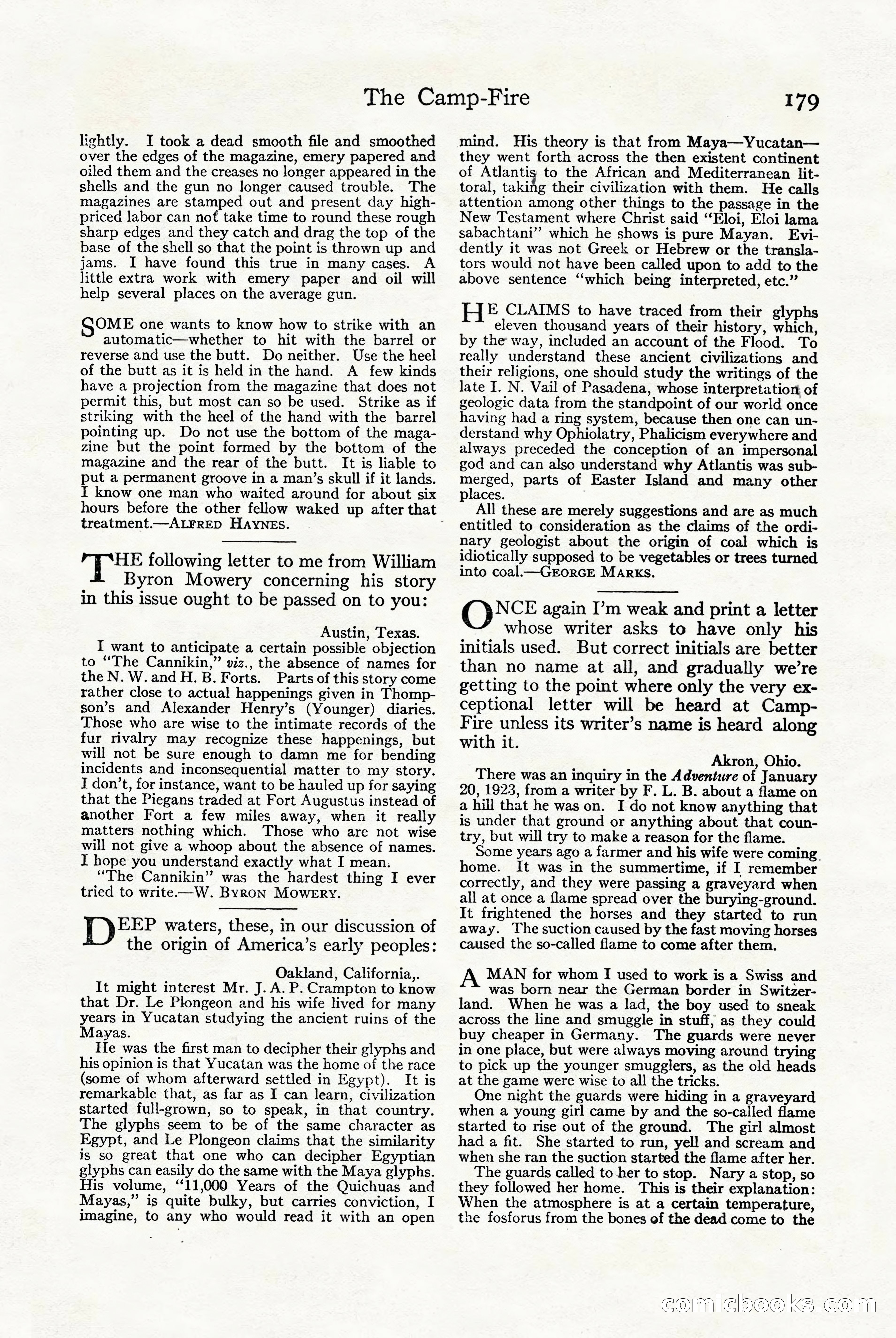
A restored page from Pulp Fiction, 1924. Page through the whole issue in the reader above.
📄 Transcribed text from this page (OCR, searchable)
Machine-transcribed from the original scan — historical spelling and the odd misread are preserved.
The Camp-Fire lightly. I took a dead smooth file and smoothed over the edges of the magazine, emery papered and iled them and the creases no longer appeared in the shells and the gun no longer caused trouble. The magazines are stamped out and present day high- priced labor can not take time to round these rough sharp edges and they catch and drag the top of the base of the shell so that the point is thrown up and jams. I have found this true in many cases. A little extra work with emery paper and oil will help several places on the average gun. OME one wants to know how to strike with an automatic—whether to hit with the barrel or reverse and use the butt. Do neither. Use the heel of the butt as it is held in the hand. A few kinds have a projection from the magazine that does not permit this, but most can so be used. Strike as if striking with the heel of the hand with the barrel pointing up. Do not use the bottom of the maga- zine but the point formed by the bottom of the magazine and the rear of the butt. It is liable to put a permanent groove in a man’s skull if it lands. I know one man who waited around for about six hours before the other fellow waked up after that treatment.—ALFRED HAYNES. fs following letter to me from William Byron Mowery concerning his story in this issue ought to be passed on to you: Austin, Texas. I want to anticipate a certain possible objection to “The Cannikin,” viz., the absence of names for the N. W. and H.B. Forts. Parts of this story come rather close to actual happenings given in Thomp- son’s and Alexander Henry’s (Younger) diaries. Those who are wise to the intimate records of the fur rivalry may recognize these happenings, but will not be sure enough to damn me for bending incidents and inconsequential matter to my story. I don’t, for instance, want to be hauled up for saying that the Piegans traded at Fort Augustus instead of another Fort a few miles away, when it really matters nothing which. Those who are not wise will not give a whoop about the absence of names. I hope you understand exactly what I mean. “The Cannikin” was the hardest thing I ever tried to write—W. Byron MowERY. EEP waters, these, in our discussion of the origin of America’s early peoples: Oakland, California,. It might interest Mr. J. A. P. Crampton to know that Dr. Le Plongeon and his wife lived for many years in Yucatan studying the ancient ruins of the Mayas. He was the first man to decipher their glyphs and his opinion is that Yucatan was the home of the race (some of whom afterward settled in Egypt). It is remarkable that, as far as I can learn, civilization started full-grown, so to speak, in that country. The glyphs seem to be of the same character as Egypt, and Le Plongeon claims that the similarity is so great that one who can decipher Egyptian glyphs can easily do the same with the Maya glyphs. His volume, ‘11,000 Years of the Quichuas and Mayas,” is quite bulky, but carries conviction, I imagine, to any who would read it with an open 179 mind. His theory is that from Maya—Yucatan— they went forth across the then existent continent of Atlantis to the African and Mediterranean lit- toral, taking their civilization with them. He calls attention among other things to the passage in the New Testament where Christ said “Eloi, Eloi lama sabachtani” which he shows is pure Mayan. Evi- dently it was not Greek or Hebrew or the transla- tors would not have been called upon to add to the above sentence ‘‘which being interpreted, etc.” HE CLAIMS to have traced from their glyphs eleven thousand years of their history, which, by the way, included an account of the Flood. To really understand these ancient civilizations and their religions, one should study the writings of the late I. N. Vail of Pasadena, whose interpretation of geologic data from the standpoint of our world once having had a ring system, because then one can un- derstand why Ophiolatry, Phalicism everywhere and always preceded the conception of an impersonal god and can also understand why Atlantis was sub- merged, parts of Easter Island and many other places. All these are merely suggestions and are as much entitled to consideration as the claims of the ordi- nary geologist about the origin of coal which is idiotically supposed to be vegetables or trees turned into coal.— GEORGE Marks. Cyr again I’m weak and print a letter whose writer asks to have only his initials used. But correct initials are better than no name at all, and gradually we’re getting to the point where only the very ex- ceptional letter will be heard at Camp- Fire unless its writer’s name is heard along with it. Akron, Ohio. There was an inquiry in the Adventure of January 20, 1923, from a writer by F. L. B. about a flame on a hill that he was on. I do not know anything that is under that ground or anything about that coun- try, but will try to make a reason for the flame. Some years ago a farmer and his wife were coming. home. It was in the summertime, if I remember correctly, and they were passing a graveyard when all at once a flame spread over the burying-ground. It frightened the horses and they started to run away. The suction caused by the fast moving horses caused the so-called flame to come after them. A MAN for whom I used to work is a Swiss and was born near the German border in Switzer- land. When he was a lad, the boy used to sneak across the line and smuggle in stuff, as they could buy cheaper in Germany. The guards were never in one place, but were always moving around trying to pick up the younger smugglers, as the old heads at the game were wise to all the tricks. One night the guards were hiding in a graveyard when a young girl came by and the so-called flame started to rise out of the ground. The girl almost had a fit. She started to run, yell and scream and when she ran the suction started the flame after her. The guards called to-her to stop. Nary a stop, so they followed her home. This is their explanation: When the atmosphere is at a certain temperature, the fosforus from the bones of the dead come to the Co DOO C©