
Pulp Fiction, 1924 · page 180 of 196
Adventure Magazine Cover — page 180: what you’re looking at
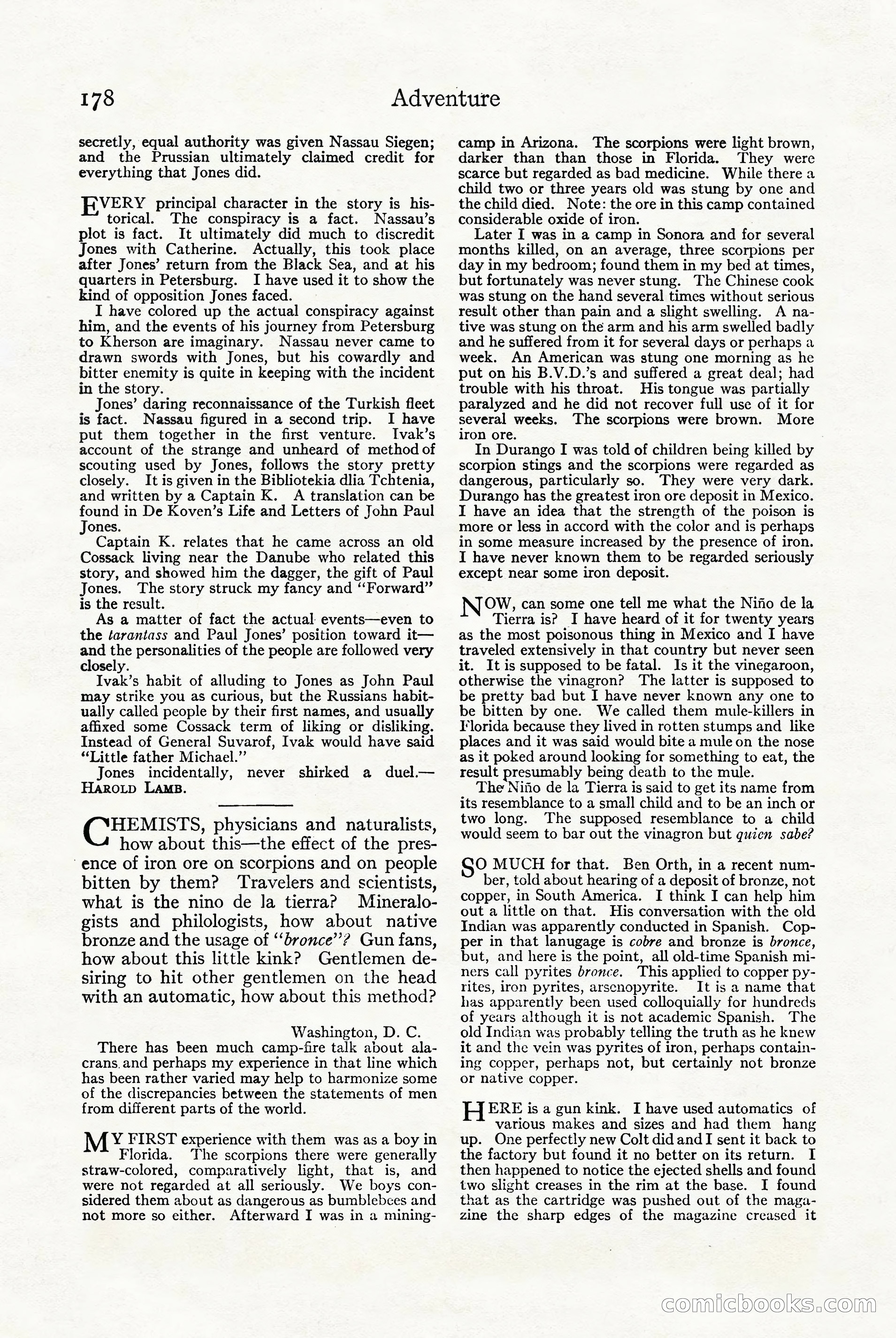
A restored page from Pulp Fiction, 1924. Page through the whole issue in the reader above.
📄 Transcribed text from this page (OCR, searchable)
Machine-transcribed from the original scan — historical spelling and the odd misread are preserved.
178 secretly, equal authority was given Nassau Siegen; and the Prussian ultimately claimed credit for everything that Jones did. VERY principal character in the story is _his- torical. The conspiracy is a fact. Nassau’s plot is fact. It ultimately did much to discredit Jones with Catherine. Actually, this took place after Jones’ return from the Black Sea, and at his quarters in Petersburg. I have used it to show the kind of opposition Jones faced. I have colored up the actual conspiracy against him, and the events of his journey from Petersburg to Kherson are imaginary. Nassau never came to drawn swords with Jones, but his cowardly and bitter enemity is quite in keeping with the incident in the story. Jones’ daring reconnaissance of the Turkish fleet is fact. Nassau figured in a second trip. I have put them together in the first venture. Ivak’s account of the strange and unheard of method of scouting used by Jones, follows the story pretty closely. It is given in the Bibliotekia dlia Tchtenia, and written by a Captain K. A translation can be found in De Koven’s Life and Letters of John Paul Jones. Captain K. relates that he came across an old Cossack living near the Danube who related this story, and showed him the dagger, the gift of Paul Jones. The story struck my fancy and ‘‘Forward” is the result. As a matter of fact the actual: events—even to the ¢arantass and Paul Jones’ position toward it— and the personalities of the people are followed very closely. Ivak’s habit of alluding to Jones as John Paul may strike you as curious, but the Russians habit- ually called people by their first names, and usually affixed some Cossack term of liking or disliking. Instead of General Suvarof, Ivak would have said “Little father Michael.” Jones incidentally, HAROLD LAMB. never shirked a duel.— (Cay physicians and naturalists, how about this—the effect of the pres- ence of iron ore on scorpions and on people bitten by them? ‘Travelers and scientists, what is the nino de la tierra? Mineralo- gists and philologists, how about native bronze and the usage of “‘bronce’’? Gun fans, how about this little kink? Gentlemen de- siring to hit other gentlemen on the head with an automatic, how about this method? Washington, D. C. There has been much camp-fire talk about ala- crans.and perhaps my experience in that line which has been rather varied may help to harmonize some of the discrepancies between the statements of men from different parts of the world. MY FIRST experience with them was as a boy in Florida. The scorpions there were generally straw-colored, comparatively light, that is, and were not regarded at all seriously. We boys con- sidered them about as dangerous as bumblebees and not more so either. Afterward I was in a mining- Adventure camp in Arizona. The scorpions were light brown, darker than than those in Florida. They were scarce but regarded as bad medicine. While there a child two or three years old was stung by one and the child died. Note: the ore in this camp contained considerable oxide of iron. Later I was in a camp in Sonora and for several months killed, on an average, three scorpions per day in my bedroom; found them in my bed at times, but fortunately was never stung. The Chinese cook was stung on the hand several times without serious result other than pain and a slight swelling. A na- tive was stung on the arm and his arm swelled badly and he suffered from it for several days or perhaps a week. An American was stung one morning as he put on his B.V.D.’s and suffered a great deal; had trouble with his throat. His tongue was partially paralyzed and he did not recover full use of it for several weeks. The scorpions were brown. More iron ore. In Durango I was told of children being killed by | scorpion stings and the scorpions were regarded as dangerous, particularly so. They were very dark. Durango has the greatest iron ore deposit in Mexico. I have an idea that the strength of the poison is more or less in accord with the color and is perhaps in some measure increased by the presence of iron. I have never known them to be regarded seriously except near some iron deposit. Now, can some one tell me what the Nijfio de la Tierra is? I have heard of it for twenty years as the most poisonous thing in Mexico and I have traveled extensively in that country but never seen it. It is supposed to be fatal. Is it the vinegaroon, otherwise the vinagronr The latter is supposed to be pretty bad but I have never known any one to be bitten by one. We called them mule-killers in Tlorida because they lived in rotten stumps and like places and it was said would bite a mule on the nose as it poked around looking for something to eat, the result presumably being death to the mule. The Nifio de la Tierra is said to get its name from its resemblance to a small child and to be an inch or two long. The supposed resemblance to a child would seem to bar out the vinagron but quien sabe? So MUCH for that. Ben Orth, in a recent num- ber, told about hearing of a deposit of bronze, not copper, in South America. I think I can help him out a little on that. His conversation with the old Indian was apparently conducted in Spanish. Cop- per in that lanugage is cobre and bronze is bronce, but, and here is the point, all old-time Spanish mi- ners call pyrites bronce. This applied to copper py- rites, iron pyrites, arscnopyrite. It is a name that has apparently been used colloquially for hundreds of years although it is not academic Spanish. The old Indian was probably telling the truth as he knew it and the vein was pyrites of iron, perhaps contain- ing copper, perhaps not, but certainly not bronze or native copper. ERE is a gun kink. I have used automatics of various makes and sizes and had them hang up. One perfectly new Colt did andI sent it back to the factory but found it no better on its return. I then happened to notice the ejected shells and found two slight creases in the rim at the base. I found that as the cartridge was pushed out of the maga- zine the sharp edges of the magazine creased it DOO (© inn