
Pulp Fiction, 1924 · page 99 of 204
Adventure Magazine Cover — page 99: what you’re looking at
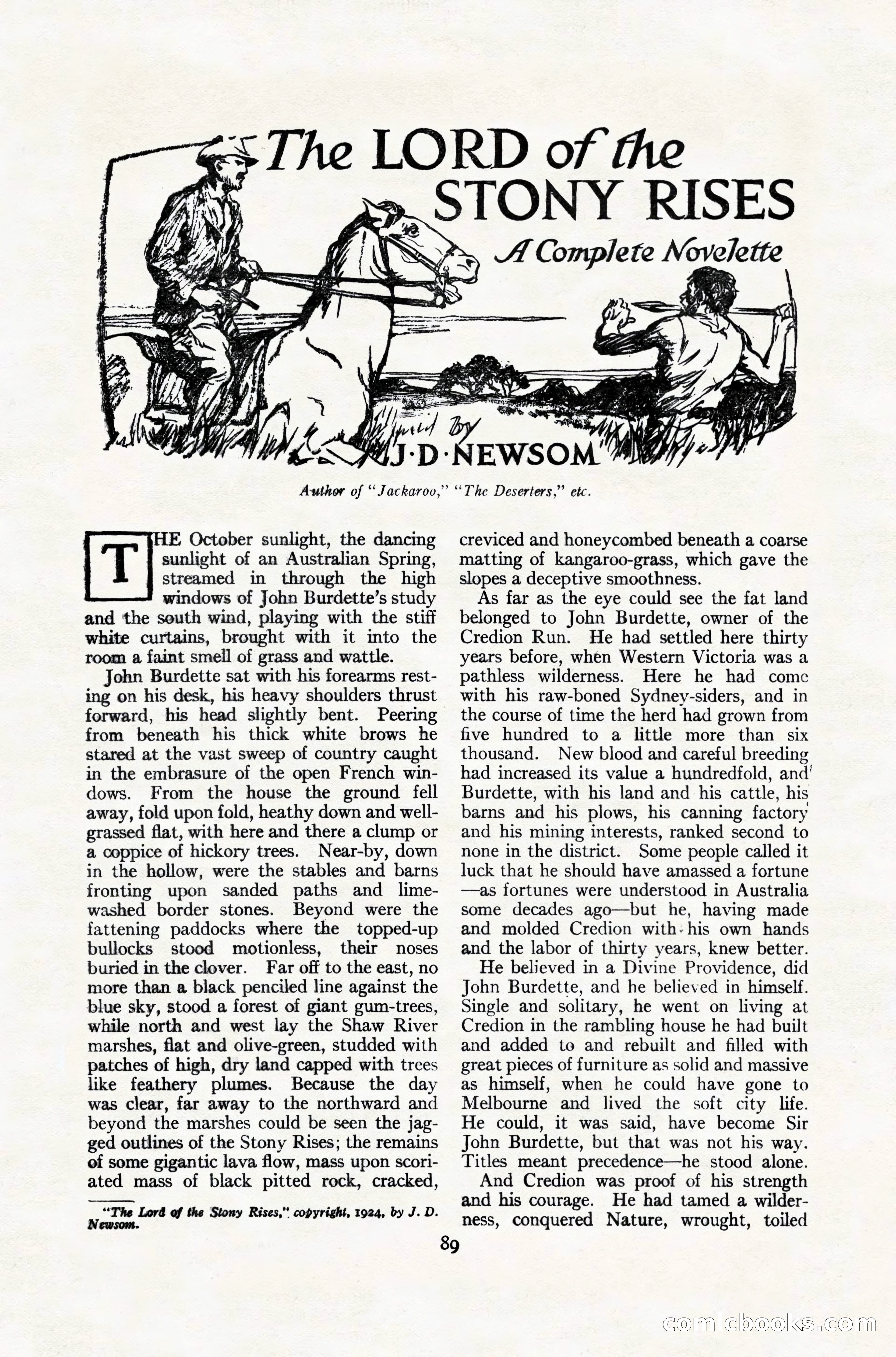
A restored page from Pulp Fiction, 1924. Page through the whole issue in the reader above.
📄 Transcribed text from this page (OCR, searchable)
Machine-transcribed from the original scan — historical spelling and the odd misread are preserved.
gy Lhe ae of the Na ie a Zi yi ie Author of ‘ Jackaroo,” “The Deserters,”’ etc. HE October sunlight, the dancing sunlight of an Australian Spring, streamed in through the high windows of John Burdette’s study and the south wind, playing with the stiff white curtains, brought with it into the room a faint smell of grass and wattle. John Burdette sat with his forearms rest- ing on his desk, his heavy shoulders thrust forward, his head slightly bent. Peering from beneath his thick white brows he stared at the vast sweep of country caught in the embrasure of the open French win- dows. From the house the ground fell away, fold upon fold, heathy down and well- grassed flat, with here and there a clump or a coppice of hickory trees. Near-by, down in the hollow, were the stables and barns fronting upon sanded paths and _lime- washed border stones. Beyond were the fattening paddocks where the topped-up bullocks stood motionless, their noses buried in the clover. Far off to the east, no more than a black penciled line against the blue sky, stood a forest of giant gum-trees, while north and west lay the Shaw River marshes, flat and olive-green, studded with patches of high, dry land capped with trees like feathery plumes. Because the day was clear, far away to the northward and beyond the marshes could be seen the jag- ged outlines of the Stony Rises; the remains of some gigantic lava flow, mass upon scori- ated mass of black pitted rock, cracked, “The Lord of the Stony Rises,” copyright, 1924, by J. D. Newsom. 89 creviced and honeycombed beneath a coarse matting of kangaroo-grass, which gave the slopes a deceptive smoothness. As far as the eye could see the fat land belonged to John Burdette, owner of the Credion Run. He had settled here thirty years before, when Western Victoria was a pathless wilderness. Here he had come with his raw-boned Sydney-siders, and in the course of time the herd had grown from five hundred to a little more than six thousand. New blood and careful breeding had increased its value a hundredfold, and! Burdette, with his land and his cattle, his barns and his plows, his canning factory and his mining interests, ranked second to none in the district. Some people called it luck that he should have amassed a fortune —as fortunes were understood in Australia some decades ago—but he, having made and molded Credion with-his own hands and the labor of thirty years, knew better. He believed in a Divine Providence, did John Burdette, and he believed in himself. Single and solitary, he went on living at Credion in the rambling house he had built and added to and rebuilt and filled with great pieces of furniture as solid and massive as himself, when he could have gone to Melbourne and lived the soft city life. He could, it was said, have become Sir John Burdette, but that was not his way. Titles meant precedence—he stood alone. And Credion was proof of his strength and his courage. He had tamed a wilder- ness, conquered Nature, wrought, toiled Go NOOK 1 O)