
Pulp Fiction, 1924 · page 98 of 204
Adventure Magazine Cover — page 98: what you’re looking at
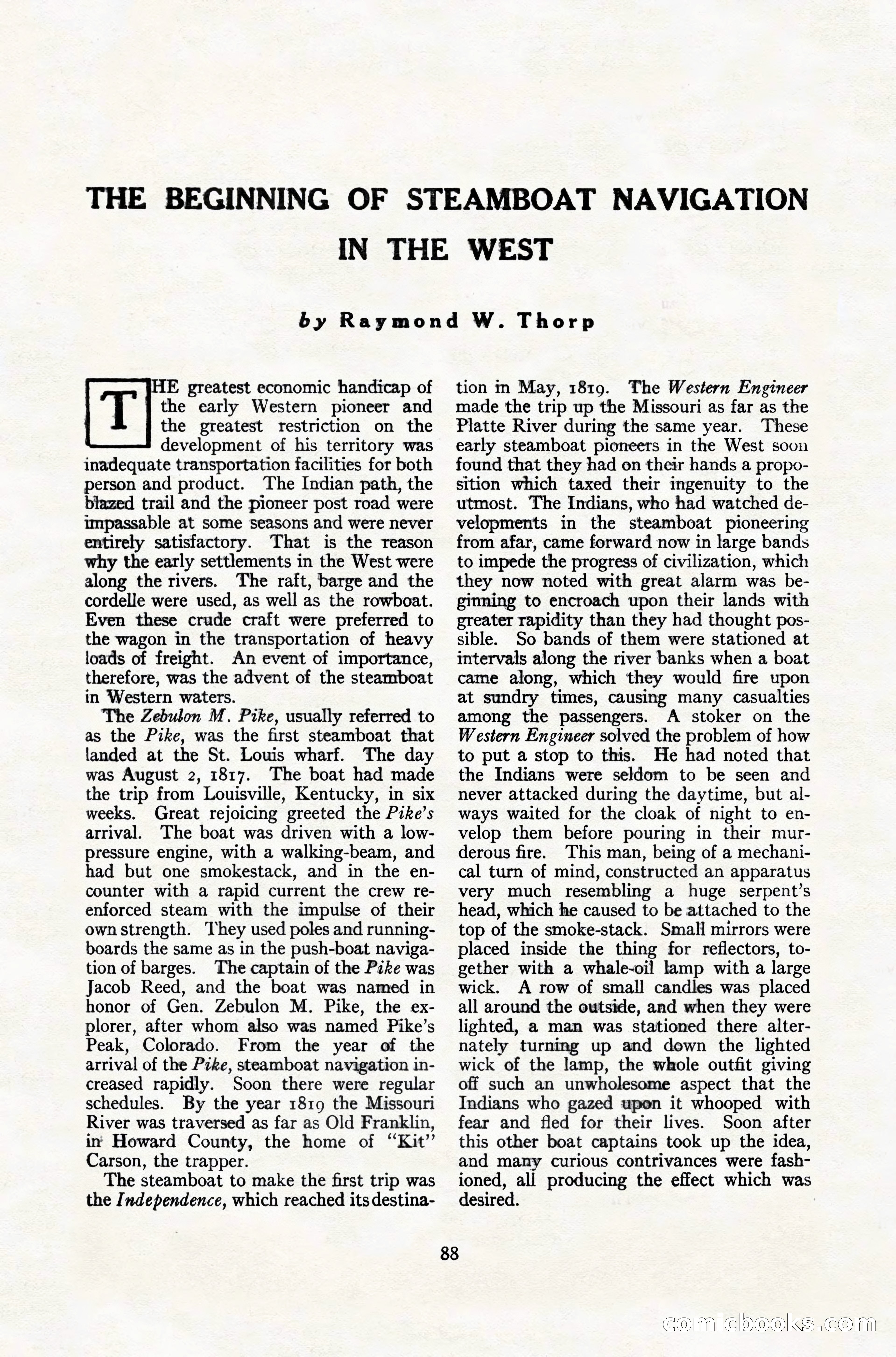
A restored page from Pulp Fiction, 1924. Page through the whole issue in the reader above.
📄 Transcribed text from this page (OCR, searchable)
Machine-transcribed from the original scan — historical spelling and the odd misread are preserved.
THE BEGINNING OF STEAMBOAT NAVIGATION IN THE WEST by Raymond W. Thorp ITE greatest economic handicap of | the early Western pioneer and the greatest restriction on the development of his territory was inadequate transportation facilities for both person and product. ‘The Indian path, the biazed trail and the pioneer post road were impassable at some seasons and were never entirely satisfactory. That is the reason why the early settlements in the West were along the rivers. The raft, barge and the cordelle were used, as well as the rowboat. Even these crude craft were preferred to the wagon in the transportation of heavy loads of freight. An event of importance, therefore, was the advent of the steamboat in Western waters. The Zebulon M. Pike, usually referred to as the Pike, was the first steamboat that landed at the St. Louis wharf. The day was August 2, 1817. The boat had made the trip from Louisville, Kentucky, in six weeks, Great rejoicing greeted the Prke’s arrival. The boat was driven with a low- pressure engine, with a walking-beam, and had but one smokestack, and in the en- counter with a rapid current the crew re- enforced steam with the impulse of their own strength. ‘l'hey used poles and running- boards the same as in the push-boat naviga- tion of barges. The captain of the Pike was Jacob Reed, and the boat was named in honor of Gen. Zebulon M. Pike, the ex- plorer, after whom also was named Pike’s Peak, Colorado. From the year of the arrival of the Pzke, steamboat navigation in- creased rapidly. Soon there were regular schedules. By the year 1819 the Missouri River was traversed as far as Old Franklin, in Howard County, the home of “Kit” Carson, the trapper. The steamboat to make the first trip was the Independence, which reached its destina- tion m May, 1819. The Western Engineer made the trip up the Missouri as far as the Platte River during the same year. These early steamboat pioneers in the West soon found that they had on their hands a propo- sition which taxed their ingenuity to the utmost. The Indians, who had watched de- velopments in the steamboat pioneering from afar, came forward now in large bands to impede the progress of civilization, which they now noted with great alarm was be- ginning to encroach upon their lands with greater rapidity than they had thought pos- sible. So bands of them were stationed at intervals along the river banks when a boat came along, which they would fire upon at sundry times, causing many casualties among the passengers. A stoker on the Western Engineer solved the problem of how to put a stop to this. He had noted that the Indians were seldom to be seen and never attacked during the daytime, but al- ways waited for the cloak of night to en- velop them before pouring in their mur- derous fire. This man, being of a mechani- cal turn of mind, constructed an apparatus very much resembling a huge serpent’s head, which he caused to be attached to the top of the smoke-stack. Small mirrors were placed inside the thing for reflectors, to- gether with a whale-oil lamp with a large wick. A row of small candles was placed all around the outside, and when they were lighted, a man was stationed there alter- nately turning up and down the lighted wick of the lamp, the whole outfit giving off such an unwholesome aspect that the Indians who gazed upon it whooped with fear and fled for their lives. Soon after this other boat captains took up the idea, and many curious contrivances were fash- ioned, all producing the effect which was desired. 88 Go NOOK 1 @)