
Pulp Fiction, 1924 · page 18 of 204
Adventure Magazine Cover — page 18: what you’re looking at
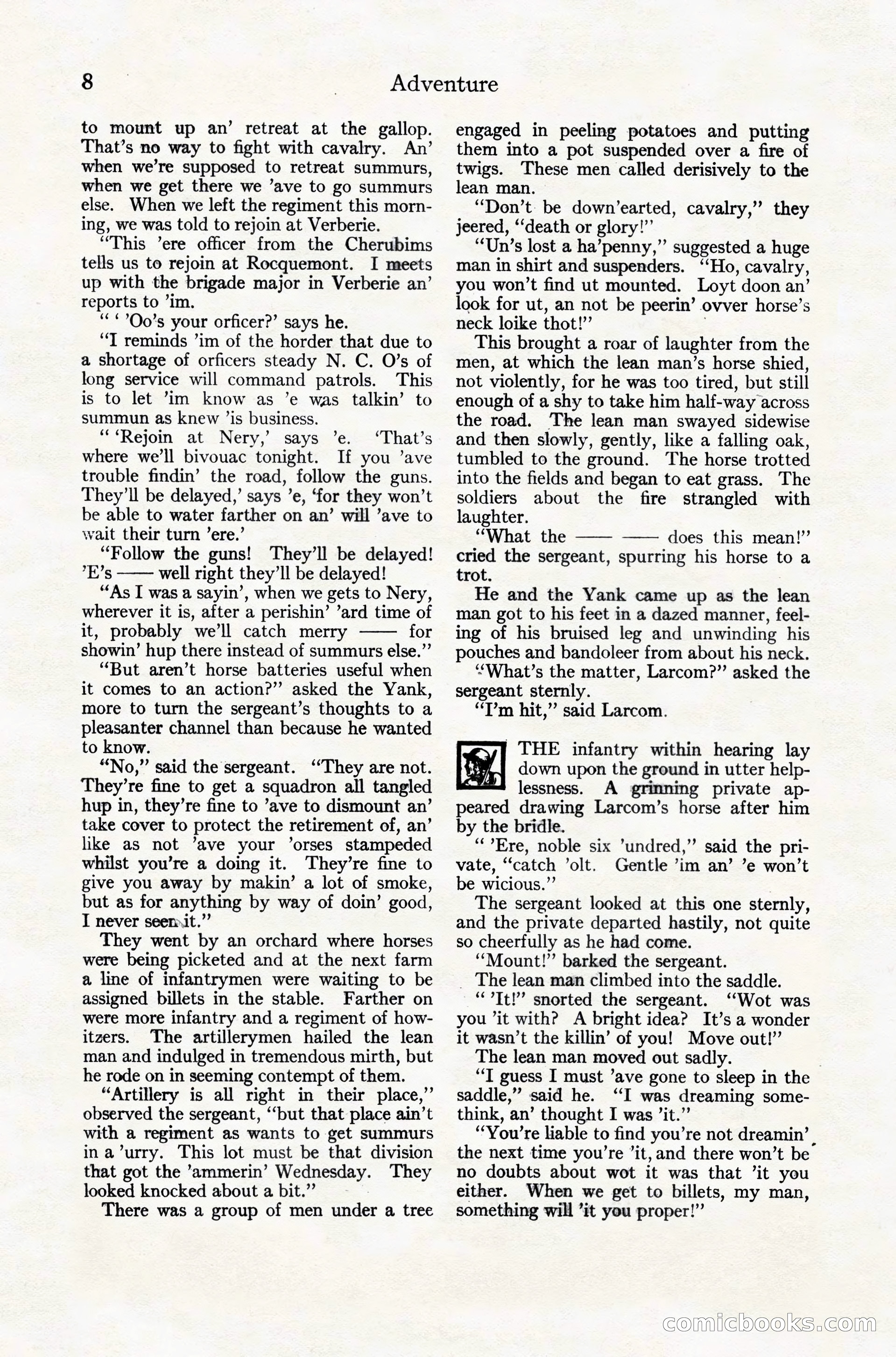
A restored page from Pulp Fiction, 1924. Page through the whole issue in the reader above.
📄 Transcribed text from this page (OCR, searchable)
Machine-transcribed from the original scan — historical spelling and the odd misread are preserved.
: Eres | Adventure to mount up an’ retreat at the gallop. That’s no way to fight with cavalry. An’ when we’re supposed to retreat summurs, when we get there we ’ave to go summurs else. When we left the regiment this morn- ing, we was told to rejoin at Verberie. “This ’ere officer from the Cherubims tells us to rejoin at Rocquemont. I meets up with the brigade major in Verberie an’ reports to ’im. ‘*°Qo’s your orficer?’ says he. ‘‘T reminds ’im of the horder that due to a shortage of orficers steady N. C. O’s of long service will command patrols. This is to let ’im know as ’e was talkin’ to summun as knew ’is business. “Rejoin at Nery,’ says ’e. ‘That’s where we'll bivouac tonight. If you ’ave trouble findin’ the road, follow the guns. They’ll be delayed,’ says ’e, ‘for they won’t be able to water farther on an’ will ’ave to wait their turn ’ere.’ “Follow the guns! They’ll be delayed! "E’s well right they’ll be delayed! “As I was a sayin’, when we gets to Nery, wherever it is, after a perishin’ ’ard time of it, probably we'll catch merry for showin’ hup there instead of summurs else.”’ “But aren’t horse batteries useful when it comes to an action?” asked the Yank, more to turn the sergeant’s thoughts to a pleasanter channel than because he wanted to know. “No,” said the sergeant. ‘“They are not. They’re fine to get a squadron all tangled hup in, they’re fine to ’ave to dismount an’ take cover to protect the retirement of, an’ like as not ’ave your ’orses stampeded whilst you’re a doing it. They’re fine to give you away by makin’ a lot of smoke, but as for anything by way of doin’ good, I never seemit.”’ They went by an orchard where horses were being picketed and at the next farm a line of infantrymen were waiting to be assigned billets in the stable. Farther on were more infantry and a regiment of how- itzers. The artillerymen hailed the lean man and indulged in tremendous mirth, but he rode on in seeming contempt of them. “Artillery is all right in their place,” observed the sergeant, “but that place ain’t with a regiment as wants to get summurs ina’urry. This lot must be that division that got the ’ammerin’ Wednesday. They looked knocked about a bit.”’ There was a group of men under a tree engaged in peeling potatoes and putting them into a pot suspended over a fire of twigs. These men called derisively to the lean man. ‘Don’t be down’earted, cavalry,” they jeered, ‘“‘death or glory!”’ ‘Un’s lost a ha’penny,”’ suggested a huge man in shirt and suspenders. ‘‘Ho, cavalry, you won’t find ut mounted. Loyt doon an’ look for ut, an not be peerin’ ovver horse’s neck loike thot!’’ , This brought a roar of laughter from the men, at which the lean man’s horse shied, not violently, for he was too tired, but still enough of a shy to take him half-way across the road. The lean man swayed sidewise and then slowly, gently, like a falling oak, tumbled to the ground. The horse trotted into the fields and began to eat grass. The soldiers about the fire strangled with laughter. “What the —— —— does this mean!” cried the sergeant, spurring his horse to a trot. He and the Yank came up as the lean man got to his feet in a dazed manner, feel- ing of his bruised leg and unwinding his pouches and bandoleer from about his neck. ‘““What’s the matter, Larcom?”’ asked the sergeant sternly. “T’m hit,” said Larcom. THE infantry within hearing lay a down upon the ground in utter help- =a lessness. A grinning private ap- peared drawing Larcom’s horse after him by the bridle. ‘“*Ere, noble six ’undred,” said the pri- vate, ‘catch ’olt. Gentle ’im an’ ’e won’t be wicious.”’ : The sergeant looked at this one sternly, and the private departed hastily, not quite so cheerfully as he had come. ‘““Mount!”’ barked the sergeant. _ The lean man climbed into the saddle. “It!” snorted the sergeant. ‘‘Wot was you ’it with? A bright idea? It’s a wonder it wasn’t the killin’ of you! Move out!” The lean man moved out sadly. “T guess I must ’ave gone to sleep in the saddle,” said he. ‘I was dreaming some- think, an’ thought I was ’it.”’ “You're liable to find you’re not dreamin’ | the next time you’re ’it, and there won’t be no doubts about wot it was that ’it you either. When we get to billets, my man, something will ’it you proper!”’ Go NOOK (©