
Pulp Fiction, 1924 · page 17 of 204
Adventure Magazine Cover — page 17: what you’re looking at
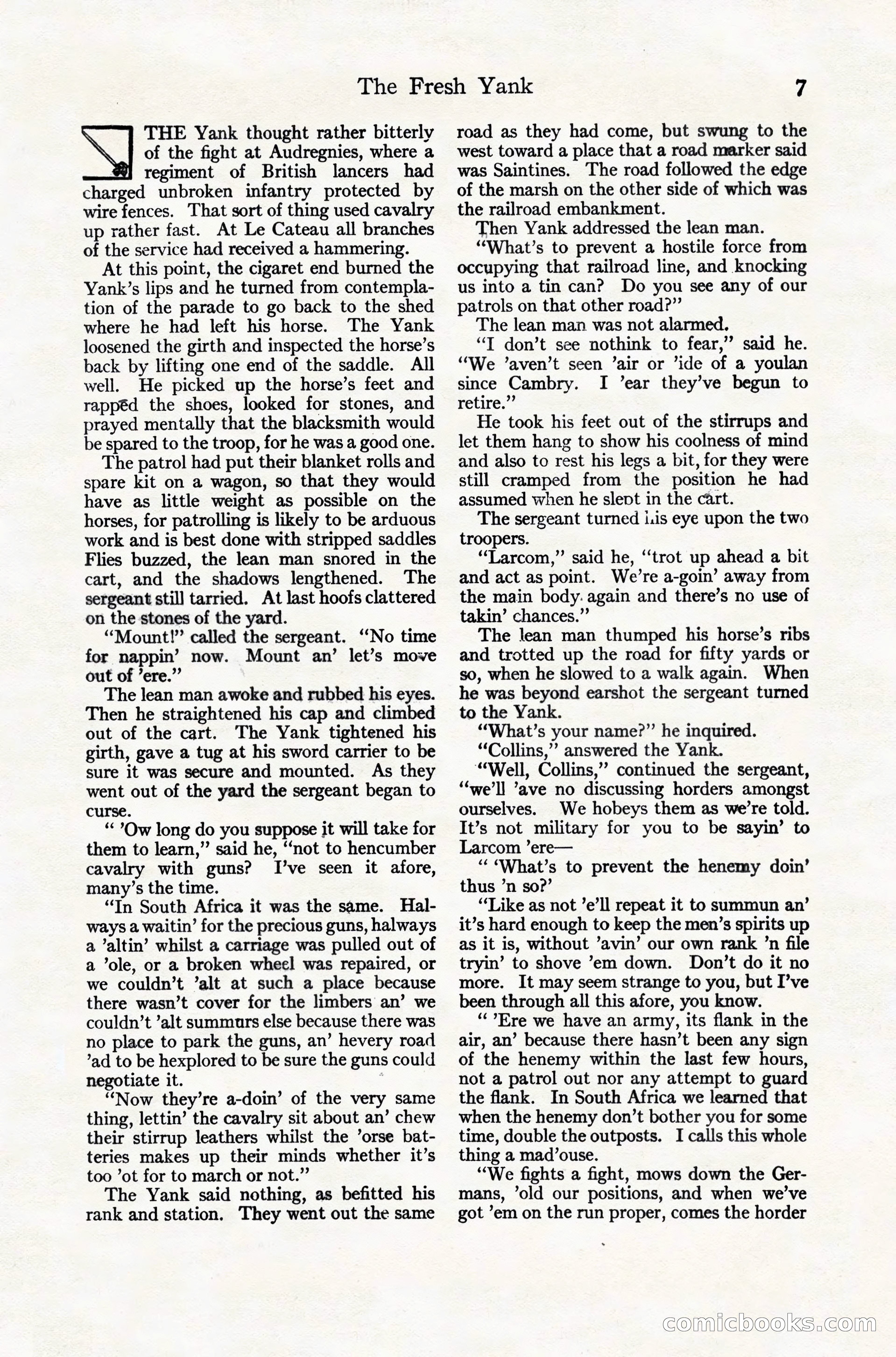
A restored page from Pulp Fiction, 1924. Page through the whole issue in the reader above.
📄 Transcribed text from this page (OCR, searchable)
Machine-transcribed from the original scan — historical spelling and the odd misread are preserved.
The Fresh Yank 7 THE Yank thought rather bitterly of the fight at Audregnies, where a regiment of British lancers had charged unbroken infantry protected by wire fences. That sort of thing used cavalry up rather fast. At Le Cateau all branches of the service had received a hammering. At this point, the cigaret end burned the Yank’s lips and he turned from contempla- tion of the parade to go back to the shed where he had left his horse. The Yank loosened the girth and inspected the horse’s back by lifting one end of the saddle. All well. He picked up the horse’s feet and rappéd the shoes, looked for stones, and prayed mentally that the blacksmith would be spared to the troop, for he was a good one. The patrol had put their blanket rolls and spare kit on a wagon, so that they would have as little weight as possible on the horses, for patrolling is likely to be arduous work and is best done with stripped saddles Flies buzzed, the lean man snored in the cart, and the shadows lengthened. The sergeant still tarried. At last hoofs clattered on the stones of the yard. “Mount!” called the sergeant. “No time for nappin’ now. Mount an’ let’s move out of ’ere.” The lean man awoke and rubbed his eyes. Then he straightened his cap and climbed out of the cart. The Yank tightened his girth, gave a tug at his sword carrier to be sure it was secure and mounted. As they went out of the yard the sergeant began to curse. “’Ow long do you suppose it will take for them to learn,’’ said he, “‘not to hencumber cavalry with guns? I’ve seen it afore, many’s the time. “In South Africa it was the same. Hal- ways a waitin’ for the precious guns, halways a ’altin’ whilst a carriage was pulled out of a ’ole, or a broken wheel was repaired, or we couldn’t ’alt at such a place because there wasn’t cover for the limbers an’ we couldn’t ’alt summars else because there was no place to park the guns, an’ hevery road ’ad to be hexplored to be sure the guns could negotiate it. : “Now they’re a-doin’ of the very same thing, lettin’ the cavalry sit about an’ chew their stirrup leathers whilst the ’orse bat- teries makes up their minds whether it’s too ’ot for to march or not.” The Yank said nothing, as befitted his rank and station. They went out the same road as they had come, but swung to the west toward a place that a road marker said was Saintines. The road followed the edge of the marsh on the other side of which was the railroad embankment. Then Yank addressed the lean man. ‘“‘What’s to prevent a hostile force from occupying that railroad line, and knocking us into a tin can? Do you see any of our patrols on that other road?” The lean man was not alarmed. “T don’t see nothink to fear,’’ said he. “We ’aven’t seen ’air or ’ide of a youlan since Cambry. I ’ear they’ve begun to retire.”’ He took his feet out of the stirrups and let them hang to show his coolness of mind and also to rest his legs a bit, for they were still cramped from the position he had assumed when he slept in the cart. The sergeant turned i.is eye upon the two troopers. “Larcom,” said he, ‘trot up ahead a bit and act as point. We’re a-goin’ away from the main body. again and there’s no use of takin’ chances.” The lean man thumped his horse’s ribs and trotted up the road for fifty yards or so, when he slowed to a walk again. When he was beyond earshot the sergeant turned to the Yank. “‘What’s your name?” he inquired. “Collins,”’ answered the Yank. “Well, Collins,” continued the sergeant, ‘we'll ’ave no discussing horders amongst ourselves. We hobeys them as we’re told. It’s not military for you to be sayin’ to Larcom ’ere— ‘“‘‘What’s to prevent the henemy doin’ thus ’n so?’ “Like as not ’e’ll repeat it to summun an’ it’s hard enough to keep the men’s spirits up as it is, without ’avin’ our own rank ’n file tryin’ to shove ’em down. Don’t do it no more. It may seem strange to you, but I’ve been through all this afore, you know. “Ere we have an army, its flank in the air, an’ because there hasn’t been any sign of the henemy within the last few hours, not a patrol out nor any attempt to guard the flank. In South Africa we learned that when the henemy don’t bother you for some time, double the outposts. I calls this whole thing a mad’ouse. ‘“‘We fights a fight, mows down the Ger- mans, ’old our positions, and when we’ve got ’em on the run proper, comes the horder Co DOOLK 1 O)