
Pulp Fiction, 1924 · page 6 of 196
Adventure Magazine, April 10, 1924 — page 6: what you’re looking at
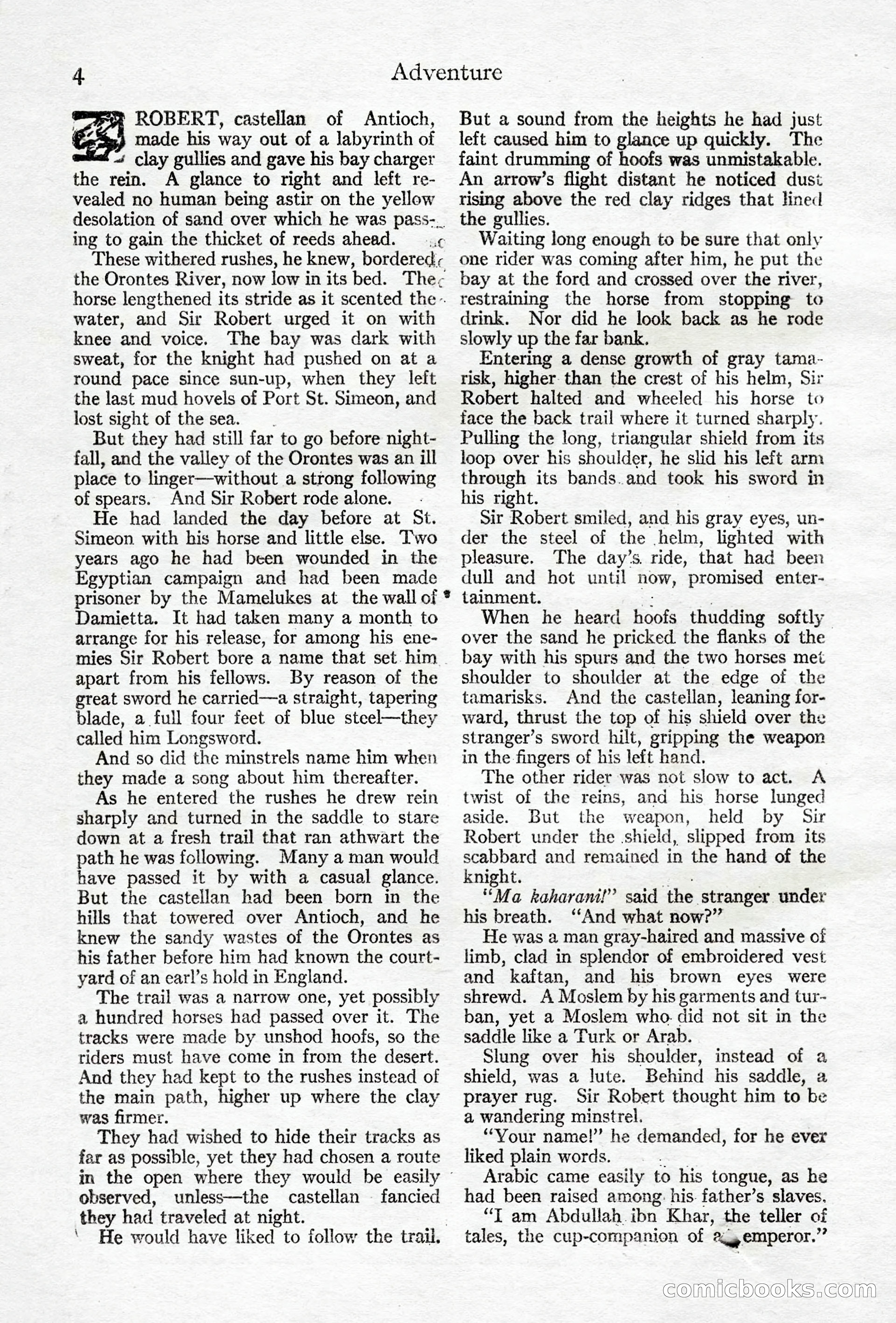
A restored page from Pulp Fiction, 1924. Page through the whole issue in the reader above.
📄 Transcribed text from this page (OCR, searchable)
Machine-transcribed from the original scan — historical spelling and the odd misread are preserved.
i ROBERT, castellan of Antioch, made his way out of a labyrinth of + clay gullies and gave his bay charger the rein. A glance to right and left re- vealed no human being astir on the yellow desolation of sand over which he was pass-.. ing to gain the thicket of reeds ahead. These withered rushes, he knew, bordered the Orontes River, now low in its bed The- horse lengthened its stride as it scented the - water, and Sir Robert urged it on with knee and voice. The bay was dark with sweat, for the knight had pushed on at a round pace since sun-up, when they left the last mud hovels of Port St. Simeon, and lost sight of the sea. But they had still far to go before night- fall, and the valley of the Orontes was an ill place to linger—without a strong following of spears. And Sir Robert rode alone. . He had landed the day before at St. Simeon. with his horse and little else. Two years ago he had been wounded in the Egyptian campaign and had been made prisoner by the Mamelukes at the wall of Damietta. It had taken many a month to arrange for his release, for among his ene- mies Sir Robert bore a name that set. him apart from his fellows. By reason of the great sword he carried—a straight, tapering blade, a full four feet of blue steel—they called him Longsword. And so did the minstrels name him when they made a song about him thereafter. As he entered the rushes he drew rein sharply and turned in the saddle to stare down at a fresh trail that ran athwart the path he was following. Many a man would have passed it by ‘with a casual glance. But the castellan had been born in the hills that towered over Antioch, and he knew the sandy wastes of the Orontes as his father before him had known the court- yard of an ear!’s hold in England. The trail was a narrow one, yet possibly a hundred horses had passed over it. The tracks were made by unshod hoofs, so the riders must have come in from the desert. And they had kept to the rushes instead of the main path, higher up where the clay was firmer. They had wished to hide their tracks as far as possible, yet they had chosen a route in the open where they would be easily ~ observed, unless—the castellan fancied they had traveled at night. He would have liked to follow the trail, Adventure But a sound from the heights he had just left caused him to glance up quickly. The faint drumming of hoofs was unmistakable. An arrow’s flight distant he noticed dust rising above the red clay ridges that lined the gullies. Waiting long enough to be sure that only one rider was coming after him, he put the bay at the ford and crossed over the river, restraining the horse from stopping to drink. Nor did he look back as he rode slowly up the far bank. Entering a dense growth of gray tama- risk, higher than the crest of his helm, Sir Robert halted and wheeled his horse to face the back trail where it turned sharply. Pulling the long, triangular shield from its loop over his shoulder, he slid his left arm through its bands.and took his sword in his right. Sir Robert smiled, and his gray eyes, un- der the steel of the helm, lighted with pleasure. The day’s. ride, that had been dull and hot until now, promised enter- tainment. When he heard hoofs thudding softly over the sand he pricked the flanks of the bay with his spurs and the two horses met shoulder to shoulder at the edge of the tamarisks. And the castellan, leaning for- ward, thrust the top of his shield over the stranger’s sword hilt, gripping the weapon in the fingers of his left hand. The other rider was not slow to act. A twist of the reins, and his horse lunged aside. But the weapon, held by Sir Robert under the shield, slipped from its scabbard and remained in the hand of the knight. ‘Ma kaharanit” said the stranger under his breath. “And what now?” He was a man gray-haired and massive of limb, clad in splendor of embroidered vest and kaftan, and his brown eyes were shrewd. A Moslem by his garments and tur- ban, yet a Moslem who. did not sit in the saddle like a Turk or Arab. Slung over his shoulder, instead of a shield, was a lute. Behind his saddle, a prayer rug. Sir Robert thought him to be a wandering minstrel. “Your name!” he demanded, for he ever liked plain words. Arabic came easily to his tongue, as he had been raised among: his. father’s slaves. “fT am Abdullah.ibn Khar, the teller of tales, the cup-companion of a,emperor.” GO DOO) AMG S (CO