
Pulp Fiction, 1924 · page 5 of 196
Adventure Magazine, April 10, 1924 — page 5: what you’re looking at
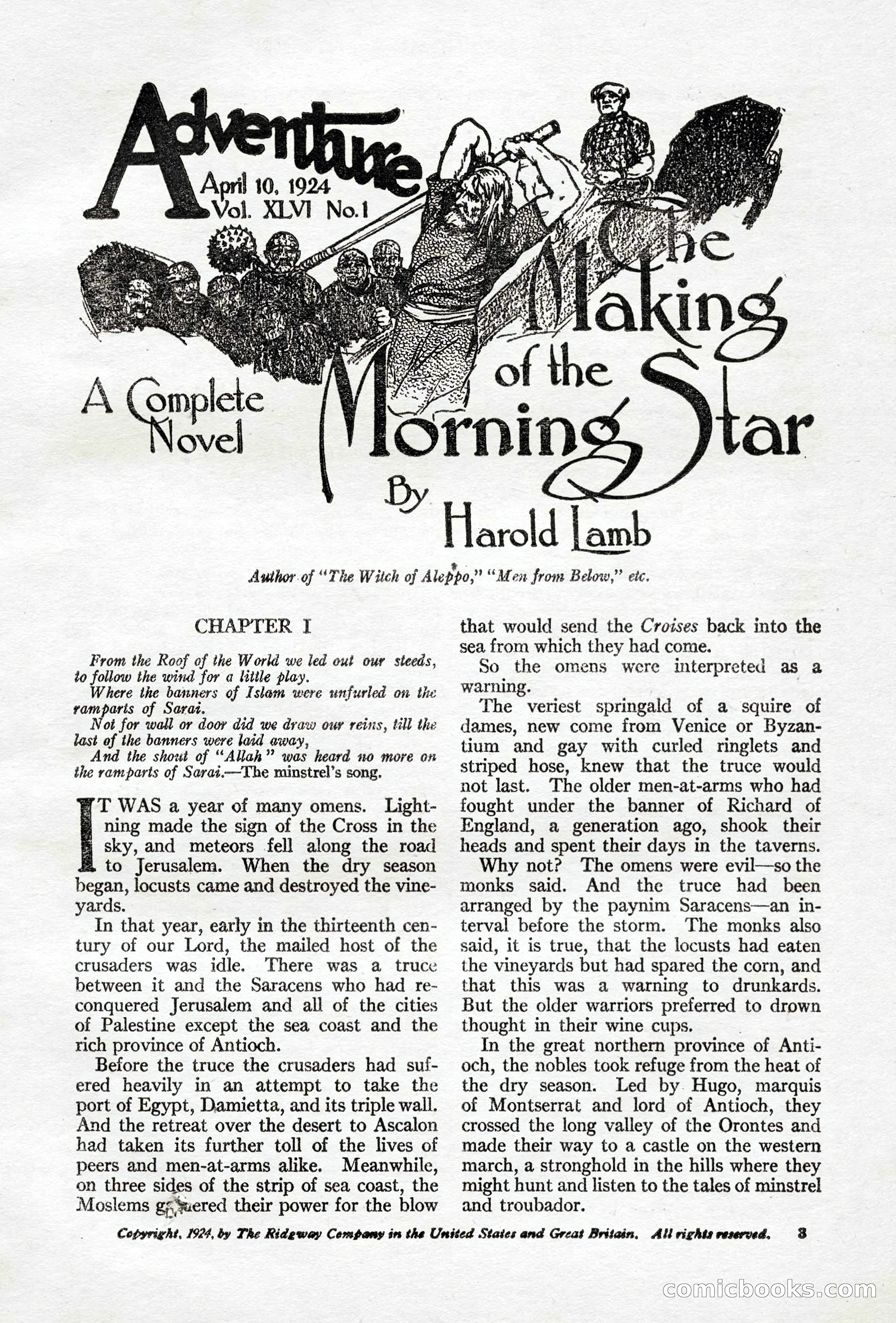
A restored page from Pulp Fiction, 1924. Page through the whole issue in the reader above.
📄 Transcribed text from this page (OCR, searchable)
Machine-transcribed from the original scan — historical spelling and the odd misread are preserved.
hea Smplete ovel a lorni Harold lamb Lae Author of “The Witch of Aleppo,” “Men from Below,” etc. CHAPTER I From the Roof of the World we led out our steeds, to follow the wind for a little play. Where the banners of Islam were unfurled on the ramparis of Sarat. Not for wall or door did we draw our reins, till the last of the banners were laid away, And the shout of “Allah” was heard no more on the ramparts of Sarai.—The minstrel’s song. T WAS a year of many omens. Light- ning made the sign of the Cross in the sky, and meteors fell along the road to Jerusalem. When the dry season began, locusts came and destroyed the vine- yards. In that year, early in the thirteenth cen- tury of our Lord, the mailed host of the crusaders was idle. There was a truce between it and the Saracens who had re- conquered Jerusalem and all of the cities of Palestine except the sea coast and the rich province of Antioch. Before the truce the crusaders had suf- ered heavily in an attempt to take the port of Egypt, Damietta, and its triple wall. And the retreat over the desert to Ascalon had taken its further toll of the lives of peers and men-at-arms alike. Meanwhile, on three sides of the strip of sea coast, the Moslems gfjuered their power for the blow Copyright, 1924, by The Rideway Company in the United States and Great Britain. that would send the Croises back into the sea from which they had come. So the omens were interpreted as a warning. The veriest springald of a squire of dames, new come from Venice or Byzan- tium and gay with curled ringlets and striped hose, knew that the truce would not last. The older men-at-arms who had fought under the banner of Richard of England, a generation ago, shook their heads and spent their days in the taverns. Why not? The omens were evil—so the monks said. And the truce had been arranged by the paynim Saracens—an in- terval before the storm. The monks also said, it is true, that the locusts had eaten the vineyards but had spared the corn, and that this was a warning to drunkards. But the older warriors preferred to drown thought in their wine cups. In the great northern province of Anti- och, the nobles took refuge from the heat of the dry season. Led by. Hugo, marquis of Montserrat and lord of Antioch, they crossed the long valley of the Orontes and made their way to a castle on the western march, a stronghold in the hills where they might hunt and listen to the tales of minstrel and troubador. Ali rights reserved, 3 cComicloool< G (C@ S|