
Pulp Fiction, 1924 · page 157 of 196
Adventure Magazine, April 10, 1924 — page 157: what you’re looking at
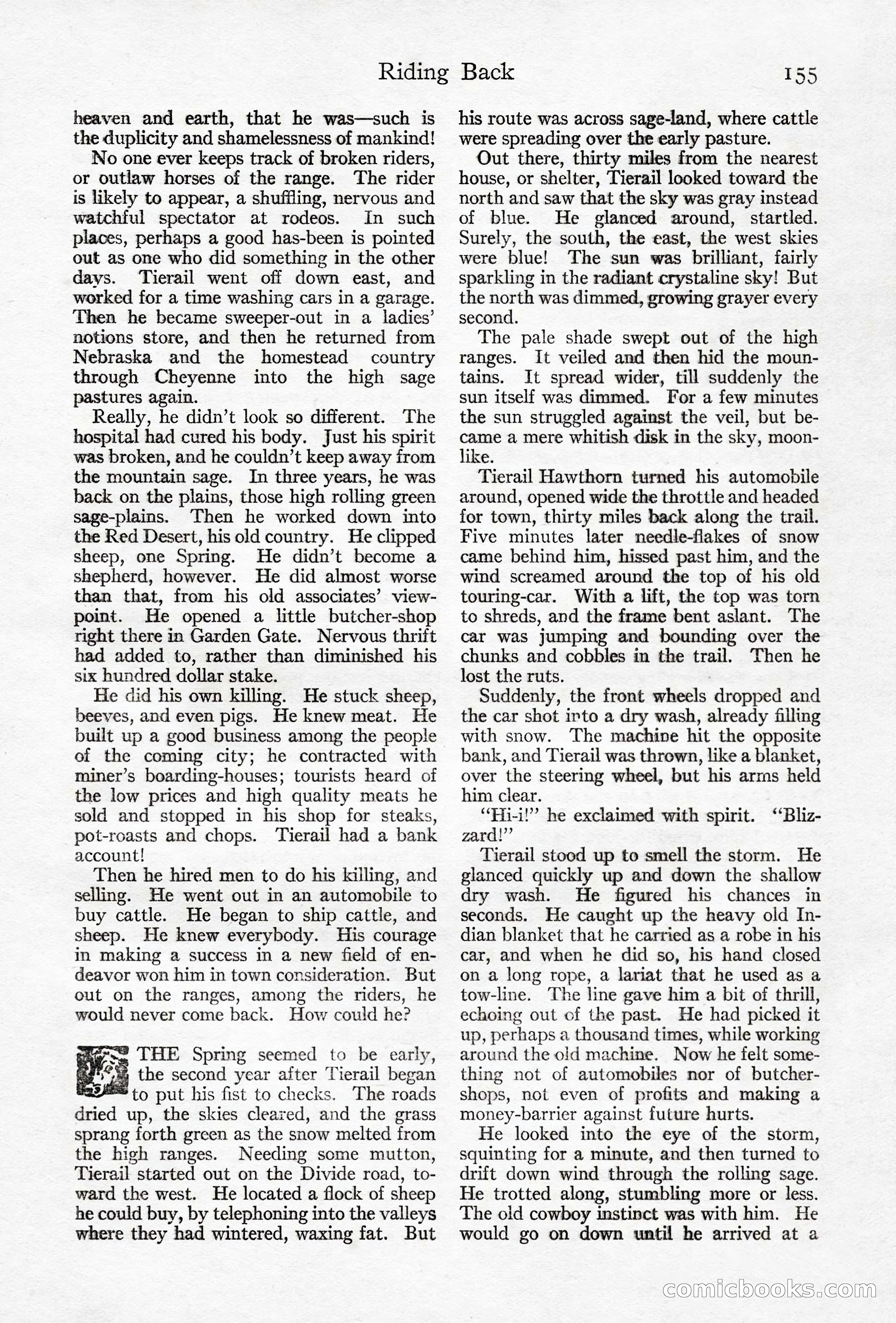
A restored page from Pulp Fiction, 1924. Page through the whole issue in the reader above.
📄 Transcribed text from this page (OCR, searchable)
Machine-transcribed from the original scan — historical spelling and the odd misread are preserved.
Riding Back heaven and earth, that he was—such is the duplicity and shamelessness of mankind! No one ever keeps track of broken riders, or outlaw horses of the range. The rider is likely to appear, a shuffling, nervous and watchful spectator at rodeos. In such places, perhaps a good has-been is pointed out as one who did something in the other days. Tierail went off down east, and worked for a time washing cars in a garage. Then he became sweeper-out in a ladies’ notions store, and then he returned from Nebraska and the homestead country through Cheyenne into the high sage pastures again. Really, he didn’t look so different. The hospital had cured his body. Just his spirit was broken, and he couldn’t keep away from the mountain sage. In three years, he was back on the plains, those high rolling green sage-plains. Then he worked down into the Red Desert, his old country. He clipped sheep, one Spring. He didn’t become a shepherd, however. He did almost worse than that, from his old associates’ view- point. He opened a little butcher-shop right there in Garden Gate. Nervous thrift had added to, rather than diminished his six hundred dollar stake. He did his own killing. He stuck sheep, beeves, and even pigs. He knew meat. He built up a good business among the people of the coming city; he contracted with miner’s boarding-houses; tourists heard of the low prices and high quality meats he sold and stopped in his shop for steaks, pot-roasts and chops. Tierail had a bank account! Then he hired men to do his killing, and selling. He went out in an automobile to buy cattle. He began to ship cattle, and sheep. He knew everybody. His courage in making a success in a new field of en- deavor won him in town consideration. But out on the ranges, among the riders, he would never come back. How could he? ores LHE Spring seemed to be early, ug 44 the second year aiter Tierail began ne to put his fist to checks. The roads dried up, the skies cleared, and the grass sprang forth green as the snow melted from the high ranges. Needing some mutton, Tierail started out on the Divide road, to- ward the west. He located a flock of sheep he could buy, by telephoning into the valleys where they had wintered, waxing fat. But I55 his route was across sage-land, where cattle were spreading over the early pasture. Out there, thirty miles from the nearest house, or shelter, Tierail looked toward the north and saw that the sky was gray instead of blue. He glanced around, startled. Surely, the south, the east, the west skies were blue! The sun was brilliant, fairly sparkling in the radiant crystaline sky! But the north was dimmed, growing grayer every second. The pale shade swept out of the high ranges. It veiled and then hid the moun- tains. It spread wider, till suddenly the sun itself was dimmed. For a few minutes the sun struggled against the veil, but be- came a mere whitish disk in the sky, moon- like. Tierail Hawthorn turned his automobile around, opened wide the throttle and headed for town, thirty miles back along the trail. Five minutes later needle-flakes of snow came behind him, hissed past him, and the wind screamed around the top of his old touring-car. With a lift, the top was torn to shreds, and the frame bent aslant. The car was jumping and bounding over the chunks and cobbles in the trail. Then he lost the ruts. Suddenly, the front wheels dropped and the car shot irto a dry wash, already filling with snow. The machine hit the opposite bank, and Tierail was thrown, like a blanket, over the steering wheel, but his arms held him clear. ““Fii-i!”’ he exclaimed with spirit. ‘Bliz- zard!”’ Tierail stood up to smell the storm. He glanced quickly up and down the shallow dry wash. He figured his chances in seconds. He caught up the heavy old In- dian blanket that he carried as a robe in his car, and when he did so, his hand closed on a long rope, a lariat that he used as a tow-line. The line gave him a bit of thrill, echoing out of the past. He had picked it up, perhaps a thousand times, while working around the old machine. Now he felt some- thing not of automobiles nor of butcher- shops, not even of profits and making a money-barrier against future hurts. He looked into the eye of the storm, squinting for a minute, and then turned to drift down wind through the rolling sage. He trotted along, stumbling more or less. The old cowboy instinct was with him. He would go on down until he arrived at a COnICLoO C S C@