
Pulp Fiction, 1924 · page 156 of 196
Adventure Magazine, April 10, 1924 — page 156: what you’re looking at
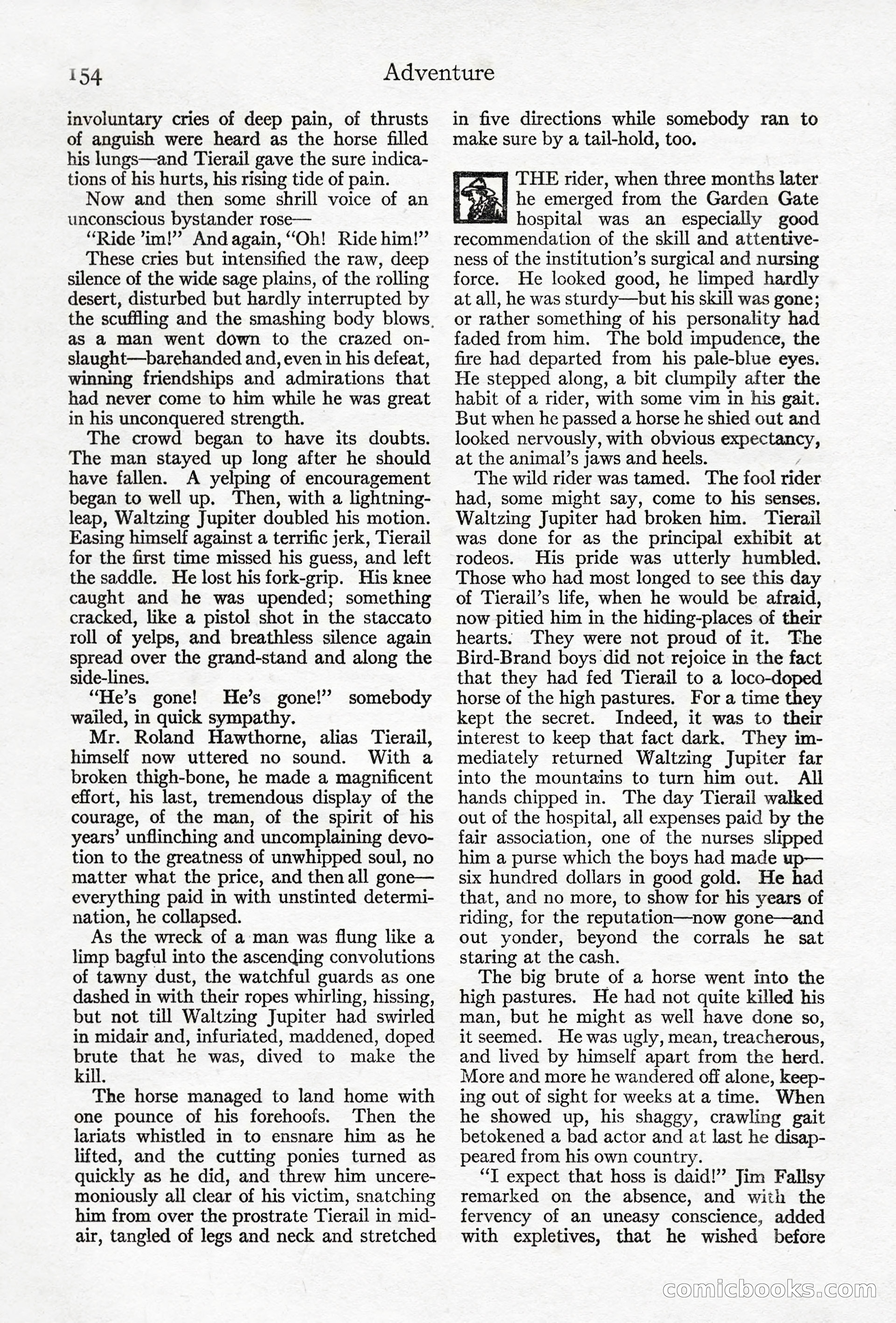
A restored page from Pulp Fiction, 1924. Page through the whole issue in the reader above.
📄 Transcribed text from this page (OCR, searchable)
Machine-transcribed from the original scan — historical spelling and the odd misread are preserved.
154 involuntary cries of deep pain, of thrusts of anguish were heard as the horse filled his lungs—and Tierail gave the sure indica- tions of his hurts, his rising tide of pain. Now and then some shrill voice of an unconscious bystander rose— “Ride ’im!”? And again, “Oh! Ride him!” These cries but intensified the raw, deep silence of the wide sage plains, of the rolling desert, disturbed but hardly interrupted by the scuffling and the smashing body blows. as a man went down to the crazed on- slaught—barehanded and, even in his defeat, winning friendships and admirations that had never come to him while he was great in his unconquered strength. The crowd began to have its doubts. The man stayed up long after he should have fallen. A yelping of encouragement began to well up. Then, with a lightning- leap, Waltzing Jupiter doubled his motion. Easing himself against a terrific jerk, Tierail for the first time missed his guess, and left the saddle. He lost his fork-grip. His knee caught and he was upended; something cracked, like a pistol shot in the staccato roll of yelps, and breathless silence again spread over the grand-stand and along the side-lines. “He’s gone! He’s gone!” somebody wailed, in quick sympathy. Mr. Roland Hawthorne, alias Tierail, himself now uttered no sound. With a broken thigh-bone, he made a magnificent effort, his last, tremendous display of the courage, of the man, of the spirit of his years’ unflinching and uncomplaining devo- tion to the greatness of unwhipped soul, no matter what the price, and then all gone— everything paid in with unstinted determi- nation, he collapsed. As the wreck of a man was flung like a limp bagful into the ascending convolutions of tawny dust, the watchful guards as one dashed in with their ropes whirling, hissing, but not till Waltzing Jupiter had swirled in midair and, infuriated, maddened, doped brute that he was, dived to make the kill. The horse managed to land home with one pounce of his forehoofs. ‘Then the lariats whistled in to ensnare him as he lifted, and the cutting ponies turned as quickly as he did, and threw him uncere- moniously all clear of his victim, snatching him from over the prostrate Tierail in mid- air, tangled of legs and neck and stretched Adventure in five directions while somebody ran to make sure by a tail-hold, too. ray | THE rider, when three months later pre he emerged from the Garden Gate ee hospital was an especially good recommendation of the skill and attentive- ness of the institution’s surgical and nursing force. He looked good, he limped hardly at all, he was sturdy—but his skill was gone; or rather something of his personality had faded from him. The bold impudence, the fire had departed from his pale-blue eyes. He stepped along, a bit clumpily after the habit of a rider, with some vim in his gait. But when he passed a horse he shied out and looked nervously, with obvious expectancy, at the animal’s jaws and heels. The wild rider was tamed. ‘The fool rider had, some might say, come to his senses, Waltzing Jupiter had broken him. Tierail was done for as the principal exhibit at rodeos. His pride was utterly humbled. Those who had most longed to see this day of Tierail’s life, when he would be afraid, now pitied him in the hiding-places of their hearts: They were not proud of it. The Bird-Brand boys did not rejoice in the fact that they had fed Tierail to a loco-doped horse of the high pastures. For a time they kept the secret. Indeed, it was to their interest to keep that fact dark. They im- mediately returned Waltzing Jupiter far into the mountains to turn him out. All hands chipped in. The day Tierail walked out of the hospital, all expenses paid by the fair association, one of the nurses slipped him a purse which the boys had made up— six hundred dollars in good gold. He had that, and no more, to show for his years of riding, for the reputation—now gone—and out yonder, beyond the corrals he sat staring at the cash. The big brute of a horse went into the high pastures. He had not quite killed his man, but he might as well have done so, it seemed. He was ugly, mean, treacherous, and lived by himself apart from the herd. More and more he wandered off alone, keep- ing out of sight for weeks at a time. When he showed up, his shaggy, crawling gait betokened a bad actor and at last he disap- peared from his own country. “IT expect that hoss is daid!” Jim Fallsy remarked on the absence, and with the fervency of an uneasy conscience, added with expletives, that he wished before COMICLOOCkKS.GO 5}