
Pulp Fiction, 1924 · page 183 of 200
Adventure Magazine Cover — page 183: what you’re looking at
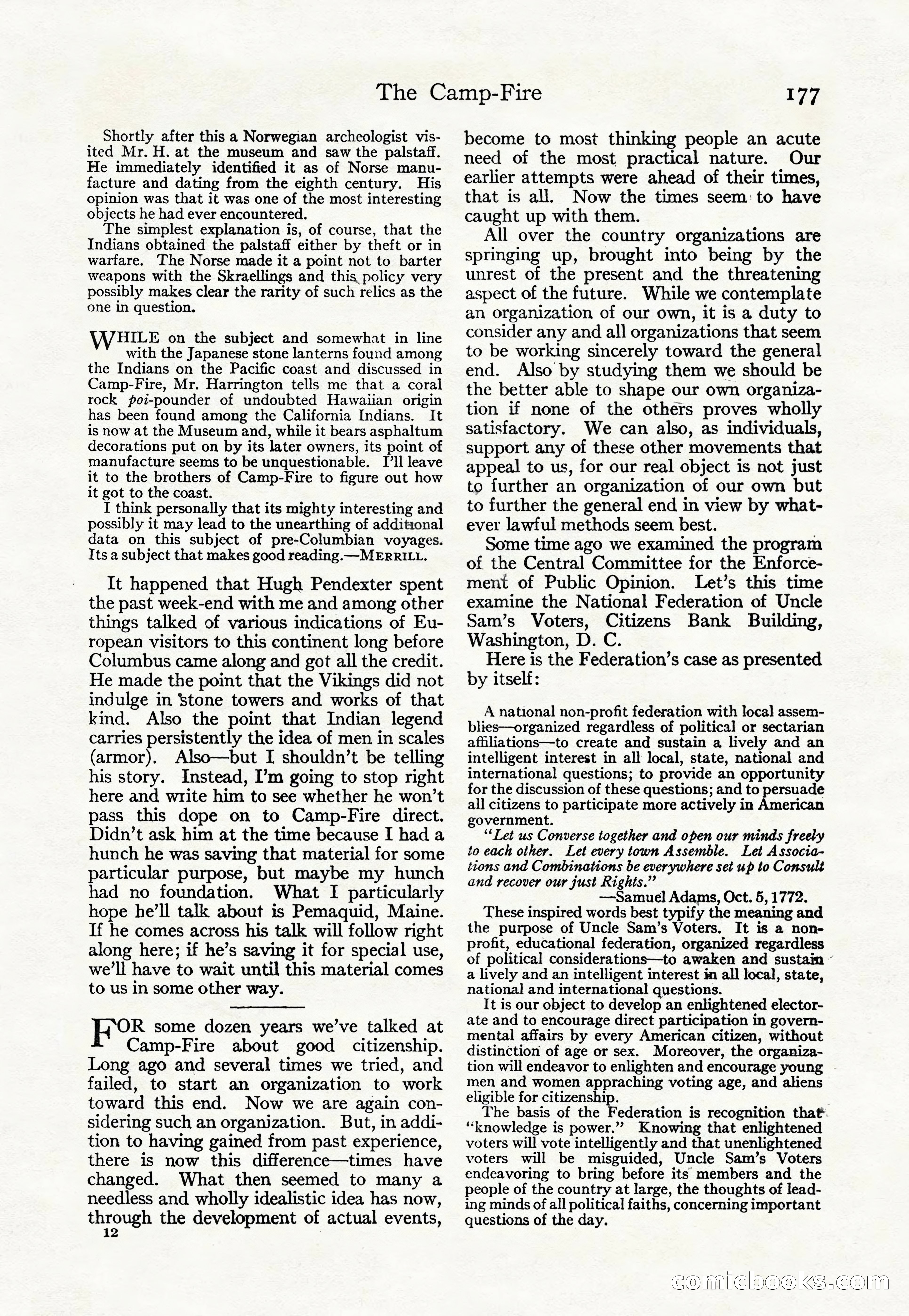
A restored page from Pulp Fiction, 1924. Page through the whole issue in the reader above.
📄 Transcribed text from this page (OCR, searchable)
Machine-transcribed from the original scan — historical spelling and the odd misread are preserved.
The Camp-Fire Shortly after this a Norwegian archeologist vis- ited Mr. H. at the museum and saw the palstaff. He immediately identified it as of Norse manu- facture and dating from the eighth century. His opinion was that it was one of the most interesting objects he had ever encountered. The simplest explanation is, of course, that the Indians obtained the palstaff either by theft or in warfare. The Norse made it a point not to barter weapons with the Skraellings and this policy very possibly makes clear the rarity of such relics as the one in question. WHILE on the subject and somewhat in line with the Japanese stone lanterns found among the Indians on the Pacific coast and discussed in Camp-Fire, Mr. Harrington tells me that a coral rock poi-pounder of undoubted Hawaiian origin has been found among the California Indians. It is now at the Museum and, while it bears asphaltum decorations put on by its later owners, its point of manufacture seems to be unquestionable. I’ll leave it to the brothers of Camp-Fire to figure out how it got to the coast. I think personally that its mighty interesting and possibly it may lead to the unearthing of additional data on this subject of pre-Columbian voyages. Its a subject that makes good reading. —MERRILL. It happened that Hugh Pendexter spent the past week-end with me and among other things talked of various indications of Eu- ropean visitors to this continent long before Columbus came along and got all the credit. He made the point that the Vikings did not indulge in stone towers and works of that kind. Also the point that Indian legend carries persistently the idea of men in scales (armor). Also—but I shouldn’t be telling his story. Instead, I’m going to stop right here and write him to see whether he won’t pass this dope on to Camp-Fire direct. Didn’t ask him at the time because I had a hunch he was saving that material for some particular purpose, but maybe my hunch had no foundation. What I particularly hope he'll talk about is Pemaquid, Maine. If he comes across his talk will follow right along here; if he’s saving it for special use, we'll have to wait until this material comes to us in some other way. Prok some dozen years we’ve talked at Camp-Fire about good citizenship. Long ago and several times we tried, and failed, to start an organization to work toward this end. Now we are again con- sidering such an organization. But, in addi- tion to having gained from past experience, there is now this difference—times have changed. What then seemed to many a needless and wholly idealistic idea has now, through the development of actual events, 177 become to most thinking people an acute need of the most practical nature. Our earlier attempts were ahead of their times, that is all. Now the times seem: to have caught up with them. All over the country organizations are springing up, brought into being by the unrest of the present and the threatening aspect of the future. While we contemplate an organization of our own, it is a duty to consider any and all organizations that seem to be working sincerely toward the general end. Also by studying them we should be the better able to shape our own organiza- tion if none of the others proves wholly satisfactory. We can also, as individuals, support any of these other movements that appeal to us, for our real object is not just to further an organization of our own but to further the general end in view by what- ever lawful methods seem best. Some time ago we examined the program of the Central Committee for the Enforce- ment of Public Opinion. Let’s this time examine the National Federation of Uncle Sam’s Voters, Citizens Bank Building, Washington, D. C. Here is the Federation’s case as presented by itself: A national non-profit federation with local assem- blies—organized regardless of political or sectarian affliations—to create and sustain a lively and an intelligent interest in all local, state, national and international questions; to provide an opportunity for the discussion of these questions; and to persuade all citizens to participate more actively in American government. “Let us Converse together and open our minds freely to each other. Let every town Assemble. Let Associa- tions and Combinations be everywhere set up to Consult and recover our just Rights.” —Samuel Adams, Oct. 5, 1772. These inspired words best typify the meaning and the purpose of Uncle Sam’s Voters. It is a non- profit, educational federation, organized regardless of political considerations—to awaken and sustain - a lively and an intelligent interest in all local, state, national and international questions. It is our object to develop an enlightened elector- ate and to encourage direct participation in govern- mental affairs by every American citizen, without distinction of age or sex. Moreover, the organiza- tion will endeavor to enlighten and encourage young men and women appraching voting age, and aliens eligible for citizenship. The basis of the Federation is recognition that “knowledge is power.”? Knowing that enlightened voters will vote intelligently and that unenlightened voters will be misguided, Uncle Sam’s Voters endeavoring to bring before its members and the people of the country at large, the thoughts of lead- ing minds of all political faiths, concerning important questions of the day. COmiclbook S|