
Pulp Fiction, 1924 · page 182 of 200
Adventure Magazine Cover — page 182: what you’re looking at
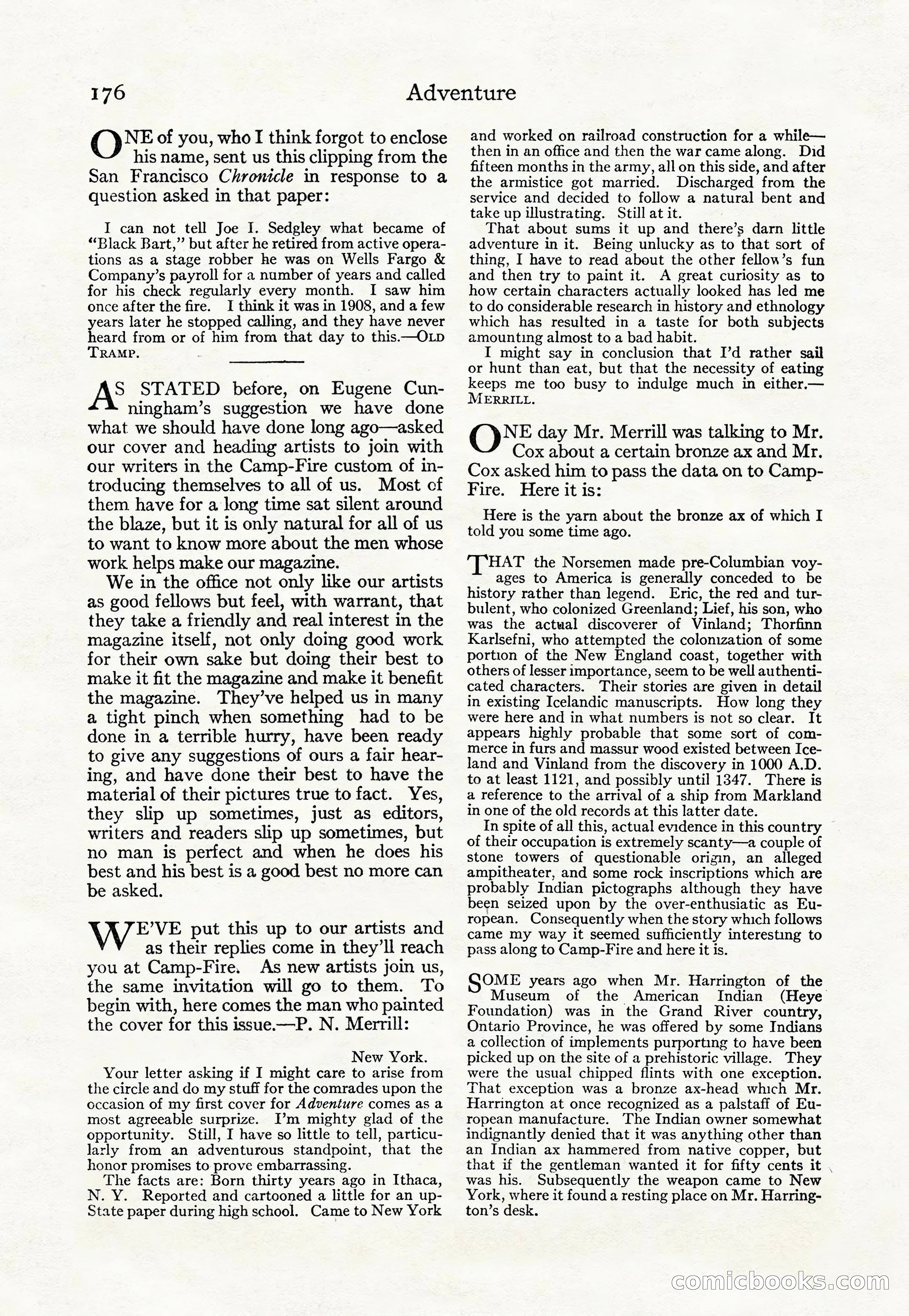
A restored page from Pulp Fiction, 1924. Page through the whole issue in the reader above.
📄 Transcribed text from this page (OCR, searchable)
Machine-transcribed from the original scan — historical spelling and the odd misread are preserved.
176 QE of you, who I think forgot to enclose his name, sent us this clipping from the San Francisco Chronicle in response to a question asked in that paper: I can not tell Joe I. Sedgley what became of “Black Bart,” but after he retired from active opera- tions as a stage robber he was on Wells Fargo & Company’s payroll for a number of years and called for his check regularly every month. I saw him once after the fire. I think it was in 1908, and a few years later he stopped calling, and they have never heard from or of him from that day to this.—OLpD TRAMP. 3 A STATED before, on Eugene Cun- ningham’s suggestion we have done what we should have done long ago—asked our cover and heading artists to join with our writers in the Camp-Fire custom of in- troducing themselves to all of us. Most cf them have for a long time sat silent around the blaze, but it is only natural for all of us to want to know more about the men whose work helps make our magazine. We in the office not only like our artists as good fellows but feel, with warrant, that they take a friendly and real interest in the magazine itself, not only doing good work for their own sake but doing their best to make it fit the magazine and make it benefit the magazine. They’ve helped us in many a tight pinch when something had to be done in a terrible hurry, have been ready to give any suggestions of ours a fair hear- ing, and have done their best to have the material of their pictures true to fact. Yes, they slip up sometimes, just as editors, writers and readers slip up sometimes, but no man is perfect and when he does his best and his best is a good best no more can be asked. E’VE put this up to our artists and as their replies come in they'll reach you at Camp-Fire. As new artists join us, the same invitation will go to them. To begin with, here comes the man who painted the cover for this issue.—P. N. Merrill: New York. Your letter asking if I might care to arise from the circle and do my stuff for the comrades upon the occasion of my first cover for Adventure comes as a most agreeable surprize. I’m mighty glad of the opportunity. Still, I have so little to tell, particu- larly from an adventurous standpoint, that the honor promises to prove embarrassing. The facts are: Born thirty years ago in Ithaca, N. Y. Reported and cartooned a little for an up- State paper during high school. Came to New York Adventure and worked on railroad construction for a while— then in an office and then the war came along. Did fifteen months in the army, all on this side, and after the armistice got married. Discharged from the service and decided to follow a natural bent and take up illustrating. Still at it. That about sums it up and there’s darn little adventure in it. Being unlucky as to that sort of thing, I have to read about the other fellow’s fun and then try to paint it. A great curiosity as to how certain characters actually looked has led me to do considerable research in history and ethnology which has resulted in a taste for both subjects amounting almost to a bad habit. I might say in conclusion that I’d rather sail or hunt than eat, but that the necessity of eating keeps me too busy to indulge much in either.— MERRILL. Q)N E day Mr. Merrill was talking to Mr. Cox about a certain bronze ax and Mr. Cox asked him to pass the data on to Camp- Fire. Here it is: Here is the yarn about the bronze ax of which I told you some time ago. HAT the Norsemen made pre-Columbian voy- ages to America is generally conceded to be history rather than legend. Eric, the red and tur- bulent, who colonized Greenland; Lief, his son, who was the actual discoverer of Vinland; Thorfinn Karlsefni, who attempted the colonization of some portion of the New England coast, together with others of lesser importance, seem to be well authenti- cated characters. Their stories are given in detail in existing Icelandic manuscripts. How long they were here and in what numbers is not so clear. It appears highly probable that some sort of com- merce in furs and massur wood existed between Ice- land and Vinland from the discovery in 1000 A.D. to at least 1121, and possibly until 1347. There is a reference to the arrival of a ship from Markland in one of the old records at this latter date. In spite of all this, actual evidence in this country of their occupation is extremely scanty—a couple of stone towers of questionable origin, an alleged ampitheater, and some rock inscriptions which are probably Indian pictographs although they have been seized upon by the over-enthusiatic as Eu- ropean. Consequently when the story which follows came my way it seemed sufficiently interesting to pass along to Camp-Fire and here it is. OME years ago when Mr. Harrington of the Museum of the American Indian (Heye Foundation) was in the Grand River country, Ontario Province, he was offered by some Indians a collection of implements purporting to have been picked up on the site of a prehistoric village. They were the usual chipped flints with one exception. That exception was a bronze ax-head which Mr. Harrington at once recognized as a palstaff of Eu- ropean manufacture. The Indian owner somewhat indignantly denied that it was anything other than an Indian ax hammered from native copper, but that if the gentleman wanted it for fifty cents it was his. Subsequently the weapon came to New York, where it found a resting place on Mr. Harring- ton’s desk. COmiclboook S|