
Pulp Fiction, 1924 · page 166 of 200
Adventure Magazine Cover — page 166: what you’re looking at
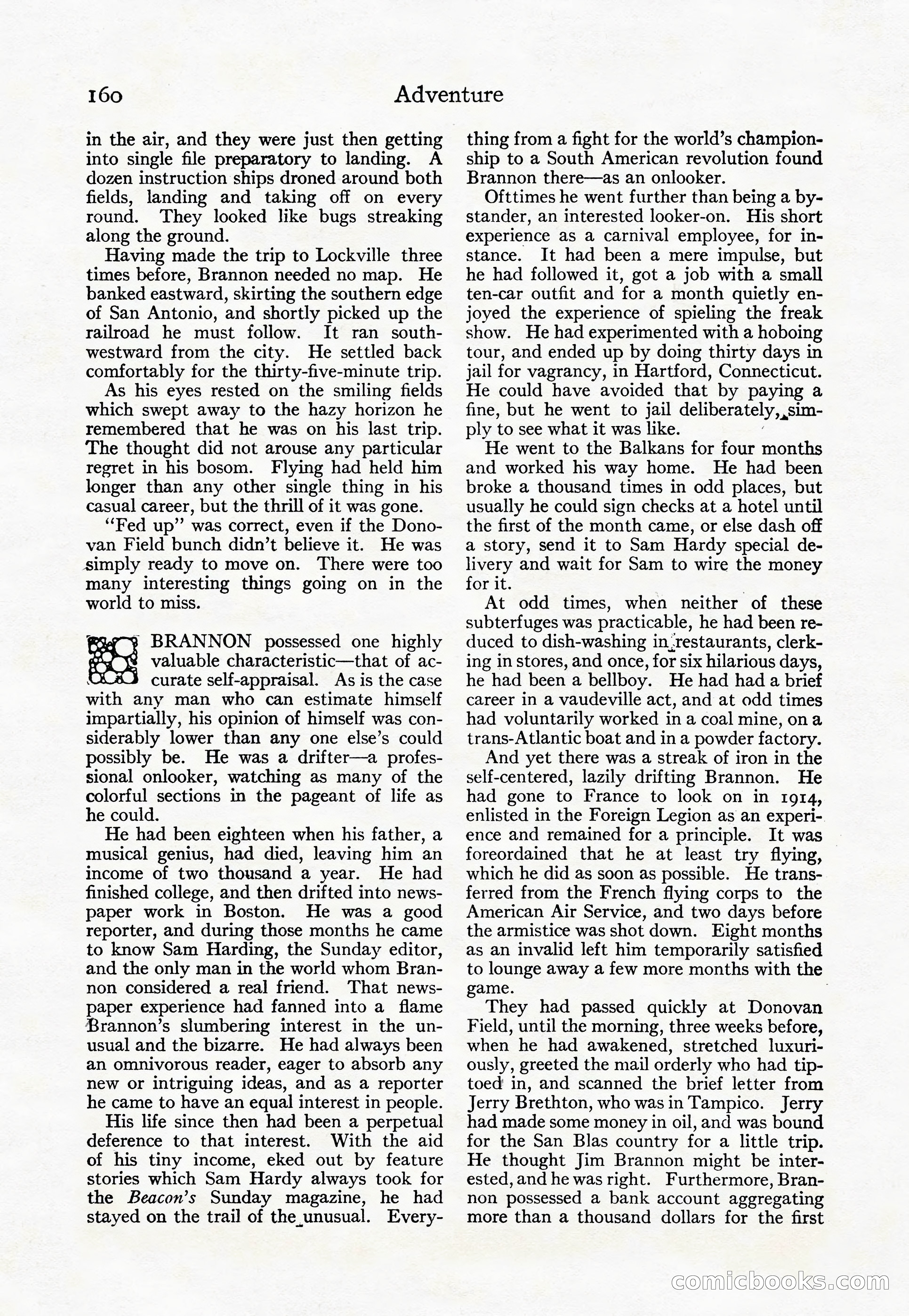
A restored page from Pulp Fiction, 1924. Page through the whole issue in the reader above.
📄 Transcribed text from this page (OCR, searchable)
Machine-transcribed from the original scan — historical spelling and the odd misread are preserved.
160 in the air, and they were just then getting into single file preparatory to landing. A dozen instruction ships droned around both fields, landing and taking off on every round. They looked like bugs streaking along the ground. Having made the trip to Lockville three times before, Brannon needed no map. He banked eastward, skirting the southern edge of San Antonio, and shortly picked up the railroad he must follow. It ran south- westward from the city. He settled back comfortably for the thirty-five-minute trip. As his eyes rested on the smiling fields which swept away to the hazy horizon he remembered that he was on his last trip. The thought did not arouse any particular regret in his bosom. Flying had held him longer than any other single thing in his casual career, but the thrill of it was gone. “Fed up” was correct, even if the Dono- van Field bunch didn’t believe it. He was simply ready to move on. There were too many interesting things going on in the world to miss. fe: valuable characteristic—that of ac- curate self-appraisal. As is the case with any man who can estimate himself impartially, his opinion of himself was con- siderably lower than any one else’s could possibly be. He was a drifter—a profes- sional onlooker, watching as many of the colorful sections in the pageant of life as he could. He had been eighteen when his father, a musical genius, had died, leaving him an income of two thousand a year. He had finished college, and then drifted into news- paper work in Boston. He was a good reporter, and during those months he came to know Sam Harding, the Sunday editor, and the only man in the world whom Bran- non considered a real friend. That news- paper experience had fanned into a flame Brannon’s slumbering interest in the un- usual and the bizarre. He had always been an omnivorous reader, eager to absorb any new or intriguing ideas, and as a reporter he came to have an equal interest in people. His life since then had been a perpetual deference to that interest. With the aid of his tiny income, eked out by feature stories which Sam Hardy always took for the Beacon’s Sunday magazine, he had stayed on the trail of the unusual. Every- BRANNON possessed one highly Adventure thing from a fight for the world’s champion- ship to a South American revolution found Brannon there—as an onlooker. Ofttimes he went further than being a by- stander, an interested looker-on. His short experience as a carnival employee, for in- stance. It had been a mere impulse, but he had followed it, got a job with a small ten-car outfit and for a month quietly en- joyed the experience of spieling the freak show. He had experimented with a hoboing tour, and ended up by doing thirty days in jail for vagrancy, in Hartford, Connecticut. He could have avoided that by paying a fine, but he went to jail deliberately, sim- ply to see what it was like. He went to the Balkans for four months and worked his way home. He had been broke a thousand times in odd places, but usually he could sign checks at a hotel until the first of the month came, or else dash off a story, send it to Sam Hardy special de- livery and wait for Sam to wire the money for it. At odd times, when neither of these subterfuges was practicable, he had been re- duced to dish-washing in,restaurants, clerk- ing in stores, and once, for six hilarious days, he had been a bellboy. He had had a brief career in a vaudeville act, and at odd times had voluntarily worked in a coal mine, ona trans-Atlantic boat and in a powder factory. And yet there was a streak of iron in the self-centered, lazily drifting Brannon. He had gone to France to look on in 1914, enlisted in the Foreign Legion as an experi- ence and remained for a principle. It was foreordained that he at least try flying, which he did as soon as possible. He trans- ferred from the French flying corps to the American Air Service, and two days before the armistice was shot down. Eight months as an invalid left him temporarily satisfied to lounge away a few more months with the game. They had passed quickly at Donovan Field, until the morning, three weeks before, when he had awakened, stretched luxuri- ously, greeted the mail orderly who had tip- toed in, and scanned the brief letter from Jerry Brethton, who was in Tampico. Jerry had made some money in oil, and was bound for the San Blas country for a little trip. He thought Jim Brannon might be inter- ested, and he was right. Furthermore, Bran- non possessed a bank account aggregating more than a thousand dollars for the first COmiclboolks (©