
Pulp Fiction, 1924 · page 165 of 200
Adventure Magazine Cover — page 165: what you’re looking at
A restored page from Pulp Fiction, 1924. Page through the whole issue in the reader above.
📄 Transcribed text from this page (OCR, searchable)
Machine-transcribed from the original scan — historical spelling and the odd misread are preserved.
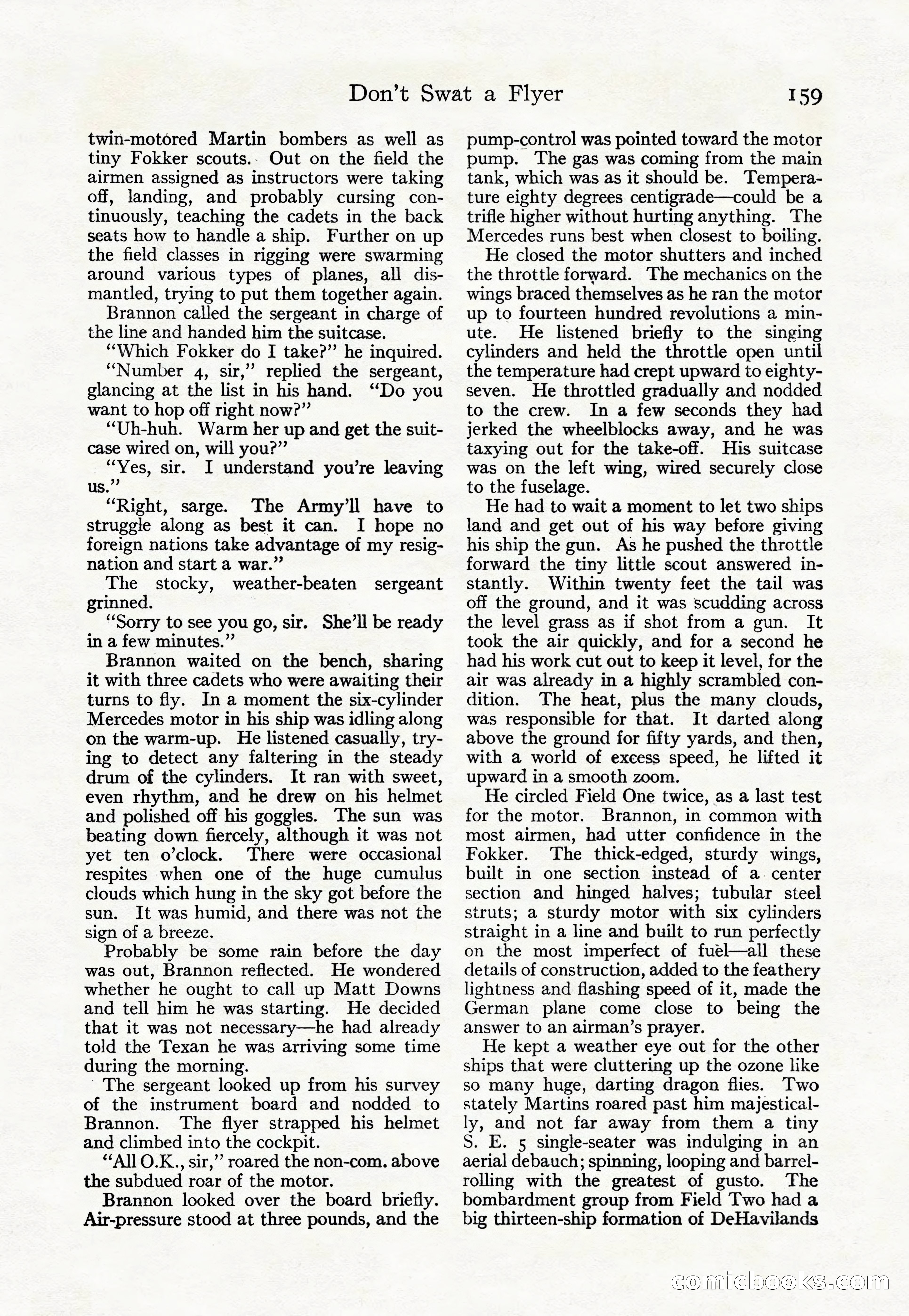
Don’t Swat a Flyer twin-motored Martin bombers as well as tiny Fokker scouts.. Out on the field the airmen assigned as instructors were taking off, landing, and probably cursing con- tinuously, teaching the cadets in the back seats how to handle a ship. Further on up the field classes in rigging were swarming around various types of planes, all dis- mantled, trying to put them together again. Brannon called the sergeant in charge of the line and handed him the suitcase. “Which Fokker do I take?” he inquired. ‘“‘Number 4, sir,” replied the sergeant, glancing at the list in his hand. “Do you want to hop off right now?” “Uh-huh. Warm her up and get the suit- case wired on, will you?” “Yes, sir. I understand you’re leaving “Right, sarge. The Army’ll have to struggle along as best it can. I hope no foreign nations take advantage of my resig- nation and start a war.” The stocky, weather-beaten sergeant grinned. | ‘Sorry to see you go, sir. She'll be ready in a few minutes.” Brannon waited on the bench, sharing it with three cadets who were awaiting their turns to fly. In a moment the six-cylinder Mercedes motor in his ship was idling along on the warm-up. He listened casually, try- ing to detect any faltering in the steady drum of the cylinders. It ran with sweet, even rhythm, and he drew on his helmet and polished off his goggles. The sun was beating down fiercely, although it was not yet ten o’clock. There were occasional respites when one of the huge cumulus clouds which hung in the sky got before the sun. It was humid, and there was not the sign of a breeze. Probably be some rain before the day was out, Brannon reflected. He wondered whether he ought to call up Matt Downs and tell him he was starting. He decided that it was not necessary—he had already told the Texan he was arriving some time during the morning. ' The sergeant looked up from his survey of the instrument board and nodded to Brannon. The flyer strapped his helmet and climbed into the cockpit. ‘All O.K., sir,”’ roared the non-com. above the subdued roar of the motor. Brannon looked over the board briefly. Air-pressure stood at three pounds, and the 159 pump-control was pointed toward the motor pump. The gas was coming from the main tank, which was as it should be. Tempera- ture eighty degrees centigrade—could be a trifle higher without hurting anything. The Mercedes runs best when closest to boiling. He closed the motor shutters and inched the throttle forward. The mechanics on the wings braced themselves as he ran the motor up to fourteen hundred revolutions a min- ute. He listened briefly to the singing cylinders and held the throttle open until the temperature had crept upward to eighty- seven. He throttled gradually and nodded to the crew. In a few seconds they had jerked the wheelblocks away, and he was taxying out for the take-off. His suitcase was on the left wing, wired securely close to the fuselage. He had to wait a moment to let two ships land and get out of his way before giving his ship the gun. As he pushed the throttle forward the tiny little scout answered in- stantly. Within twenty feet the tail was off the ground, and it was scudding across the level grass as if shot from a gun. It took the air quickly, and for a second he had his work cut out to keep it level, for the air was already in a highly scrambled con- dition. The heat, plus the many clouds, was responsible for that. It darted along above the ground for fifty yards, and then, with a world of excess speed, he lifted it upward in a smooth zoom. He circled Field One twice, as a last test for the motor. Brannon, in common with most airmen, had utter confidence in the Fokker. The thick-edged, sturdy wings, built in one section instead of a. center section and hinged halves; tubular steel struts; a sturdy motor with six cylinders straight in a line and built to run perfectly on the most imperfect of fuel—all these details of construction, added to the feathery lightness and flashing speed of it, made the German plane come close to being the answer to an airman’s prayer. He kept a weather eye out for the other ships that were cluttering up the ozone like so many huge, darting dragon flies. Two stately Martins roared past him majestical- ly, and not far away from them a tiny S. E. 5 single-seater was indulging in an aerial debauch; spinning, looping and barrel- rolling with the greatest of gusto. The bombardment group from Field Two had a big thirteen-ship formation of DeHavilands cCOmiclboolks CO