
Pulp Fiction, 1922 · page 93 of 204
Adventure Magazine Cover — page 93: what you’re looking at
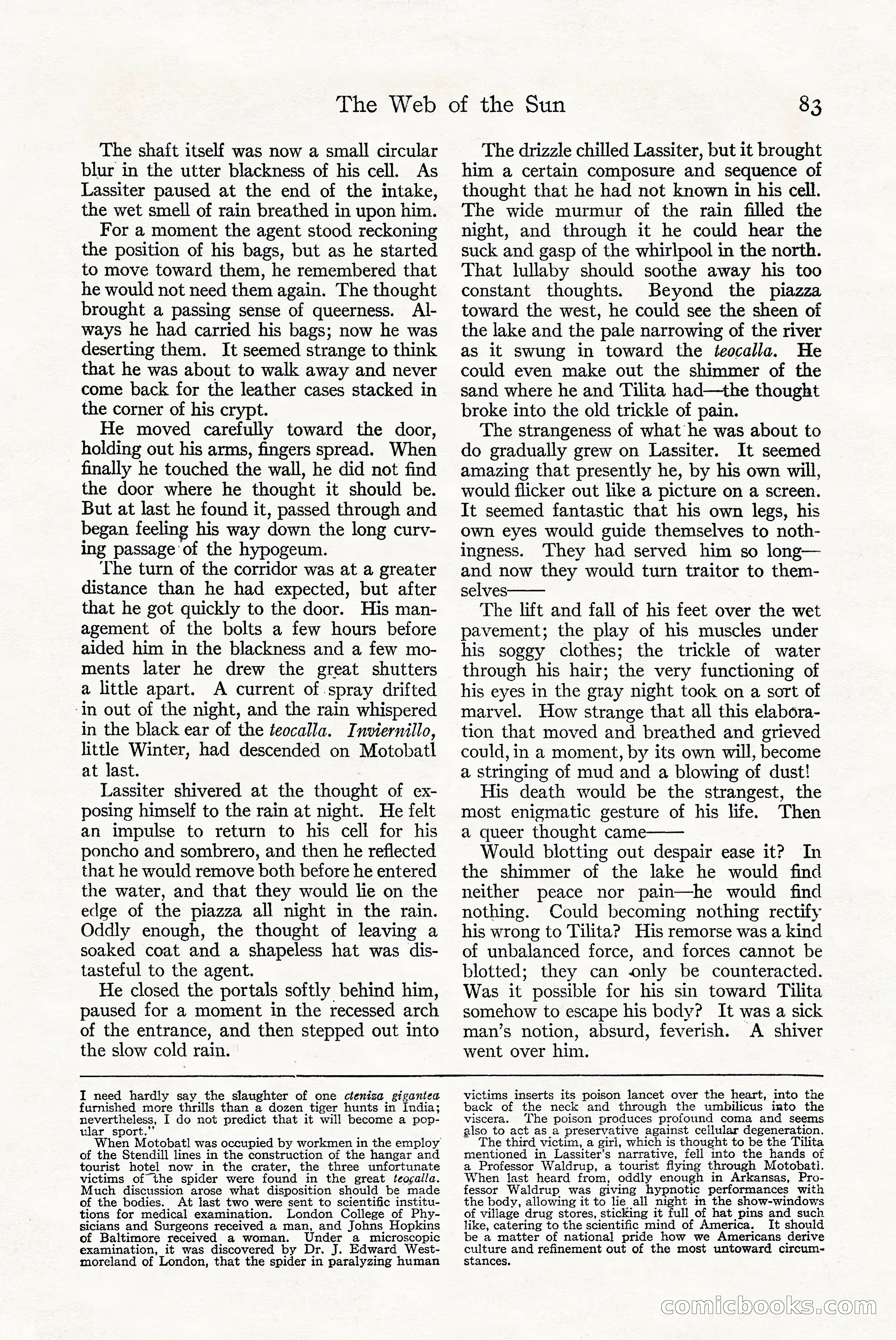
A restored page from Pulp Fiction, 1922. Page through the whole issue in the reader above.
📄 Transcribed text from this page (OCR, searchable)
Machine-transcribed from the original scan — historical spelling and the odd misread are preserved.
The Web of the Sun 83 The shaft itself was now a small circular blur in the utter blackness of his cell. As Lassiter paused at the end of the intake, the wet smell of rain breathed in upon him. For a moment the agent stood reckoning the position of his bags, but as he started to move toward them, he remembered that he would not need them again. The thought brought a passing sense of queerness. Al- ways he had carried his bags; now he was deserting them. It seemed strange to think that he was about to walk away and never come back for the leather cases stacked in the corner of his crypt. He moved carefully toward the door, holding out his arms, fingers spread. When finally he touched the wall, he did not find the door where he thought it should be. But at last he found it, passed through and began feeling his way down the long curvy- ing passage of the hypogeum. The turn of the corridor was at a greater distance than he had expected, but after that he got quickly to the door. His man- agement of the bolts a few hours before aided him in the blackness and a few mo- ments later he drew the great shutters a little apart. A current of spray drifted ‘In out of the night, and the rain whispered in the black ear of the feocalla. Inviernillo, little Winter, had descended on Motobatl at last. Lassiter shivered at the thought of ex- posing himself to the rain at night. He felt an impulse to return to his cell for his poncho and sombrero, and then he reflected that he would remove both before he entered the water, and that they would lie on the edge of the piazza all night in the rain. Oddly enough, the thought of leaving a soaked coat and a shapeless hat was dis- tasteful to the agent. He closed the portals softly behind him, paused for a moment in the recessed arch of the entrance, and then stepped out into the slow cold rain. I need hardly say the slaughter of one ctenisa gigantea furnished more thrills than a dozen tiger hunts in India; nevertheless, I do not predict that it will become a pop- ular sport.” When Motobatl was occupied by workmen in the employ of the Stendill lines in the construction of the hangar and tourist hotel now in the crater, the three unfortunate victims of the spider were found in the great teog¢alla. Much discussion arose what disposition should be made of the bodies. At last two were sent to scientific institu- tions for medical examination. London College of Phy- sicians and Surgeons received a man, and Johns Hopkins of Baltimore received a woman. Under a microscopic examination, it was discovered by Dr. J. Edward West- moreland of London, that the spider in paralyzing human The drizzle chilled Lassiter, but it brought him a certain composure and sequence of thought that he had not known in his cell. The wide murmur of the rain filled the night, and through it he could hear the suck and gasp of the whirlpool in the north. That lullaby should soothe away his too constant thoughts. Beyond the piazza toward the west, he could see the sheen of the lake and the pale narrowing of the river as it swung in toward the teocalla. He could even make out the shimmer of the sand where he and Tilita had—the thought broke into the old trickle of pain. The strangeness of what he was about to do gradually grew on Lassiter. It seemed amazing that presently he, by his own will, would flicker out like a picture on a screen. It seemed fantastic that his own legs, his own eyes would guide themselves to noth- ingness. They had served him so long— and now they would turn traitor to them- selves The lift and fall of his feet over the wet pavement; the play of his muscles under his soggy clothes; the trickle of water through his hair; the very functioning of his eyes in the gray night took on a sort of marvel. How strange that all this elabora- tion that moved and breathed and grieved could, in a moment, by its own will, become a stringing of mud and a blowing of dust! His death would be the strangest, the most enigmatic gesture of his life. Then a queer thought came Would blotting out despair ease it? In the shimmer of the lake he would find neither peace nor pain—he would find nothing. Could becoming nothing rectify his wrong to Tilita? His remorse was a kind of unbalanced force, and forces cannot be blotted; they can only be counteracted. Was it possible for his sin toward Tilita somehow to escape his body? It was a sick man’s notion, absurd, feverish. A shiver went over him. victims inserts its poison lancet over the heart, into the back of the neck and through the umbilicus into the viscera. ‘The poison produces profound coma and seems also to act as a preservative against cellular degeneration. The third victim, a girl, which is thought to be the Tilita mentioned in Lassiter’s narrative, fell into the hands of a Professor Waldrup, a tourist flying through Motobati. When last heard from, oddly enough in Arkansas, Pro- fessor Waldrup was giving hypnotic performances with the body, allowing it to lie all night in the show-windows of village drug stores, sticking it full of hat pins and such like, catering to the scientific mind of America. It should be a matter of national pride how we Americans derive culture and refinement out of the most untoward circum- stances. COnmiclboooks.c©