
Pulp Fiction, 1922 · page 92 of 204
Adventure Magazine Cover — page 92: what you’re looking at
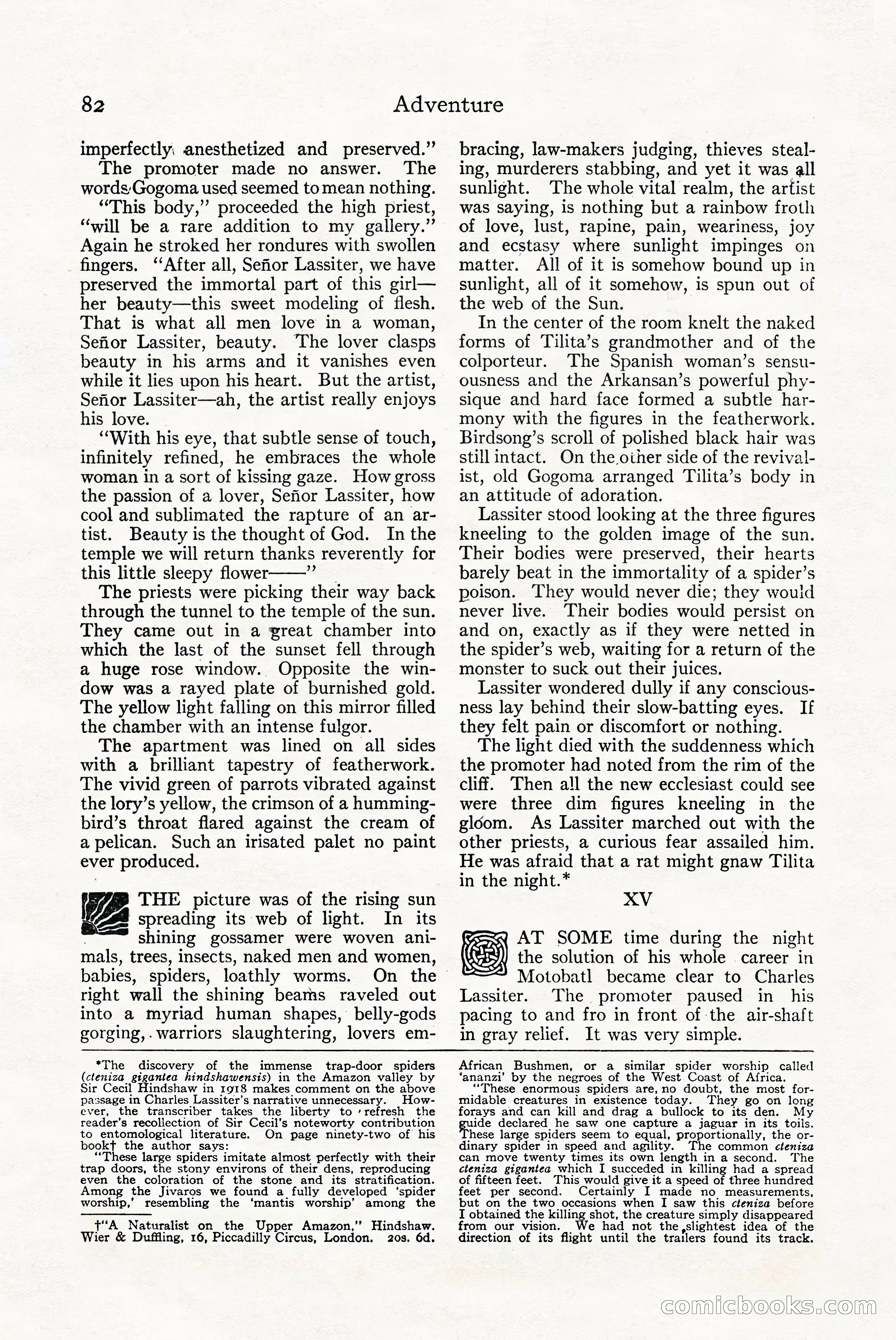
A restored page from Pulp Fiction, 1922. Page through the whole issue in the reader above.
📄 Transcribed text from this page (OCR, searchable)
Machine-transcribed from the original scan — historical spelling and the odd misread are preserved.
82 imperfectly: anesthetized and preserved.” The promoter made no answer. The words Gogoma used seemed to mean nothing. “This body,” proceeded the high priest, “will be a rare addition to my gallery.” Again he stroked her rondures with swollen fingers. ‘‘After all, Sefior Lassiter, we have preserved the immortal part of this girl— her beauty—this sweet modeling of flesh. That is what all men love in a woman, Sefior Lassiter, beauty. ‘The lover clasps beauty in his arms and it vanishes even while it lies upon his heart. But the artist, Sefior Lassiter—ah, the artist really enjoys his love. | ‘With his eye, that subtle sense of touch, infinitely refined, he embraces the whole woman in a sort of kissing gaze. How gross the passion of a lover, Sefor Lassiter, how cool and sublimated the rapture of an ar- tist. Beauty is the thought of God. In the temple we will return thanks reverently for this little sleepy flower The priests were picking their way back through the tunnel to the temple of the sun. They came out in a great chamber into which the last of the sunset fell through a huge rose window. Opposite the win- dow was a rayed plate of burnished gold. The yellow light falling on this mirror filled the chamber with an intense fulgor. The apartment was lined on all sides with a brilliant tapestry of featherwork. The vivid green of parrots vibrated against the lory’s yellow, the crimson of a humming- bird’s throat flared against the cream of a pelican. Such an irisated palet no paint ever produced. ZB spreading its web of light. In its shining gossamer were woven ani- mals, trees, insects, naked men and women, babies, spiders, loathly worms. right wall the shining beams raveled out into a myriad human shapes, belly-gods gorging,. warriors slaughtering, lovers em- THE picture was of the rising sun *The discovery of the immense trap-door spiders (cteniza gigantea hindshawensis) in the Amazon valley by Sir Cecil Hindshaw in 1918 makes comment on the above passage in Charles Lassiter’s narrative unnecessary. How- ever, the transcriber takes the liberty to refresh the reader's recollection of Sir Cecil’s noteworty contribution to entomological literature. On page ninety-two of his bookt the author says: “These large spiders imitate almost perfectly with their trap doors, the stony environs of their dens, reproducing even the coloration of the stone and its stratification. Among the Jivaros we found a fully developed ‘spider worship,’ resembling the ‘mantis worship’ among the tA Naturalist on the Upper Amazon,’’ Hindshaw. Wier & Duffling, 16, Piccadilly Gipeus, London, 20s. 6d. On the Adventure bracing, law-makers judging, thieves steal- ing, murderers stabbing, and yet it was all sunlight. The whole vital realm, the artist was saying, is nothing but a rainbow froth of love, lust, rapine, pain, weariness, joy and ecstasy where sunlight impinges on matter. All of it is somehow bound up in sunlight, all of it somehow, is spun out of the web of the Sun. In the center of the room knelt the naked forms of Tilita’s grandmother and of the colporteur. The Spanish woman’s sensu- ousness and the Arkansan’s powerful phy- sique and hard face formed a subtle har- mony with the figures in the featherwork. Birdsong’s scroll of polished black hair was still intact. On the other side of the revival- ist, old Gogoma arranged Tilita’s body in an attitude of adoration. Lassiter stood looking at the three figures kneeling to the golden image of the sun. Their bodies were preserved, their hearts barely beat in the immortality of a spider’s poison. They would never die; they would never live. Their bodies would persist on and on, exactly as if they were netted in the spider’s web, waiting for a return of the monster to suck out their juices. Lassiter wondered dully if any conscious- ness lay behind their slow-batting eyes. If they felt pain or discomfort or nothing. The light died with the suddenness which the promoter had noted from the rim of the cliff. Then all the new ecclesiast could see were three dim figures kneeling in the gloom. As Lassiter marched out with the other priests, a curious fear assailed him. He was afraid that a rat might gnaw Tilita in the night.* yy the solution of his whole . career in 4 Motobatl became clear to Charles Lassiter. The promoter paused in his pacing to and fro in front of the air-shaft in gray relief. It was very simple. XV <—¥ AT SOME time during the night ——— African Bushmen, or a similar spider worship called ‘ananzi’ by the negroes of the West Coast of Africa. “These enormous spiders are, no doubt, the most for- midable creatures in existence today. They go on long forays and can kill and drag a bullock to its den. My made declared he saw one capture a jaguar in its toils. hese large spiders seem to equal, proportionally, the or- dinary spider in speed and agility. The common ¢teniza can move twenty times its own length in a second. The cteniza gigantea which I succeded in killing had a spread of fifteen feet. This would give it a speed of three hundred feet per second. Certainly I made no measurements, but on the two occasions when I saw this cteniza before I obtained the killing shot, the creature simply disappeared from our vision. We had not the pslightest idea of the direction of its flight until the trailers found its track. DOO (C@