
Pulp Fiction, 1922 · page 46 of 204
Adventure Magazine Cover — page 46: what you’re looking at
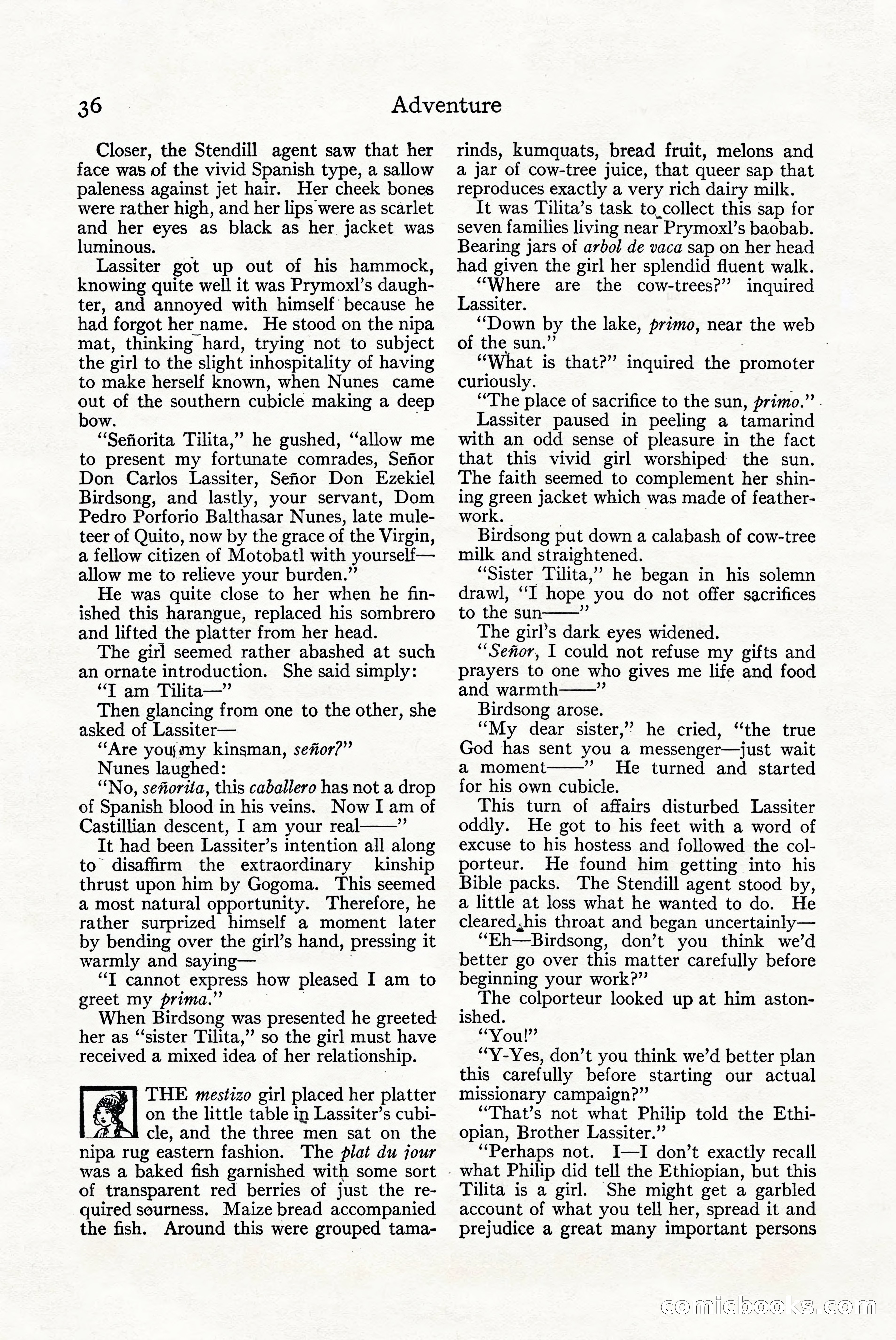
A restored page from Pulp Fiction, 1922. Page through the whole issue in the reader above.
📄 Transcribed text from this page (OCR, searchable)
Machine-transcribed from the original scan — historical spelling and the odd misread are preserved.
36 Closer, the Stendill agent saw that her face was of the vivid Spanish type, a sallow paleness against jet hair. Her cheek bones were rather high, and her lips were as scarlet and her eyes as black as her. jacket was luminous. Lassiter got up out of his hammock, knowing quite well it was Prymoxl’s daugh- ter, and annoyed with himself because he had forgot her name. He stood on the nipa mat, thinking hard, trying not to subject the girl to the slight inhospitality of having to make herself known, when Nunes came out of the southern cubicle making a deep bow. “Sefiorita Tilita,” he gushed, “allow me to present my fortunate comrades, Sefior Don Carlos Lassiter, Sefior Don Ezekiel Birdsong, and lastly, your servant, Dom Pedro Porforio Balthasar Nunes, late mule- teer of Quito, now by the grace of the Virgin, a fellow citizen of Motobatl with yourself— allow me to relieve your burden.” He was quite close to her when he fin- ished this harangue, replaced his sombrero and lifted the platter from her head. The girl seemed rather abashed at such an ornate introduction. She said simply: “T am Tilita—” Then glancing from one to the other, she asked of Lassiter— “Are yousmny kinsman, sefor?” Nunes laughed: “No, seviorita, this caballero has not a drop of Spanish blood in his veins. Now I am of Castillian descent, I am your real It had been Lassiter’s intention all along to disaffrm the extraordinary kinship thrust upon him by Gogoma. This seemed a most natural opportunity. Therefore, he rather surprized himself a moment later by bending over the girl’s hand, pressing it warmly and saying— “T cannot express how pleased I am to greet my prima.”’ When Birdsong was presented he greeted her as “sister Tilita,” so the girl must have received a mixed idea of her relationship. THE mestizo girl placed her platter ! 4 on the little table in Lassiter’s cubi- OSA cle, and the three men sat on the nipa rug eastern fashion. The plat du jour was a baked fish garnished with some sort of transparent red berries of just the re- quired sourness. Maize bread accompanied the fish. Around this were grouped tama- Adventure rinds, kumquats, bread fruit, melons and a jar of cow-tree juice, that queer sap that reproduces exactly a very rich dairy milk. It was Tilita’s task to_collect this sap for seven families living near Prymoxl’s baobab. Bearing jars of arbol de vaca sap on her head had given the girl her splendid fluent walk. ‘“‘Where are the cow-trees?”’ inquired Lassiter. “Down by the lake, primo, near the web of the sun.’ “What is that?” inquired the Hee minter curiously. “The place of sacrifice to the sun, primo.” Lassiter paused in peeling a tamarind with an odd sense of pleasure in the fact that this vivid girl worshiped the sun. The faith seemed to complement her shin- ing green jacket which was made of feather- work. | Birdsong put down a calabash of cow-tree milk and straightened. “Sister Tilita,”’ he began in his solemn drawl, “I hope you do not offer sacrifices to the sun——’”’ The girl’s dark eyes widened. “Senor, I could not refuse my gifts and prayers to one who gives me life and food and warmth——” Birdsong arose. ‘My dear sister,’? he cried, “the true God has sent you a messenger—just wait a moment ” He turned and started for his own cubicle. This turn of affairs disturbed Lassiter oddly. He got to his feet with a word of excuse to his hostess and followed the col- porteur. He found him getting into his Bible packs. The Stendill agent stood by, a little at loss what he wanted to do. He cleared;his throat and began uncertainly— ‘““Eh—Birdsong, don’t you think we’d better go over this matter carefully before beginning your work?” The colporteur looked up at him aston- ished. “Vou!” “Y-Yes, don’t you think we’d better plan this caref ully before starting our actual missionary campaign?” ‘“That’s not what Philip told the Ethi- opian, Brother Lassiter.” ‘Perhaps not. I—I don’t exactly recall - what Philip did tell the Ethiopian, but this Tilita is a girl. She might get a garbled account of what you tell her, spread it and prejudice a great many important persons NOOK C@