
Pulp Fiction, 1922 · page 45 of 204
Adventure Magazine Cover — page 45: what you’re looking at
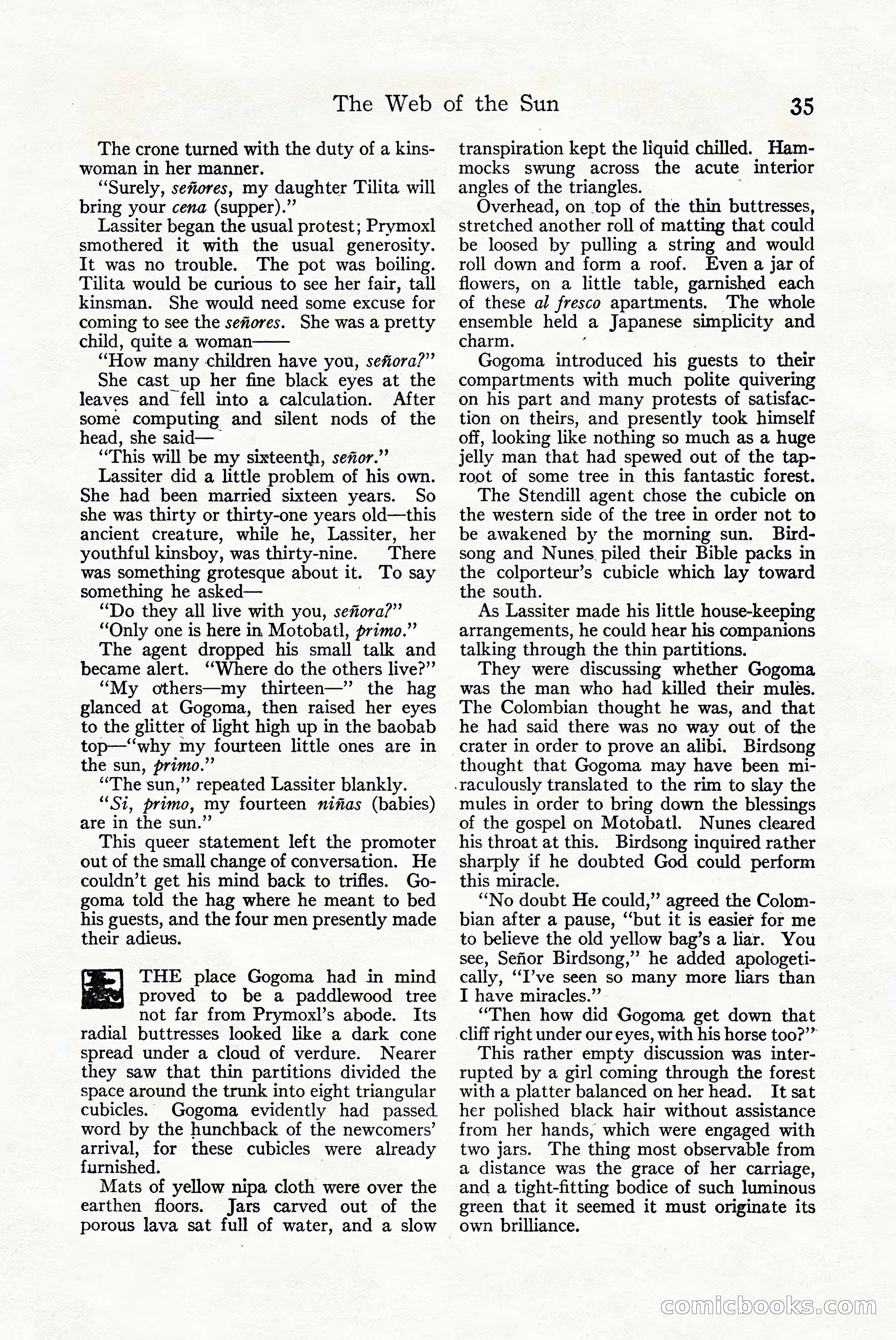
A restored page from Pulp Fiction, 1922. Page through the whole issue in the reader above.
📄 Transcribed text from this page (OCR, searchable)
Machine-transcribed from the original scan — historical spelling and the odd misread are preserved.
The Web of the Sun The crone turned with the duty of a kins- woman in her manner. “Surely, sefiores, my daughter Tilita will bring your cena (supper).”’ Lassiter began the usual protest; Prymoxl smothered it with the usual generosity. It was no trouble. The pot was boiling. Tilita would be curious to see her fair, tall kinsman. She would need some excuse for coming to see the sefiores. She was a pretty child, quite a woman “How many children have you, sefora?”’ She cast_up her fine black eyes at the leaves and fell into a calculation. After some computing and silent nods of the head, she said— ‘“‘This will be my sixteenth, sefor.”’ Lassiter did a little problem of his own. She had been married sixteen years. So she was thirty or thirty-one years old—this ancient creature, while he, Lassiter, her youthful kinsboy, was thirty-nine. There was something grotesque about it. To say something he asked— : “Do they all live with you, sefora?”’ “Only one is here in Motobatl, primo.” The agent dropped his small talk and became alert. ‘Where do the others live?”’ “My others—my thirteen—’ the hag glanced at Gogoma, then raised her eyes to the glitter of light high up in the baobab top—‘‘why my fourteen little ones are in the sun, primo.” “The sun,” repeated Lassiter blankly. “Si, primo, my fourteen nifas (babies) are in the sun.” This queer statement left the promoter out of the small change of conversation. He couldn’t get his mind back to trifles. Go- goma told the hag where he meant to bed his guests, and the four men presently made their adieus. [|] THE place Gogoma had in mind wee proved to be a paddlewood tree not far from Prymoxl’s abode. Its radial buttresses looked like a dark cone spread under a cloud of verdure. Nearer they saw that thin partitions divided the space around the trunk into eight triangular cubicles. Gogoma evidently had passed. word by the hunchback of the newcomers’ arrival, for these cubicles were already furnished. | Mats of yellow nipa cloth were over the earthen floors. Jars carved out of the porous lava sat full of water, and a slow 35 transpiration kept the liquid chilled. Ham- mocks swung across the acute interior angles of the triangles. 2 Overhead, on top of the thin buttresses, stretched another roll of matting that could be loosed by pulling a string and would roll down and form a roof. Even a jar of flowers, on a little table, garnished each of these al fresco apartments. The whole ensemble held a Japanese simplicity and charm. ; 7 Gogoma introduced his guests to their compartments with much polite quivering on his part and many protests of satisfac- tion on theirs, and presently took himself off, looking like nothing so much as a huge jelly man that had spewed out of the tap- root of some tree in this fantastic forest. The Stendill agent chose the cubicle on the western side of the tree in order not to be awakened by the morning sun. Bird- song and Nunes piled their Bible packs in the colporteur’s cubicle which lay toward the south. As Lassiter made his little house-keeping arrangements, he could hear his companions talking through the thin partitions. They were discussing whether Gogoma was the man who had killed their mules. The Colombian thought he was, and that he had said there was no way out of the crater in order to prove an alibi. Birdsong thought that Gogoma may have been mi- -raculously translated to the rim to slay the mules in order to bring down the blessings of the gospel on Motobatl. Nunes cleared his throat at this. Birdsong inquired rather sharply if he doubted God could perform this miracle. “No doubt He could,” agreed the Colom- bian after a pause, ‘‘but it is easier for me to believe the old yellow bag’s a liar. You see, Sefior Birdsong,” he added apologeti- cally, “I’ve seen so many more liars than I have miracles.”’- “Then how did Gogoma get down that cliff right under our eyes, with his horse too?’” This rather empty discussion was inter- rupted by a girl coming through the forest with a platter balanced on her head. It sat her polished black hair without assistance from her hands, which were engaged with two jars. The thing most observable from a distance was the grace of her carriage, and a tight-fitting bodice of such luminous green that it seemed it must originate its own brilliance. DOOK C©@