
Pulp Fiction, 1922 · page 185 of 204
Adventure Magazine Cover — page 185: what you’re looking at
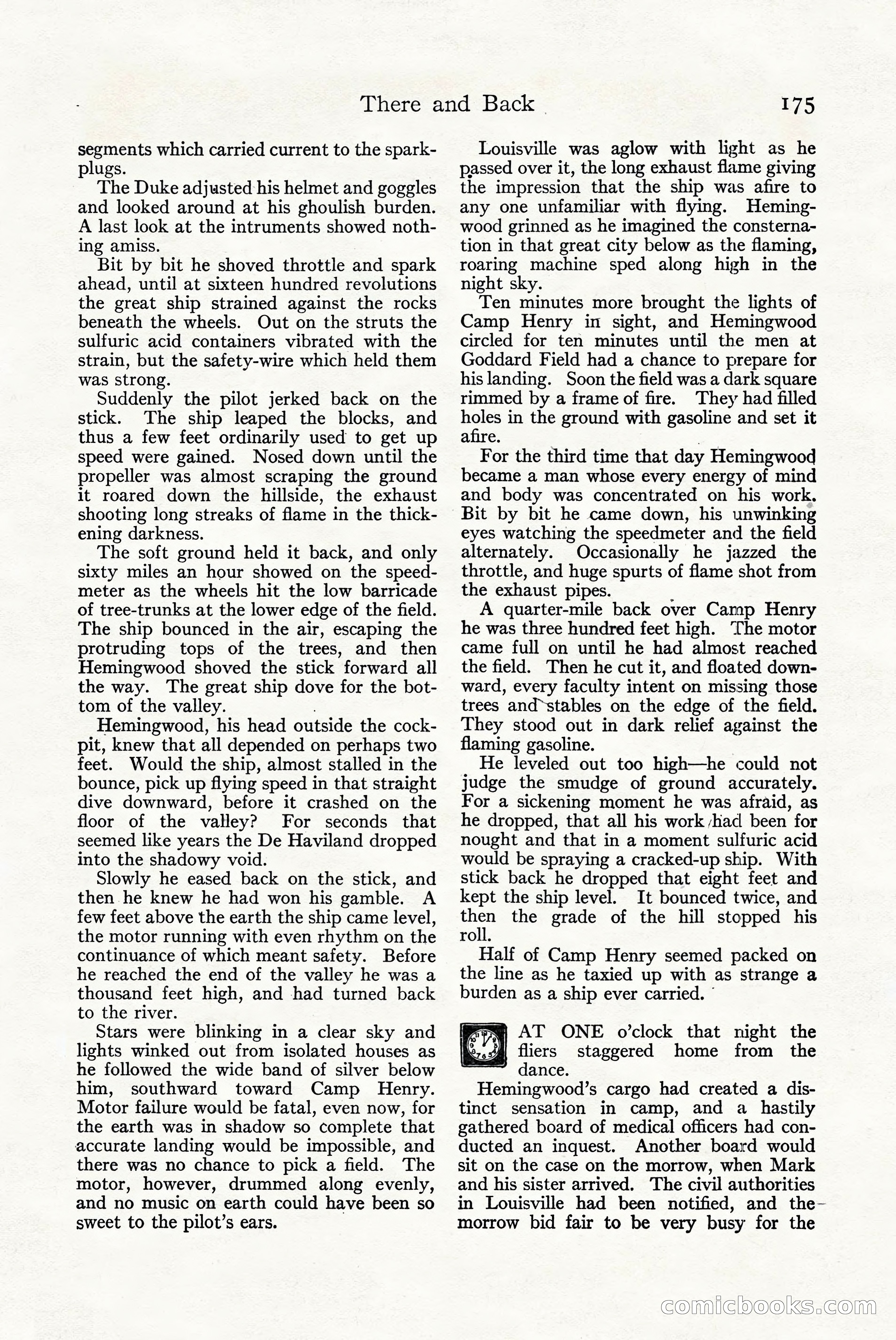
A restored page from Pulp Fiction, 1922. Page through the whole issue in the reader above.
📄 Transcribed text from this page (OCR, searchable)
Machine-transcribed from the original scan — historical spelling and the odd misread are preserved.
There and Back | segments which carried current to the spark- plugs. The Duke adjusted his helmet and goggles and looked around at his ghoulish burden. A last look at the intruments showed noth- ing amiss. Bit by bit he shoved throttle and spark ahead, until at sixteen hundred revolutions the great ship strained against the rocks beneath the wheels. Out on the struts the sulfuric acid containers vibrated with the strain, but the safety-wire which held them was strong. Suddenly the pilot jerked back on the stick. The ship leaped the blocks, and thus a few feet ordinarily used to get up speed were gained. Nosed down until the propeller was almost scraping the ground it roared down the hillside, the exhaust shooting long streaks of flame in the thick- ening darkness. The soft ground held it back, and only sixty miles an hour showed on the speed- meter as the wheels hit the low barricade of tree-trunks at the lower edge of the field. The ship bounced in the air, escaping the protruding tops of the trees, and then Hemingwood shoved the stick forward all the way. The great ship dove for the bot- tom of the valley. Hemingwood, his head outside the cock- pit, knew that all depended on perhaps two feet. Would the ship, almost stalled in the bounce, pick up flying speed in that straight dive downward, before it crashed on the floor of the valley? For seconds that seemed like years the De Haviland dropped into the shadowy void. Slowly he eased back on the stick, and then he knew he had won his gamble. A few feet above the earth the ship came level, the motor running with even rhythm on the continuance of which meant safety. Before he reached the end of the valley he was a thousand feet high, and had turned back to the river. | Stars were blinking in a clear sky and lights winked out from isolated houses as he followed the wide band of silver below him, southward toward Camp Henry. Motor failure would be fatal, even now, for the earth was in shadow so complete that accurate landing would be impossible, and there was no chance to pick a field. The motor, however, drummed along evenly, and no music on earth could have been so sweet to the pilot’s ears. 175 Louisville was aglow with light as he passed over it, the long exhaust flame giving the impression that the ship was afire to any one unfamiliar with flying. Heming- wood grinned as he imagined the consterna- tion in that great city below as the flaming, roaring machine sped along high in the night sky. Ten minutes more brought the lights of Camp Henry in sight, and Hemingwood circled for ten minutes until the men at Goddard Field had a chance to prepare for his landing. Soon the field was a dark square rimmed by a frame of fire. They had filled aS in the ground with gasoline and set it afire. For the third time that day Hemingwood became a man whose every energy of mind and body was concentrated on his work. Bit by bit he came down, his unwinking eyes watching the speedmeter and the field alternately. Occasionally he jazzed the throttle, and huge spurts of flame shot from the exhaust pipes. : A quarter-mile back over Camp Henry he was three hundred feet high. The motor came full on until he had almost reached the field. Then he cut it, and floated down- ward, every faculty intent on missing those trees and~stables on the edge of the field. They stood out in dark relief against the flaming gasoline. He leveled out too high—he could not judge the smudge of ground accurately. For a sickening moment he was afraid, as he dropped, that all his work /had been for nought and that in a moment sulfuric acid would be spraying a cracked-up ship. With stick back he dropped that eight feet and kept the ship level. It bounced twice, and ne the grade of the hill stopped his roll. Half of Camp Henry seemed packed on the line as he taxied up with as strange a burden as a ship ever carried. ” AT ONE o'clock that night the fliers staggered home from the ~ dance. Hemingwood’s cargo had created a dis- tinct sensation in camp, and a hastily gathered board of medical officers had con- ducted an inquest. Another board would sit on the case on the morrow, when Mark and his sister arrived. The civil authorities in Louisville had been notified, and the- morrow bid fair to be very busy for the NOOK C@