
Pulp Fiction, 1922 · page 178 of 204
Adventure Magazine Cover — page 178: what you’re looking at
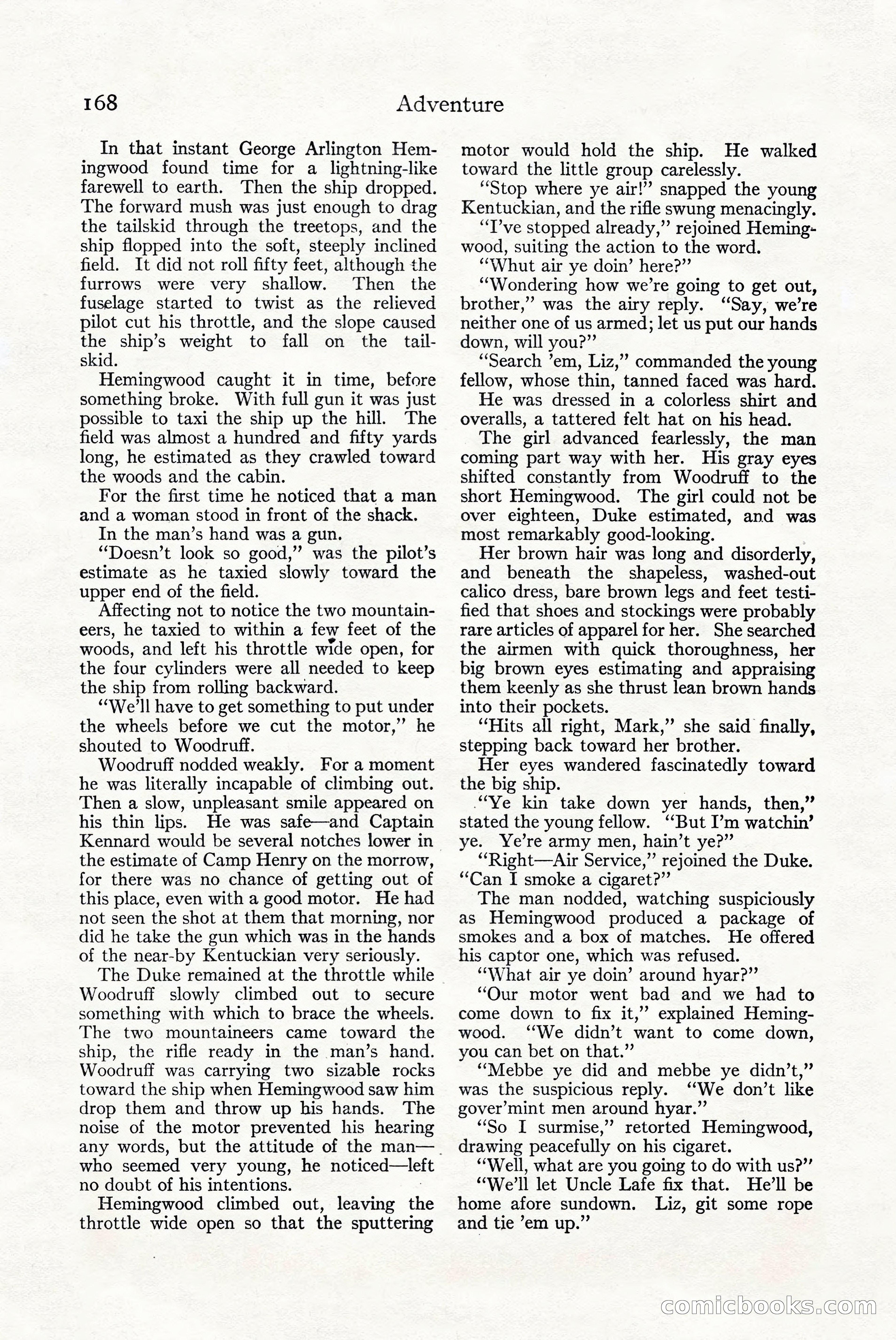
A restored page from Pulp Fiction, 1922. Page through the whole issue in the reader above.
📄 Transcribed text from this page (OCR, searchable)
Machine-transcribed from the original scan — historical spelling and the odd misread are preserved.
168 In that instant George Arlington Hem- ingwood found time for a lightning-like farewell to earth. Then the ship dropped. The forward mush was just enough to drag the tailskid through the treetops, and the ship flopped into the soft, steeply inclined field. It did not roll fifty feet, although the furrows were very shallow. Then the fuselage started to twist as the relieved pilot cut his throttle, and the slope caused the ship’s weight to fall on the tail- skid. Hemingwood caught it in time, before something broke. With full gun it was just possible to taxi the ship up the hill. The field was almost a hundred and fifty yards long, he estimated as they crawled toward the woods and the cabin. For the first time he noticed that a man and a woman stood in front of the shack. In the man’s hand was a gun. “Doesn’t look so good,”’ was the pilot’s estimate as he taxied slowly toward the upper end of the field. Affecting not to notice the two mountain- eers, he taxied to within a few feet of the woods, and left his throttle wide open, for the four cylinders were all needed to keep the ship from rolling backward. ‘“‘We’ll have to get something to put under the wheels before we cut the motor,” he shouted to Woodruff. Woodruff nodded weakly. For a moment he was literally incapable of climbing out. Then a slow, unpleasant smile appeared on his thin lips. He was safe—and Captain Kennard would be several notches lower in the estimate of Camp Henry on the morrow, for there was no chance of getting out of this place, even with a good motor. He had not seen the shot at them that morning, nor did he take the gun which was in the hands of the near-by Kentuckian very seriously. The Duke remained at the throttle while Woodruff slowly climbed out to secure something with which to brace the wheels. The two mountaineers came toward the ship, the rifle ready in the man’s hand. Woodruff was carrying two sizable rocks toward the ship when Hemingwood saw him drop them and throw up his hands. The noise of the motor prevented his hearing any words, but the attitude of the man—. who seemed very young, he noticed—left no doubt of his intentions. Hemingwood climbed out, leaving the throttle wide open so that the sputtering Adventure motor would hold the ship. He walked toward the little group carelessly. ‘Stop where ye air!” snapped the young Kentuckian, and the rifle swung menacingly. ‘T’ve stopped already,” rejoined Heming- wood, suiting the action to the word. “Whut air ye doin’ here?” “Wondering how we’re going to get out, brother,” was the airy reply. ‘Say, we’re neither one of us armed; let us put our hands down, will you?” “Search * em, Liz,” commanded the young fellow, whose thin, tanned faced was hard. He was dressed in a colorless shirt and overalls, a tattered felt hat on his head. The girl advanced fearlessly, the man coming part way with her. His gray eyes shifted constantly from Woodruff to the short Hemingwood. The girl could not be over eighteen, Duke estimated, and was most remarkably good-looking. Her brown hair was long and disorderly, and beneath the shapeless, washed-out calico dress, bare brown legs and feet testi- fied that shoes and stockings were probably rare articles of apparel for her. She searched the airmen with quick thoroughness, her big brown eyes estimating and appraising them keenly as she thrust lean brown hands into their pockets. “Hits all right, Mark,” she said finally, stepping back toward her brother. Her eyes wandered fascinatedly toward the big ship. “Ye kin take down yer hands, then,” stated the young fellow. ‘“But I’m watchin’ ye. Ye’re army men, hain’t ye?” “Right—Air Service,” rejoined the Duke. “Can I smoke a cigaret?”’ The man nodded, watching suspiciously as Hemingwood produced a package of smokes and a box of matches. He offered his captor one, which was refused. “What air ye doin’ around hyar?” “Our motor went bad and we had to come down to fix it,” explained Heming- wood. “We didn’t want to come down, you can bet on that.” ‘‘Mebbe ye did and mebbe ye didn’t,” was the suspicious reply. ‘‘We don’t like gover’mint men around hyar.”’ “So I surmise,’ retorted Hemingwood, drawing peacefully on his cigaret. “Well, what are you going to do with us?” “We'll let Uncle Lafe fix that. He’ll be home afore sundown. Liz, git some rope and tie ’em up.” MICLOOOK (©