
Pulp Fiction, 1922 · page 177 of 204
Adventure Magazine Cover — page 177: what you’re looking at
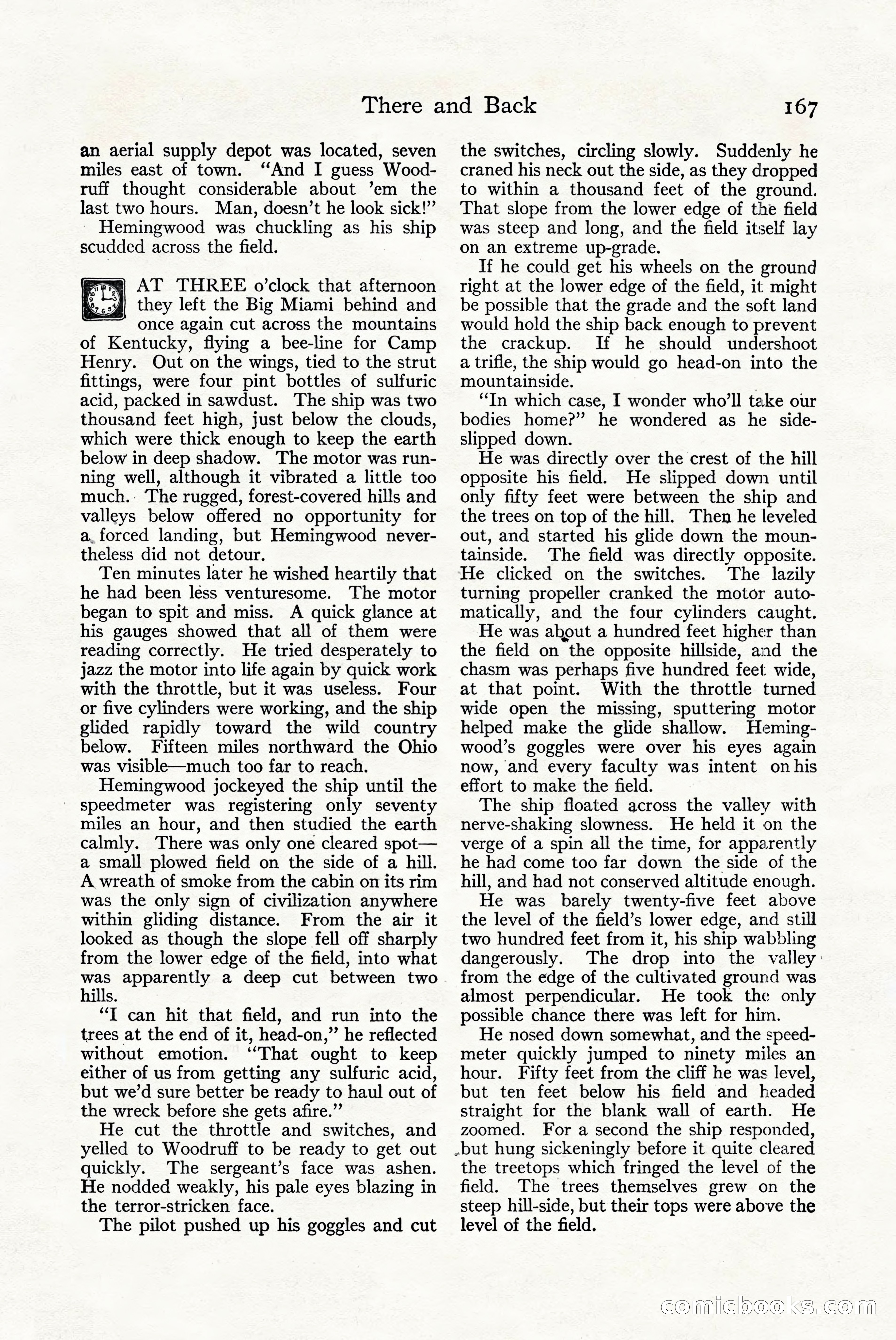
A restored page from Pulp Fiction, 1922. Page through the whole issue in the reader above.
📄 Transcribed text from this page (OCR, searchable)
Machine-transcribed from the original scan — historical spelling and the odd misread are preserved.
There and Back an aerial supply depot was located, seven miles east of town. “And I guess Wood- ruff thought considerable about ’em the last two hours. Man, doesn’t he look sick!’ ' Hemingwood was chuckling as his ship scudded across the field. free) AT THREE o’clock that afternoon i) they left the Big Miami behind and once again cut across the mountains of Kentucky, flying a bee-line for Camp Henry. Out on the wings, tied to the strut fittings, were four pint bottles of sulfuric acid, packed in sawdust. The ship was two thousand feet high, just below the clouds, which were thick enough to keep the earth below in deep shadow. The motor was run- ning well, although it vibrated a little too much. The rugged, forest-covered hills and valleys below offered no opportunity for a. forced landing, but Hemingwood never- theless did not detour. Ten minutes later he wished heartily that he had been less venturesome. The motor began to spit and miss. A quick glance at his gauges showed that all of them were reading correctly. He tried desperately to jazz the motor into life again by quick work with the throttle, but it was useless. Four or five cylinders were working, and the ship glided rapidly toward the wild country below. Fifteen miles northward the Ohio was visible—much too far to reach. Hemingwood jockeyed the ship until the speedmeter was registering only seventy miles an hour, and then studied the earth calmly. There was only one cleared spot— a small plowed field on the side of a hill. A wreath of smoke from the cabin on its rim was the only sign of civilization anywhere within gliding distance. From the air it looked as though the slope fell off sharply from the lower edge of the field, into what was apparently a deep cut between two hills. “IT can hit that field, and run into the trees at the end of it, head-on,” he reflected without emotion. ‘“That ought to keep either of us from getting any sulfuric acid, but we’d sure better be ready to haul out of the wreck before she gets afire.”’ He cut the throttle and switches, and yelled to Woodruff to be ready to get out quickly. The sergeant’s face was ashen. He nodded weakly, his pale eyes blazing in the terror-stricken face. The pilot pushed up his goggles and cut 167 the switches, circling slowly. Suddenly he craned his neck out the side, as they dropped to within a thousand feet of the ground. That slope from the lower edge of the field was steep and long, and the field itself lay on an extreme up-grade. If he could get his wheels on the ground right at the lower edge of the field, it might be possible that the grade and the soft land would hold the ship back enough to prevent the crackup. If he should undershoot a trifle, the ship would go head-on into the mountainside. 3 “In which case, I wonder who’ll take our bodies home?” he wondered as he side- slipped down. He was directly over the crest of the hill opposite his field. He slipped down until only fifty feet were between the ship and the trees on top of the hill. Then he leveled out, and started his glide down the moun- tainside. ‘The field was directly opposite. He clicked on the switches. The lazily turning propeller cranked the motor auto- matically, and the four cylinders caught. He was ahout a hundred feet higher than the field on the opposite hillside, and the chasm was perhaps five hundred feet wide, at that point. With the throttle turned wide open the missing, sputtering motor helped make the glide shallow. Heming- wood’s goggles were over his eyes again now, and every faculty was intent on his effort to make the field. The ship floated across the valley with nerve-shaking slowness. He held it on the verge of a spin all the time, for apparently he had come too far down the side of the hill, and had not conserved altitude enough. He was barely twenty-five feet above the level of the field’s lower edge, and still two hundred feet from it, his ship wabbling dangerously. The drop into the valley. from the edge of the cultivated ground was almost perpendicular. He took the only possible chance there was left for him. He nosed down somewhat, and the speed- meter quickly jumped to ninety miles an hour. Fifty feet from the cliff he was level, but ten feet below his field and headed straight for the blank wall of earth. He zoomed. For a second the ship responded, -but hung sickeningly before it quite cleared the treetops which fringed the level of the field. The trees themselves grew on the steep hill-side, but their tops were above the level of the field. NOOK C@