
Pulp Fiction, 1922 · page 15 of 204
Adventure Magazine Cover — page 15: what you’re looking at
A restored page from Pulp Fiction, 1922. Page through the whole issue in the reader above.
📄 Transcribed text from this page (OCR, searchable)
Machine-transcribed from the original scan — historical spelling and the odd misread are preserved.
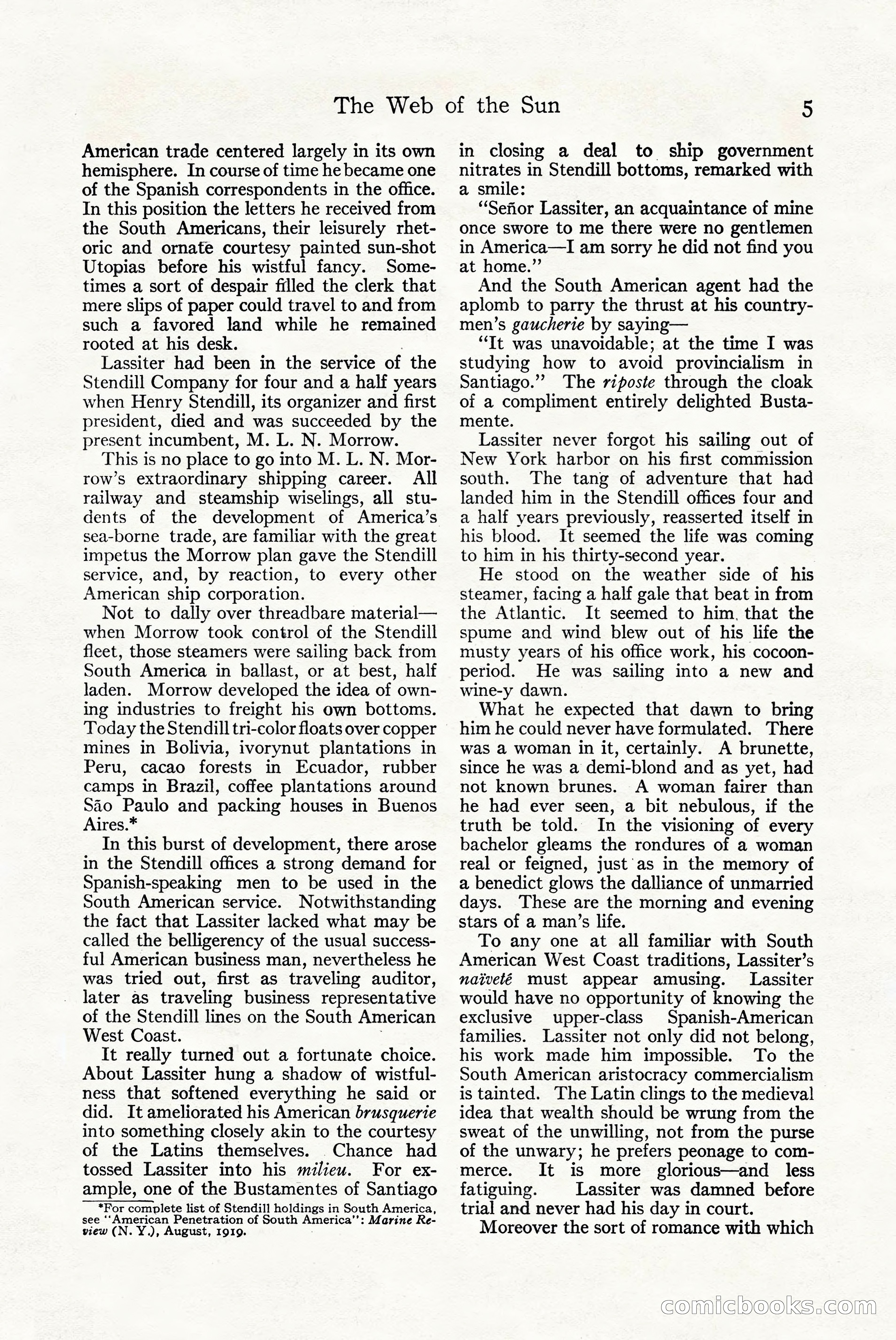
The Web of the Sun 5 American trade centered largely in its own hemisphere. In course of time he became one of the Spanish correspondents in the office. In this position the letters he received from the South Americans, their leisurely rhet- oric and ornate courtesy painted sun-shot Utopias before his wistful fancy. Some- times a sort of despair filled the clerk that mere slips of paper could travel to and from such a favored land while he remained rooted at his desk. Lassiter had been in the service of the Stendill Company for four and a half years when Henry Stendill, its organizer and first president, died and was succeeded by the present incumbent, M. L. N. Morrow. This is no place to go into M. L. N. Mor- row’s extraordinary shipping career. All railway and steamship wiselings, all stu- dents of the development of America’s sea-borne trade, are familiar with the great impetus the Morrow plan gave the Stendill service, and, by reaction, to every other American ship corporation. Not to dally over threadbare material— when Morrow took control of the Stendill fleet, those steamers were sailing back from South America in ballast, or at best, half laden. Morrow developed the idea of own- ing industries to freight his own bottoms. Today the Stendill tri-color floats over copper mines in Bolivia, ivorynut plantations in Peru, cacao forests in Ecuador, rubber camps in Brazil, coffee plantations around S40 Paulo and packing houses in Buenos Aires.* In this burst of development, there arose in the Stendill offices a strong demand for Spanish-speaking men to be used in the South American service. Notwithstanding the fact that Lassiter lacked what may be called the belligerency of the usual success- ful American business man, nevertheless he was tried out, first as traveling auditor, later as traveling business representative of the Stendill lines on the South American West Coast. It really turned out a fortunate choice. About Lassiter hung a shadow of wistful- ness that softened everything he said or did. It ameliorated his American brusquerie into something closely akin to the courtesy of the Latins themselves. _Chance had tossed Lassiter into his milieu. For ex- ample, one of the Bustamentes of Santiago *For complete list of Stendill holdings in South America, see ‘‘American Penetration of South America’: Marine Re- view (N. Y.), August, I9I9. in closing a deal to ship government nitrates in Stendill bottoms, remarked with a smile: “‘Sefior Lassiter, an acquaintance of mine once swore to me there were no gentlemen in America—I am sorry he did not find you at home.” And the South American agent had the aplomb to parry the thrust at his country- men’s gaucherie by saying— “It was unavoidable; at the time I was studying how to avoid provincialism in Santiago.”” The rzposte through the cloak of a compliment entirely delighted Busta- mente. Lassiter never forgot his sailing out of New York harbor on his first commission south. The tang of adventure that had landed him in the Stendill offices four and a half years previously, reasserted itself in his blood. It seemed the life was coming to him in his thirty-second year. He stood on the weather side of his steamer, facing a half gale that beat in from the Atlantic. It seemed to him, that the spume and wind blew out of his life the musty years of his office work, his cocoon- period. He was sailing into a new and wine-y dawn. What he expected that dawn to bring him he could never have formulated. There was a woman in it, certainly. A brunette, since he was a demi-blond and as yet, had not known brunes. A woman fairer than he had ever seen, a bit nebulous, if the truth be told. In the visioning of every bachelor gleams the rondures of a woman real or feigned, just as in the memory of a benedict glows the dalliance of unmarried days. These are the morning and evening stars of a man’s life. To any one at all familiar with South American West Coast traditions, Lassiter’s natveté must appear amusing. Lassiter would have no opportunity of knowing the exclusive upper-class Spanish-American families. Lassiter not only did not belong, his work made him impossible. To the South American aristocracy commercialism is tainted. The Latin clings to the medieval idea that wealth should be wrung from the sweat of the unwilling, not from the purse of the unwary; he prefers peonage to com- merce. It is more glorious—and _ less fatiguing. Lassiter was damned before trial and never had his day in court. Moreover the sort of romance with which MICLOOOK C@