
Pulp Fiction, 1922 · page 14 of 204
Adventure Magazine Cover — page 14: what you’re looking at
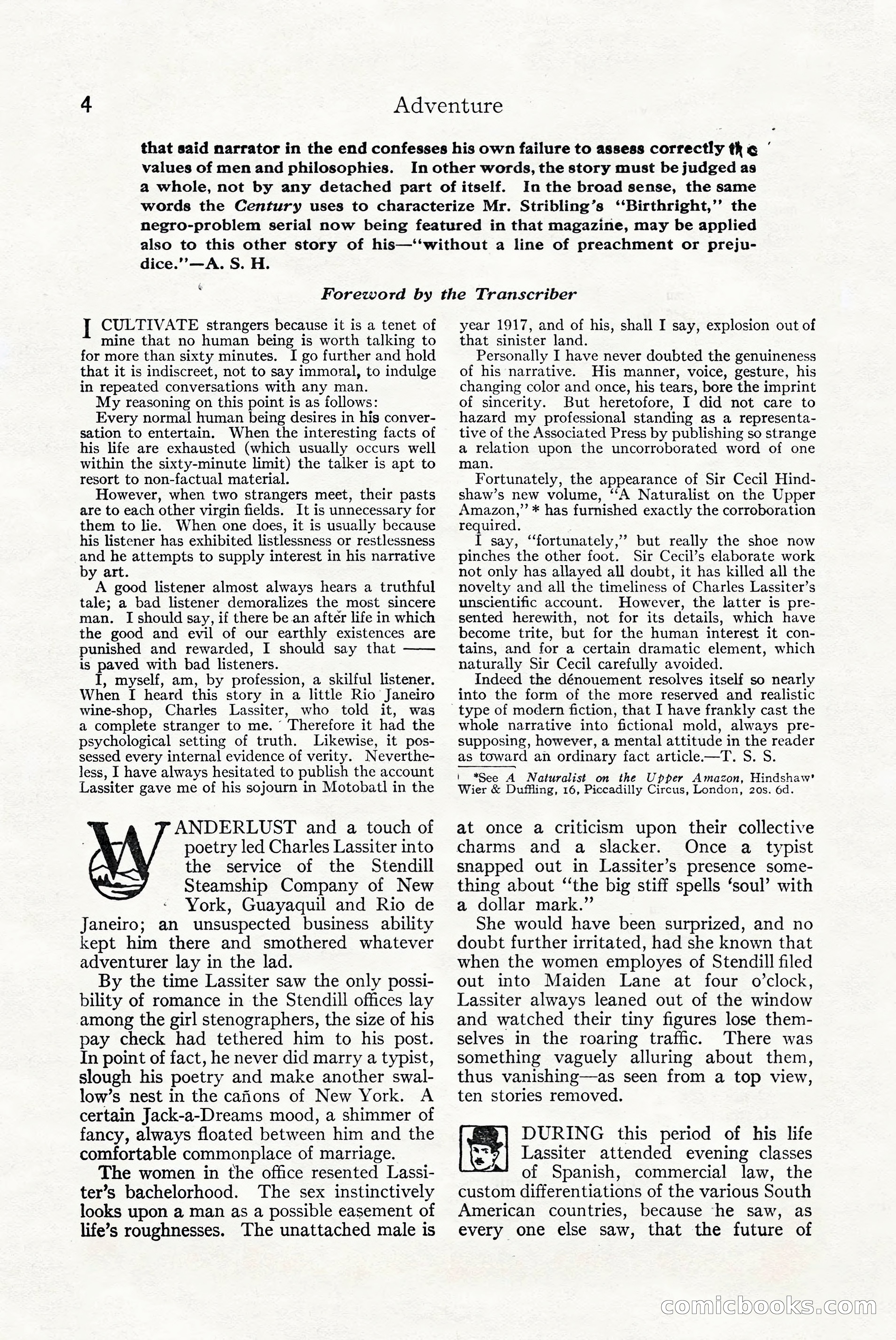
A restored page from Pulp Fiction, 1922. Page through the whole issue in the reader above.
📄 Transcribed text from this page (OCR, searchable)
Machine-transcribed from the original scan — historical spelling and the odd misread are preserved.
A Adventure that said narrator in the end confesses his own failure to assess correctly the | values of men and philosophies. a whole, not by any detached part of itself. In other words, the story must be judged as In the broad sense, the same words the Century uses to characterize Mr. Stribling’s ‘‘Birthright,’’ the negro-problem serial now being featured in that magazine, may be applied also to this other story of his—‘‘without a line of preachment or preju- dice.’’—A. S. H. “ CULTIVATE strangers because it is a tenet of mine that no human being is worth talking to for more than sixty minutes. I go further and hold that it is indiscreet, not to say immoral, to indulge in repeated conversations with any man. My reasoning on this point is as follows: Every normal human being desires in his conver- sation to entertain. When the interesting facts of his life are exhausted (which usually occurs well within the sixty-minute limit) the talker is apt to resort to non-factual material. However, when two strangers meet, their pasts are to each other virgin fields. It is unnecessary for them to lie. When one does, it is usually because his listener has exhibited listlessness or restlessness and he attempts to supply interest in his narrative by art. A good listener almost always hears a truthful tale; a bad listener demoralizes the most sincere man. I should say, if there be an after life in which the good and evil of our earthly existences are punished and rewarded, I should say that is paved with bad listeners. I, myself, am, by profession, a skilful listener. When I heard this story in a little Rio Janeiro wine-shop, Charles Lassiter, who told it, was a complete stranger to me. © Therefore it had the psychological setting of truth. Likewise, it pos- sessed every internal evidence of verity. Neverthe- less, I have always hesitated to publish the account Lassiter gave me of his sojourn in Motobatl in the ANDERLUST and a touch of poetry led Charles Lassiter into the service of the Stendill Steamship Company of New York, Guayaquil and Rio de Janeiro; an unsuspected business ability kept him there and smothered whatever adventurer lay in the lad. By the time Lassiter saw the only possi- bility of romance in the Stendill offices lay among the girl stenographers, the size of his pay check had tethered him to his post. In point of fact, he never did marry a typist, slough his poetry and make another swal- low’s nest in the cafions of New York. A certain Jack-a-Dreams mood, a shimmer of fancy, always floated between him and the comfortable commonplace of marriage. The women in the office resented Lassi- ter’s bachelorhood. The sex instinctively looks upon a man as a possible easement of life’s roughnesses. The unattached male is Foreword by the Transcriber year 1917, and of his, shall I say, explosion out of that sinister land. Personally I have never doubted the genuineness of his narrative. His manner, voice, gesture, his changing color and once, his tears, bore the imprint of sincerity. But heretofore, I did not care to hazard my professional standing as a representa- tive of the Associated Press by publishing so strange a relation upon the uncorroborated word of one man. Fortunately, the appearance of Sir Cecil Hind- shaw’s new volume, ‘“‘A Naturalist on the Upper Amazon,” * has furnished exactly the corroboration required. I say, ‘fortunately,’ but really the shoe now pinches the other foot. Sir Cecil’s elaborate work not only has allayed all doubt, it has killed all the novelty and all the timeliness of Charles Lassiter’s unscientific account. However, the latter is pre- sented herewith, not for its details, which have become trite, but for the human interest it con- tains, and for a certain dramatic element, which naturally Sir Cecil carefully avoided. Indeed the dénouement resolves itself so nearly into the form of the more reserved and realistic type of modern fiction, that I have frankly cast the whole narrative into fictional mold, always pre- supposing, however, a mental attitude in the reader as toward an ordinary fact article—T. S. S. ' “See A Naturalist on the Upper Amazon, Hindshaw’ Wier & Duffling, 16, Piccadilly Circus, London, 2os. 6d. at once a criticism upon their collective charms and a slacker. Once a typist snapped out in Lassiter’s presence some- thing about “‘the big stiff spells ‘soul’ with a dollar mark.” She would have been surprized, and no doubt further irritated, had she known that when the women employes of Stendill filed out into Maiden Lane at four o’clock, Lassiter always leaned out of the window and watched their tiny figures lose them- selves in the roaring traffic. There was something vaguely alluring about them, thus vanishing—as seen from a top view, ten stories removed. DURING this period of his life Lassiter attended evening classes of Spanish, commercial law, the custom differentiations of the various South American countries, because he saw, as every one else saw, that the future of DOO (C@