
Pulp Fiction, 1921 · page 77 of 204
Adventure Magazine Cover, June 18, 1921 — page 77: what you’re looking at
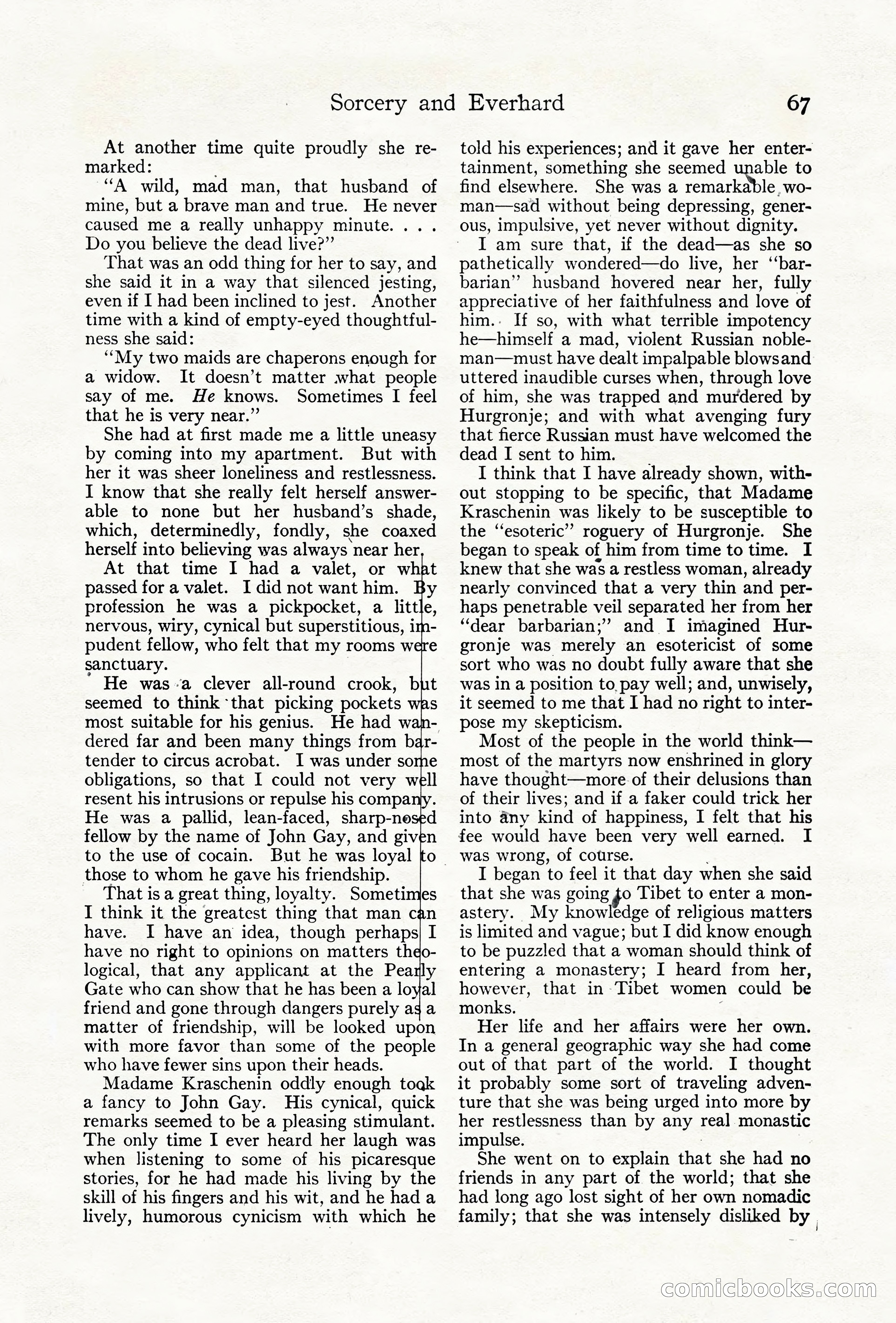
A restored page from Pulp Fiction, 1921. Page through the whole issue in the reader above.
📄 Transcribed text from this page (OCR, searchable)
Machine-transcribed from the original scan — historical spelling and the odd misread are preserved.
Sorcery and Everhard At another time quite proudly she re- marked: “A wild, mad man, that husband of mine, but a brave man and true. He never caused me a really unhappy minute... . Do you believe the dead live?”’ That was an odd thing for her to say, and she said it in a way that silenced jesting, even if I had been inclined to jest. Another time with a kind of empty-eyed thoughtful- ness she said: ‘““My two maids are chaperons enough for a widow. It doesn’t matter what people say of me. He knows. Sometimes I feel that he is very near.” She had at first made me a little uneasy by coming into my apartment. But with her it was sheer loneliness and restlessness. I know that she really felt herself answer- able to none but her husband’s shade, which, determinedly, fondly, she coaxed herself into believing was always near her At that time I had a valet, or what passed for a valet. I did not want him. profession he was a pickpocket, a little, nervous, wiry, cynical but superstitious, 1 seemed to think - that nickine pockets most suitable for his genius. He had w to the use of cocain. those to whom he gave his friendship. _ That isa great thing, loyalty. Someti I think it the greatest thing that man can have. I have an idea, though perhaps| I have no right to opinions on matters theo- logical, that any applicant at the Pea Gate who can show that he has been a loyal friend and gone through dangers purely ag a matter of friendship, will be looked upon with more favor than some of the people who have fewer sins upon their heads. Madame Kraschenin oddly enough toqk a fancy to John Gay. His cynical, quick remarks seemed to be a pleasing stimulant. The only time I ever heard her laugh was when listening to some of his picaresque stories, for he had made his living by the skill of his fingers and his wit, and he had a lively, humorous cynicism with which he But he was loyal to | 07 told his experiences; and it gave her enter- tainment, something she seemed unable to find elsewhere. She was a remarkable, wo- man—sad without being depressing, gener- ous, Impulsive, yet never without dignity. I am sure that, if the dead—as she so pathetically wondered—do live, her ‘‘bar- barian” husband hovered near her, fully appreciative of her faithfulness and love of him.: If so, with what terrible impotency he—himself a mad, violent Russian noble- man—must have dealt impalpable blowsand uttered inaudible curses when, through love of him, she was trapped and murdered by Hurgronje; and with what avenging fury that fierce Russian must have welcomed the dead Isent tohim. I think that I have already shown, with- out stopping to be specific, that Madame Kraschenin was likely to be susceptible to the “esoteric” roguery of Hurgronje. She began to speak of him from time to time. I knew that she was a restless woman, already nearly convinced that a very thin and per- haps penetrable veil separated her from her “dear barbarian;” and I imagined Hur- gronje was merely an esotericist of some sort who was no doubt fully aware that she was in a position to. pay well; and, unwisely, it seemed to me that I had no right to inter- pose my skepticism. Most of the people in the world think— most of the martyrs now enshrined in glory have thought—more of their delusions than of their lives; and if a faker could trick her into any kind of happiness, I felt that his fee would have been very well earned. I was wrong, of course. I began to feel it that day when she said that she was going fo Tibet to enter a mon- astery. My knowledge of religious matters is limited and vague; but I did know enough to be puzzled that a woman should think of entering a monastery; I heard from her, however, that in Tibet women could be monks. Her life and her affairs were her own. In a genera] geographic way she had come out of that part of the world. I thought it probably some sort of traveling adven- ture that she was being urged into more by her restlessness than by any real monastic impulse. She went on to explain that she had no friends in any part of the world; that she had long ago lost sight of her own nomadic family; that she was intensely disliked by | COmicloo CN Wp) (©