
Pulp Fiction, 1921 · page 76 of 204
Adventure Magazine Cover, June 18, 1921 — page 76: what you’re looking at
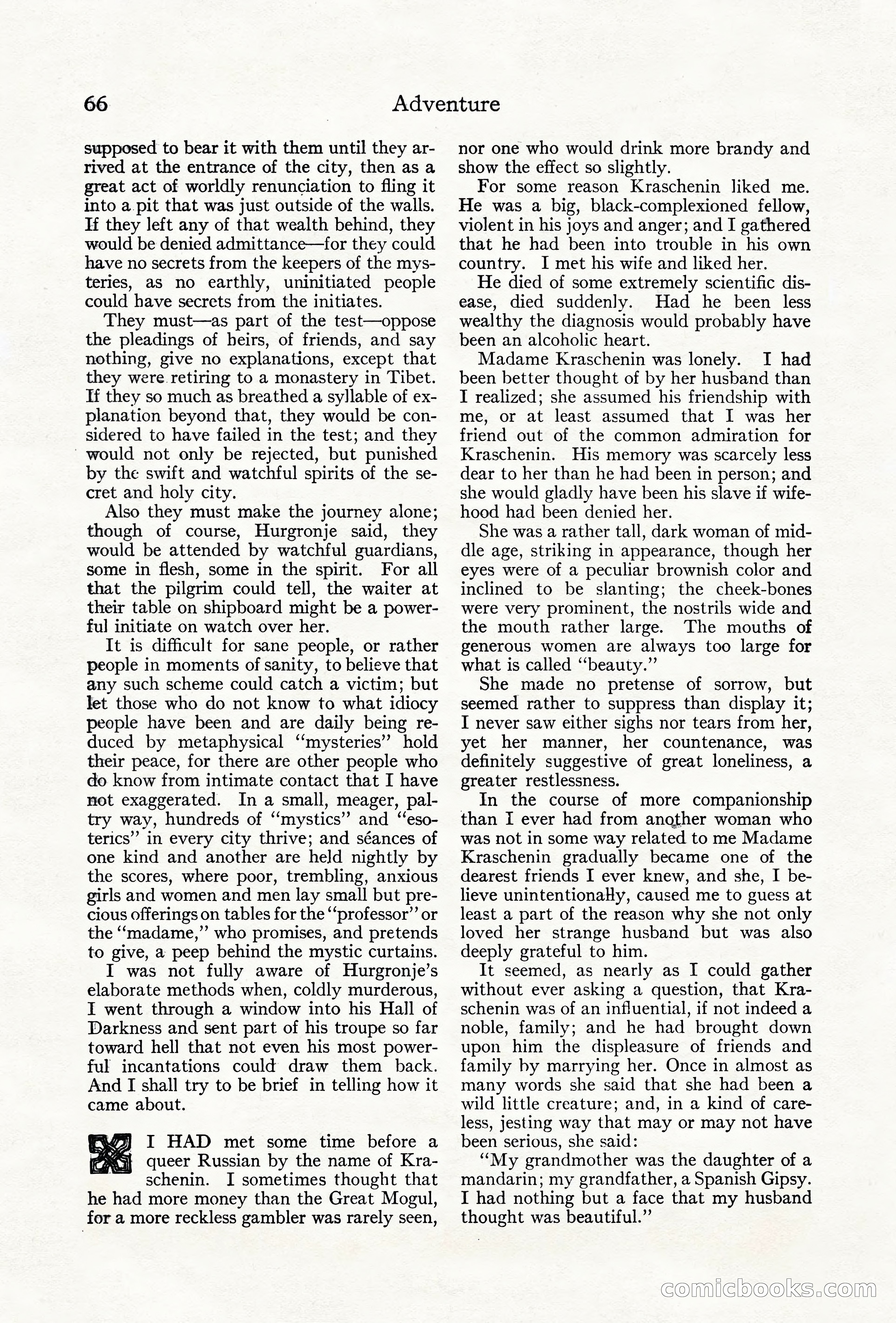
A restored page from Pulp Fiction, 1921. Page through the whole issue in the reader above.
📄 Transcribed text from this page (OCR, searchable)
Machine-transcribed from the original scan — historical spelling and the odd misread are preserved.
66 supposed to bear it with them until they ar- rived at the entrance of the city, then asa great act of worldly renunciation to fling it into a.pit that was just outside of the walls. If they left any of that wealth behind, they would be denied admittance—for they could have no secrets from the keepers of the mys- teries, as no earthly, uninitiated people could have secrets from the initiates. They must—as part of the test—oppose the pleadings of heirs, of friends, and say nothing, give no explanations, except that they were.retiring to a monastery in Tibet. If they so much as breathed a syllable of ex- planation beyond that, they would be con- sidered to have failed in the test; and they ~ would not only be rejected, but punished by the swift and watchful spirits of the se- cret and holy city. Also they must make the journey alone; though of course, Hurgronje said, they would be attended by watchful guardians, some in flesh, some in the spirit. For all that the pilgrim could tell, the waiter at their table on shipboard might be a power- ful initiate on watch over her. It is difficult for sane people, or rather people in moments of sanity, to believe that any such scheme could catch a victim; but let those who do not know to what idiocy people have been and are daily being re- duced by metaphysical “‘mysteries’” hold their peace, for there are other people who do know from intimate contact that I have not exaggerated. In a small, meager, pal- try way, hundreds of “mystics” and “eso- terics” in every city thrive; and séances of one kind and another are held nightly by the scores, where poor, trembling, anxious girls and women and men lay small but pre- cious offerings on tables for the “‘professor”’ or the ‘‘madame,”’ who promises, and pretends to give, a peep behind the mystic curtains. I was not fully aware of Hurgronje’s elaborate methods when, coldly murderous, I went through a window into his Hall of Darkness and sent part of his troupe so far toward hell that not even his most power- ful incantations could draw them back. And I shall try to be brief in telling how it came about. %} I HAD met some time before a S| queer Russian by the name of Kra- schenin. JI sometimes thought that he had more money than the Great Mogul, for a more reckless gambler was rarely seen, Adventure nor one who would drink more brandy and show the effect so slightly. For some reason Kraschenin liked me. He was a big, black-complexioned fellow, violent in his joys and anger; and I gathered that he had been into trouble in his own country. I met his wife and liked her. He died of some extremely scientific dis- ease, died suddenly. Had he been less wealthy the diagnosis would probably have been an alcoholic heart. Madame Kraschenin was lonely. I had been better thought of by her husband than I realized; she assumed his friendship with me, or at least assumed that I was her friend out of the common admiration for Kraschenin. His memory was scarcely less dear to her than he had been in person; and she would gladly have been his slave if wife- hood had been denied her. She was a rather tall, dark woman of mid- dle age, striking in appearance, though her eyes were of a peculiar brownish color and inclined to be slanting; the cheek-bones were very prominent, the nostrils wide and the mouth rather large. The mouths of generous women are always too large for what is called “beauty.” She made no pretense of sorrow, but seemed rather to suppress than display it; I never saw either sighs nor tears from her, yet her manner, her countenance, was definitely suggestive of great loneliness, a greater restlessness. In the course of more companionship than I ever had from another woman who was not in some way related to me Madame Kraschenin gradually became one of the dearest friends I ever knew, and she, I be- lieve unintentionaHy, caused me to guess at least a part of the reason why she not only loved her strange husband but was also deeply grateful to him. It seemed, as nearly as I could gather without ever asking a question, that Kra- schenin was of an influential, if not indeed a noble, family; and he had brought down upon him the displeasure of friends and family by marrying her. Once in almost as many words she said that she had been a wild little creature; and, in a kind of care- less, jesting way that may or may not have been serious, she said: “My grandmother was the daughter of a mandarin; my grandfather, a Spanish Gipsy. I had nothing but a face that my husband thought was beautiful.” COmicloo oN UM) CO