
Pulp Fiction, 1921 · page 65 of 204
Adventure Magazine Cover, June 18, 1921 — page 65: what you’re looking at
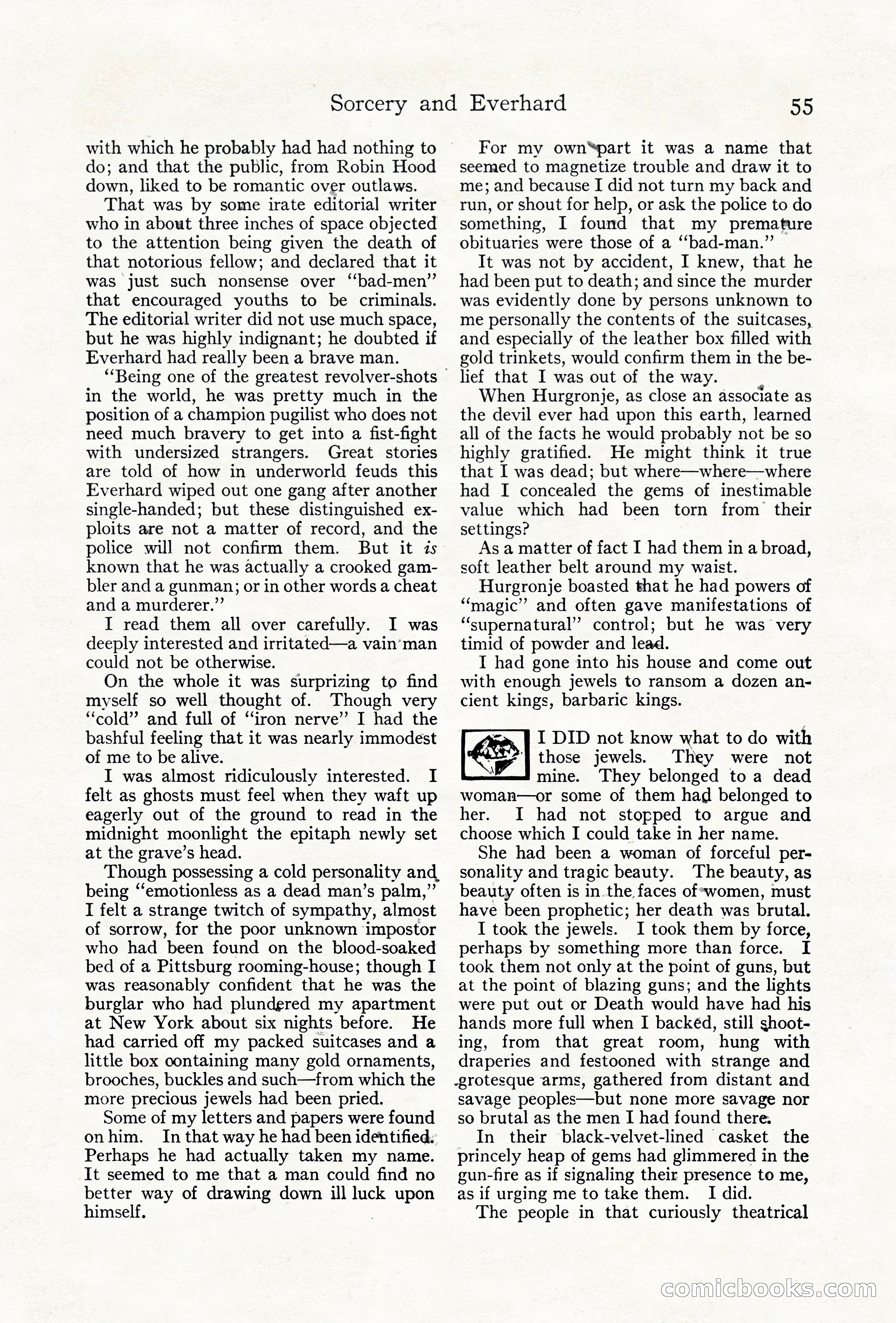
A restored page from Pulp Fiction, 1921. Page through the whole issue in the reader above.
📄 Transcribed text from this page (OCR, searchable)
Machine-transcribed from the original scan — historical spelling and the odd misread are preserved.
sorcery and Everhard with which he probably had had nothing to do; and that the public, from Robin Hood down, liked to be romantic over outlaws. That was by some irate editorial writer who in about three inches of space objected to the attention being given the death of that notorious fellow; and declared that it was just such nonsense over “‘bad-men’”’ that encouraged youths to be criminals. The editorial writer did not use much space, but he was highly indignant; he doubted if Everhard had really been a brave man. ‘“‘Being one of the greatest revolver-shots | in the world, he was pretty much in the position of a champion pugilist who does not need much bravery to get into a fist-fight with undersized strangers. Great stories are told of how in underworld feuds this Everhard wiped out one gang after another single-handed; but these distinguished ex- ploits are not a matter of record, and the police will not confirm them. But it is known that he was actually a crooked gam- bler and a gunman; or in other words a cheat and a murderer.” I read them all over carefully. I was deeply interested and irritated—a vain’man could not be otherwise. On the whole it was surprizing to find myself so well thought of. Though very “cold” and full of “iron nerve” I had the bashful feeling that it was nearly immodest of me to be alive. I was almost ridiculously interested. I felt as ghosts must feel when they waft up eagerly out of the ground to read in the midnight moonlight the epitaph newly set at the grave’s head. E hough possessing a cold personality and being ‘‘emotionless as a dead man’s palm,” I felt a strange twitch of sympathy, almost of sorrow, for the poor unknown impostor who had been found on the blood-soaked bed of a Pittsburg rooming-house; though I was reasonably confident that he was the burglar who had plundered my apartment at New York about six nights before. He had carried off my packed suitcases and a little box containing many gold ornaments, brooches, buckles and such—from which the more precious jewels had been pried. Some of my letters and papers were found onhim. In that way he had been identified: Perhaps he had actually taken my name. It seemed to me that a man could find no better way of drawing down ill luck upon himself. | 59 For my own“part it was a name that seemed to magnetize trouble and draw it to me; and because I did not turn my back and run, or shout for help, or ask the police to do something, I found that my premature obituaries were those of a ‘“‘bad-man.”’ It was not by accident, I knew, that he had been put to death; and since the murder was evidently done by persons unknown to me personally the contents of the suitcases, and especially of the leather box filled with gold trinkets, would confirm them in the be- lief that I was out of the way. When Hurgronje, as close an associate as the devil ever had upon this earth, learned all of the facts he would probably not be so highly gratified. He might think it true that I was dead; but where—where—where had I concealed the gems of inestimable value which had been torn from their settings? As a matter of fact I had them in a broad, soft leather belt around my waist. Hurgronje boasted that he had powers of “magic” and often gave manifestations of “supernatural” control; but he was very timid of powder and lead. I had gone into his house and come out with enough jewels to ransom a dozen an- cient kings, barbaric kings. those jewels. They were not : mine. They belonged to a dead woman—or some of them had belonged to her. I had not stopped to argue and choose which I could take in her name. She had been a woman of forceful per- sonality and tragic beauty. The beauty, as beauty often is in.the faces of-women, must have been prophetic; her death was brutal. I took the jewels. I took them by force, perhaps by something more than force. I took them not only at the point of guns, but at the point of blazing guns; and the lights were put out or Death would have had his hands more full when 1 backéd, still shoot- ing, from that great room, hung with draperies and festooned with strange and grotesque arms, gathered from distant and savage peoples—but none more savage nor so brutal as the men I had found there. In their black-velvet-lined casket the princely heap of gems had glimmered in the gun-fire as if signaling their presence to me, as if urging me to take them. I did. The people in that curiously theatrical I DID not know what to do with COmicloo oN ) ©