
Pulp Fiction, 1921 · page 64 of 204
Adventure Magazine Cover, June 18, 1921 — page 64: what you’re looking at
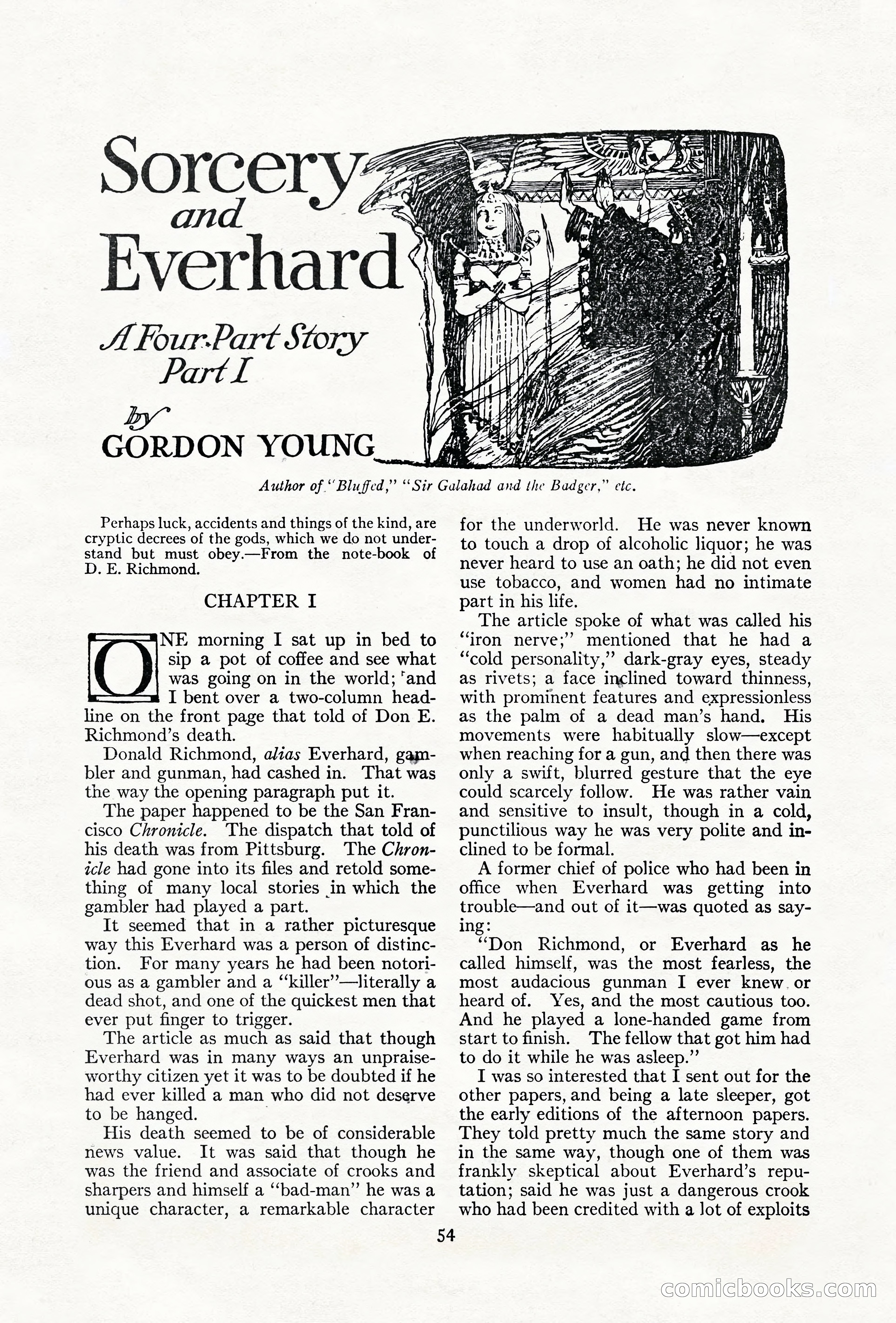
A restored page from Pulp Fiction, 1921. Page through the whole issue in the reader above.
📄 Transcribed text from this page (OCR, searchable)
Machine-transcribed from the original scan — historical spelling and the odd misread are preserved.
Al Four.Part Story Partl by” GORDON YOUNG Bsa Author of “ Bluffed,” “Sir Galahad and the Badger,” Perhaps luck, accidents and things of the kind, are cryptic decrees of the gods, which we do not under- stand but must obey.—From the note-book of D. E. Richmond. CHAPTER I —>— ANE morning I sat up in bed to sip a pot of coffee and see what was going on in the world; ‘and I bent over a two-column head- line on the front page that told of Don E. Richmond’s death. Donald Richmond, alias Everhard, gam- bler and gunman, had cashed in. That was the way the opening paragraph put it. The paper happened to be the San Fran- cisco Chronicle. The dispatch that told of his death was from Pittsburg. The Chron- icle had gone into its files and retold some- thing of many local stories in which the gambler had played a part. It seemed that in a rather picturesque way this Everhard was a person of distinc- tion. For many years he had been notori- ous as a gambler and a “‘killer’—literally a dead shot, and one of the quickest men that ever put finger to trigger. The article as much as said that though Everhard was in many ways an unpraise- worthy citizen yet it was to be doubted if he had ever killed a man who did not deserve to be hanged. His death seemed to be of considerable news value. It was said that though he was the friend and associate of crooks and sharpers and himself a “‘bad-man”’ he was a unique character, a remarkable character 54 for the underworld. He was never known to touch a drop of alcoholic liquor; he was never heard to use an oath; he did not even use tobacco, and women had no intimate part in his life. The article spoke of what was called his “iron nerve;’’ mentioned that he had a “cold personality,” dark-gray eyes, steady as rivets; a face inclined toward thinness, with prominent features and expressionless as the palm of a dead man’s hand. His movements were habitually slow—except when reaching for a gun, and then there was only a swift, blurred gesture that the eye could scarcely follow. He was rather vain and sensitive to insuJt, though in a cold, punctilious way he was very polite and in- clined to be formal. A former chief of police who had been in office when Everhard was getting into trouble—and out of it—was quoted as say- ing: “Don Richmond, or Everhard as he called himself, was the most fearless, the most audacious gunman I ever knew. or heard of. Yes, and the most cautious too. And he played a lone-handed game from start to finish. The fellow that got him had to do it while he was asleep.” I was so interested that I sent out for the other papers, and being a late sleeper, got the early editions of the afternoon papers. They told pretty much the same story and in the same way, though one of them was frankly skeptical about Everhard’s repu- tation; said he was just a dangerous crook who had been credited with a Jot of exploits EO lD@O 5}