
Pulp Fiction, 1921 · page 59 of 204
Adventure Magazine Cover, June 18, 1921 — page 59: what you’re looking at
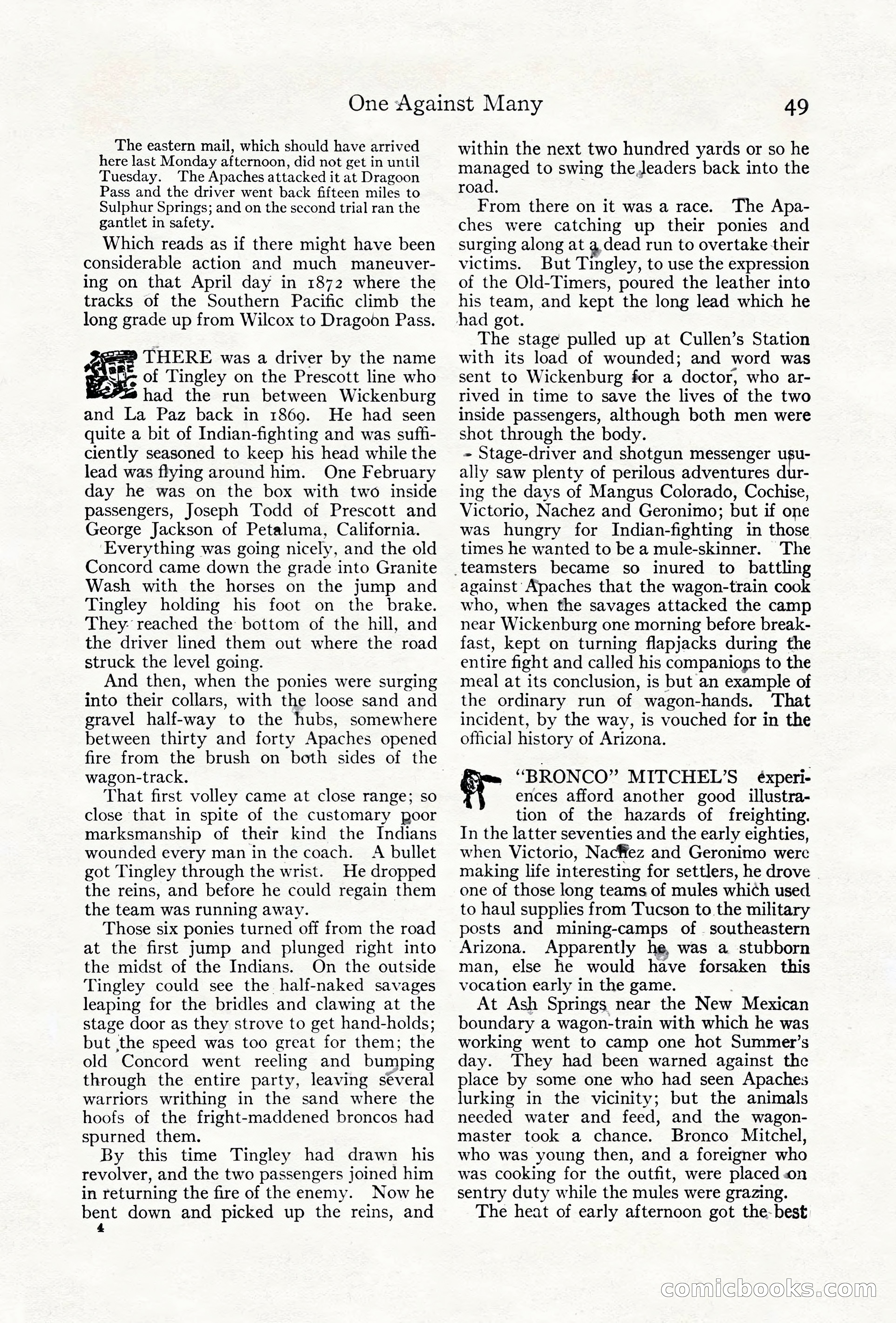
A restored page from Pulp Fiction, 1921. Page through the whole issue in the reader above.
📄 Transcribed text from this page (OCR, searchable)
Machine-transcribed from the original scan — historical spelling and the odd misread are preserved.
One Against Many The eastern mail, which should have arrived here last Monday afternoon, did not get in until Tuesday. The Apaches attacked it at Dragoon Pass and the driver went back fifteen miles to Sulphur Springs; and on the second trial ran the gantlet in safety. Which reads as if there might have been considerable action and much maneuver- ing on that April day in 1872 where the tracks of the Southern Pacific climb the long grade up from Wilcox to Dragoon Pass. = THERE was a driver by the name of Tingley on the Prescott line who Fie had the run between Wickenburg and La Paz back in 1869. He had seen quite a bit of Indian-fighting and was suff- ciently seasoned to keep his head while the lead was flying around him. One February day he was on the box with two inside passengers, Joseph Todd of Prescott and George Jackson of Petaluma, California. ‘Everything was going nicely, and the old Concord came down the grade into Granite Wash with the horses on the jump and Tingley holding his foot on the brake. They: reached the bottom of the hill, and the driver lined them out where the road struck the level going. And then, when the ponies were surging into their collars, with the loose sand and gravel half-way to the hubs, somewhere between thirty and forty Apaches opened fire from the brush on both sides of the wagon-track. That first volley came at close range; so close that in spite of the customary poor marksmanship of their kind the Indians wounded every man in the coach. A bullet got Tingley through the wrist. He dropped the reins, and before he could regain them the team was running away. Those six ponies turned off from the road at the first jump and plunged nght into the midst of the Indians. On the outside Tingley could see the half-naked savages leaping for the bridles and clawing at the stage door as they strove to get hand-holds; but the speed was too great for them; the old Concord went reeling and bumping through the entire party, leaving several warriors writhing in the sand where the hoofs of the fright-maddened broncos had spurned them. By this time Tingley had drawn his revolver, and the two passengers joined him in returning the fire of the enemy. Now he bent down and picked up the reins, and 4 49 within the next two hundred yards or so he managed to swing the.Jeaders back into the road. ; From there on it was a race. The Apa- ches were catching up their ponies and surging along at g dead run to overtake their victims. But Tingley, to use the expression of the Old-Timers, poured the leather into his team, and kept the long lead which he had got. The stage pulled up at Cullen’s Station with its load of wounded; and word was sent to Wickenburg for a doctor, who ar- rived in time to save the lives of the two inside passengers, although both men were shot through the body. - Stage-driver and shotgun messenger ugu- ally saw plenty of perilous adventures dur- ing the days of Mangus Colorado, Cochise, Victorio, Nachez and Geronimo; but if one was hungry for Indian-fighting in those times he wanted to be a mule-skinner. The _teamsters became so inured to battling against Apaches that the wagon-train cook who, when the savages attacked the camp near Wickenburg one morning before break- fast, kept on turning flapjacks during the entire fight and called his companions to the meal at its conclusion, is but an example of the ordinary run of wagon-hands. That incident, by the way, is vouched for in the official] history of Arizona. . “BRONCO” MITCHEL’S éxperi- ences afford another good illustra- tion of the hazards of freighting. In the latter seventies and the early eighties, when Victorio, Nacffez and Geronimo were making life interesting for settlers, he drove | one of those long teams of mules which used to haul supplies from Tucson to the military posts and mining-camps of southeastern Arizona. Apparently he, was a stubborn man, else he would have forsaken this vocation early in the game. At Ash Springs near the New Mexican boundary a wagon-train with which he was working went to camp one hot Summer’s day. They had been warned against the place by some one who had seen Apaches lurking in the vicinity; but the animals needed water and feed, and the wagon- master took a chance. Bronco Mitchel, who was young then, and a foreigner who was cooking for the outfit, were placed «on sentry duty while the mules were grazing. The heat of early afternoon got the-best COmicloo CN Vp) ©