
Pulp Fiction, 1921 · page 58 of 204
Adventure Magazine Cover, June 18, 1921 — page 58: what you’re looking at
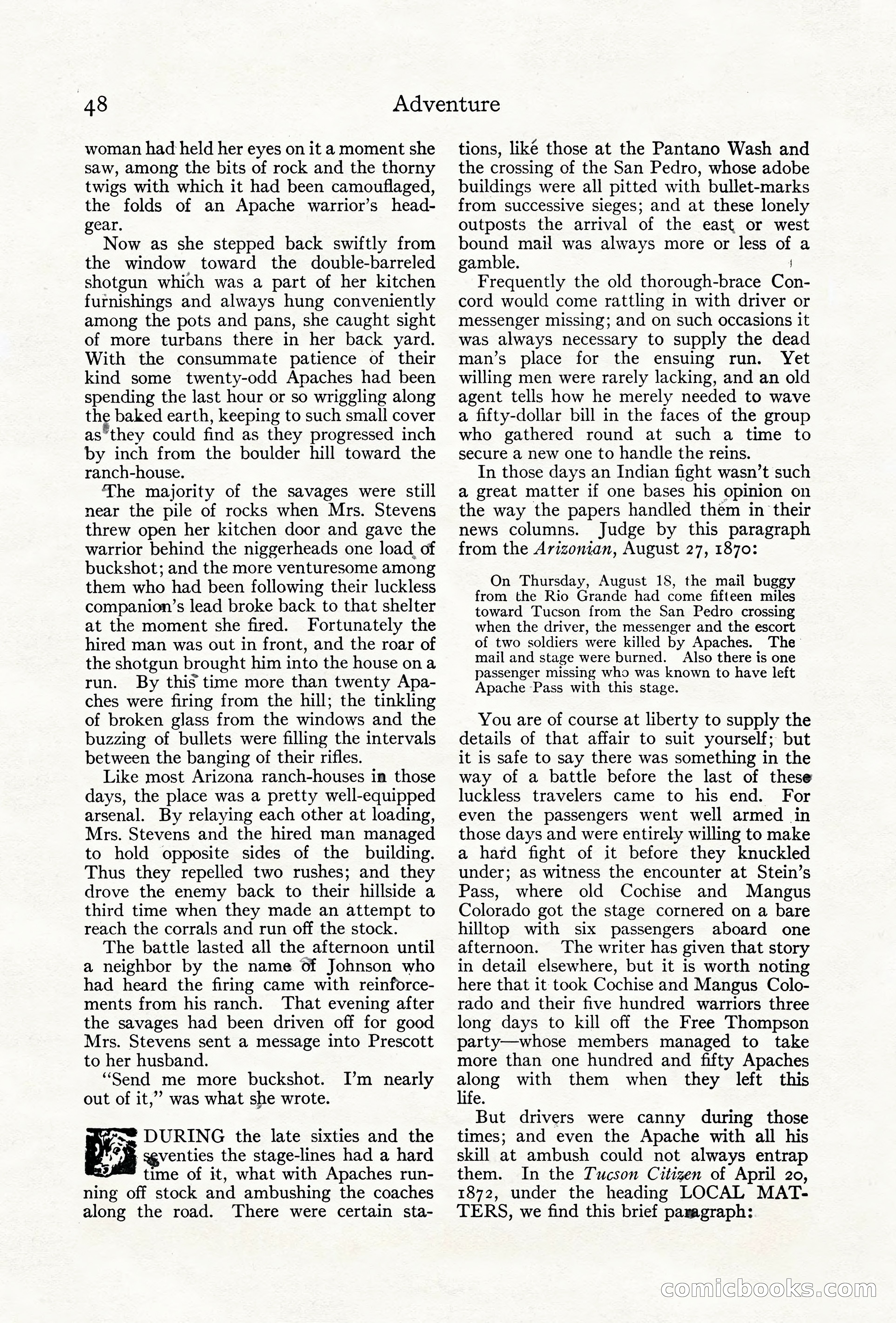
A restored page from Pulp Fiction, 1921. Page through the whole issue in the reader above.
📄 Transcribed text from this page (OCR, searchable)
Machine-transcribed from the original scan — historical spelling and the odd misread are preserved.
48 woman had held her eyes on it a moment she saw, among the bits of rock and the thorny twigs with which it had been camouflaged, the folds of an Apache warrior’s head- gear. Now as she stepped back swiftly from the window toward the double-barreled shotgun which was a part of her kitchen furnishings and always hung conveniently among the pots and pans, she caught sight of more turbans there in her back yard. With the consummate patience of their kind some twenty-odd Apaches had been spending the last hour or so wriggling along the baked earth, keeping to such small cover as*they could find as they progressed inch by inch from the boulder hill toward the ranch-house. The majority of the savages were still near the pile of rocks when Mrs. Stevens threw open her kitchen door and gave the warrior behind the niggerheads one load. of buckshot; and the more venturesome among them who had been following their luckless companion’s lead broke back to that shelter at the moment she fired. Fortunately the hired man was out in front, and the roar of the shotgun brought him into the house ona run. By this time more than twenty Apa- ches were firing from the hill; the tinkling of broken glass from the windows and the buzzing of bullets were filling the intervals between the banging of their rifles. Like most Arizona ranch-houses in those days, the place was a pretty well-equipped arsenal. By relaying each other at loading, Mrs. Stevens and the hired man managed to hold opposite sides of the building. Thus they repelled two rushes; and they drove the enemy back to their hillside a third time when they made an attempt to reach the corrals and run off the stock. The battle lasted all the afternoon until a neighbor by the name of Johnson who had heard the firing came with reinforce- ments from his ranch. That evening after the savages had been driven off for good Mrs. Stevens sent a message into Prescott to her husband. “Send me more buckshot. out of it,” was what she wrote. ~~" DURING the late sixties and the Me sgventies the stage-lines had a hard time of it, what with Apaches run- ning off stock and ambushing the coaches along the road. There were certain sta- I’m nearly Adventure tions, liké those at the Pantano Wash and the crossing of the San Pedro, whose adobe buildings were all pitted with bullet-marks from successive sieges; and at these lonely outposts the arrival of the east or west bound mail was always more or less 2 a gamble. Frequently the old thorough-brace Con. cord would come rattling in with driver or messenger missing; and on such occasions it was always necessary to supply the dead man’s place for the ensuing run. Yet willing men were rarely lacking, and an old agent tells how he merely needed to wave a fifty-dollar bill in the faces of the group who gathered round at such a time to secure a new one to handle the reins. In those days an Indian fight wasn’t such a great matter if one bases his opinion on the way the papers handled them in their news columns. Judge by this paragraph from the Arizonzan, August 27, 1870: On Thursday, August 18, the mail buggy from the Rio Grande had come fifteen miles toward Tucson from the San Pedro crossing when the driver, the messenger and the escort of two soldiers were killed by Apaches. The mail and stage were burned. Also there is one passenger missing who was known to have left Apache -Pass with this stage. You are of course at liberty to supply the details of that affair to suit yourself; but it is safe to say there was something in the way of a battle before the last of these luckless travelers came to his end. For even the passengers went well armed in those days and were entirely willing to make a hard fight of it before they knuckled under; as witness the encounter at Stein’s Pass, where old Cochise and Mangus Colorado got the stage cornered on a bare hilltop with six passengers aboard one afternoon. The writer has given that story in detail elsewhere, but it is worth noting here that it took Cochise and Mangus Colo- rado and their five hundred warriors three long days to kill off the Free Thompson party—whose members managed to take more than one hundred and fifty Apaches along with them when they left this life. But drivers were canny during those times; and even the Apache with all his skill at ambush could not always entrap them. In the Tucson Citizen of April 20, 1872, under the heading LOCAL MAT- TERS, we find this brief paragraph: COmicloo oN ) (©