
Pulp Fiction, 1921 · page 185 of 204
Adventure Magazine Cover, June 18, 1921 — page 185: what you’re looking at
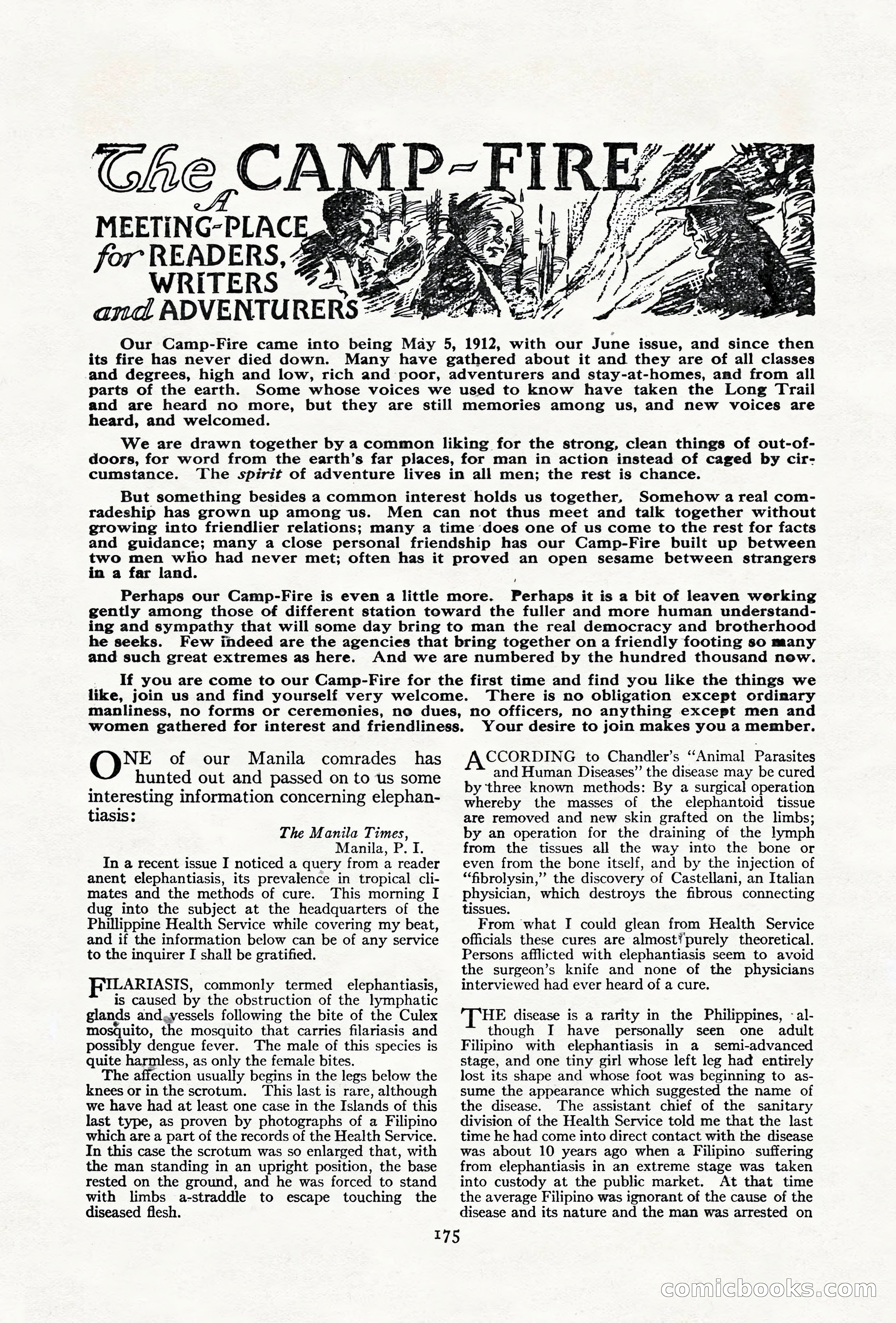
A restored page from Pulp Fiction, 1921. Page through the whole issue in the reader above.
📄 Transcribed text from this page (OCR, searchable)
Machine-transcribed from the original scan — historical spelling and the odd misread are preserved.
MEETING-PLACE, for READERS, z WRITERS éx? 9 and ADVENTURERS ~: Our Camp-Fire came into being May 5, 1912, with our June issue, and since then its fire has never died down. Many have gathered about it and they are of all classes and degrees, high and low, rich and poor, adventurers and stay-at-homes, and from all parts of the earth. Some whose voices we used to know have taken the Long Trail and are heard no more, but they are still memories among us, and new voices are heard, and welcomed. We are drawn together by a common liking for the strong, clean things of out-of- doors, for word from the earth’s far places, for man in action instead of caged by cir- cumstance. The spirit of adventure lives in all men; the rest is chance. But something besides a common interest holds us together, Somehow a real com- radeship has grown up among us. Men can not thus meet and talk together without growing into friendlier relations; many a time does one of us come to the rest for facts and guidance; many a close personal friendship has our Camp-Fire built up between abe Pe wee had never met; often has it proved an open sesame between strangers a far land. Perhaps our Camp-Fire is even a little more. Perhaps it is a bit of leaven werking gently among those of different station toward the fuller and more human understand- ing and sympathy that will some day bring to man the real democracy and brotherhood he seeks. Few indeed are the agencies that bring together on a friendly footing so many and such great extremes as here. And we are numbered by the hundred thousand now. If you are come to our Camp-Fire for the first time and find you like the things we like, join us and find yourself very welcome. There is no obligation except ordinary manliness, no forms or ceremonies, no dues, no officers, no anything except men and \ f / pes 2 B women gathered for interest and friendliness. NE of our Manila comrades has hunted out and passed on to us some interesting information concerning elephan- tiasis: The Manila Times, Manila, P. I. In a recent issue I noticed a query from a reader anent elephantiasis, its prevalence in tropical cli- mates and the methods of cure. This morning I dug into the subject at the headquarters of the Phillippine Health Service while covering my beat, and if the information below can be of any service to the inquirer I shall be gratified. | Raeset ae haeL commonly termed _ elephantiasis, is caused by the obstruction of the lymphatic glands and.vessels following the bite of the Culex mosquito, the mosquito that carries filariasis and possibly dengue fever. The male of this species is quite harmless, as only the female bites. The affection usually begins in the legs below the knees or in the scrotum. This last is rare, although we have had at least one case in the Islands of this last type, as proven by photographs of a Filipino which are a part of the records of the Health Service. In this case the scrotum was so enlarged that, with the man standing in an upright position, the base rested on the ground, and he was forced to stand with limbs a-straddle to escape touching the diseased flesh. 175 Your desire to join makes you a member. ACCORDING to Chandler’s ‘“‘Animal Parasites and Human Diseases” the disease may be cured by three known methods: By a surgical operation whereby the masses of the elephantoid tissue are removed and new skin grafted on the limbs; by an operation for the draining of the lymph from the tissues all the way into the bone or even from the bone itself, and by the injection of “‘fibrolysin,”’ the discovery of Castellani, an Italian physician, which destroys the fibrous connecting tissues. From what I could glean from Health Service officials these cures are almost’purely theoretical. Persons afflicted with elephantiasis seem to avoid the surgeon’s knife and none of the physicians interviewed had ever heard of a cure. ‘THE disease is a rarity in the Philippines, -al- though I have personally seen one adult Filipino with elephantiasis in a semi-advanced stage, and one tiny girl whose left leg had entirely lost its shape and whose foot was beginning to as- sume the appearance which suggested the name of the disease. The assistant chief of the sanitary division of the Health Service told me that the last time he had come into direct contact with the disease was about 10 years ago when a Filipino suffering from elephantiasis in an extreme stage was taken into custody at the public market. At that time the average Filipino was ignorant of the cause of the disease and its nature and the man was arrested on COmiclboo C© 5}