
Pulp Fiction, 1921 · page 184 of 204
Adventure Magazine Cover, June 18, 1921 — page 184: what you’re looking at
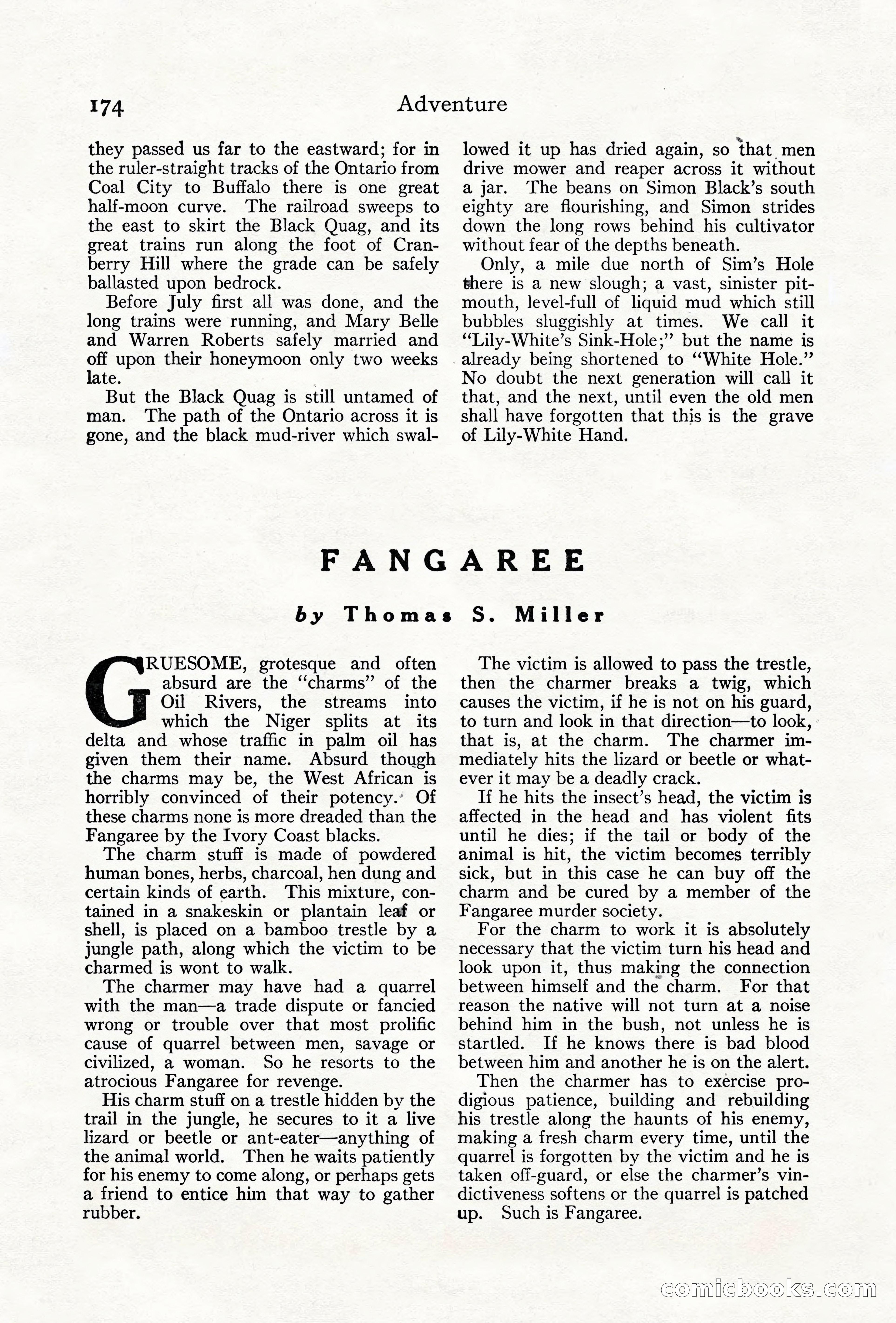
A restored page from Pulp Fiction, 1921. Page through the whole issue in the reader above.
📄 Transcribed text from this page (OCR, searchable)
Machine-transcribed from the original scan — historical spelling and the odd misread are preserved.
174 they passed us far to the eastward; for in the ruler-straight tracks of the Ontario from Coal City to Buffalo there is one great half-moon curve. The railroad sweeps to the east to skirt the Black Quag, and its great trains run along the foot of Cran- berry Hill where the grade can be safely ballasted upon bedrock. Before July first all was done, and the long trains were running, and Mary Belle and Warren Roberts safely married and off upon their honeymoon only two weeks late. But the Black Quag is still untamed of man. The path of the Ontario across it is gone, and the black mud-river which swal- FANG by Thomas RUESOME, grotesque and often absurd are the “charms” of the Oil Rivers, the streams into which the Niger splits at its delta and whose traffic in palm oil has given them their name. Absurd though the charms may be, the West African is horribly convinced of their potency.’ Of these charms none is more dreaded than the Fangaree by the Ivory Coast blacks. The charm stuff is made of powdered human bones, herbs, charcoal, hen dung and certain kinds of earth. This mixture, con- tained in a snakeskin or plantain leaf or shell, is placed on a bamboo trestle by a jungle path, along which the victim to be charmed is wont to walk. The charmer may have had a quarrel with the man—a trade dispute or fancied wrong or trouble over that most prolific cause of quarrel between men, savage or civilized, a woman. So he resorts to the atrocious Fangaree for revenge. His charm stuff on a trestle hidden by the trail in the jungle, he secures to it a live lizard or beetle or ant-eater—anything of the animal world. Then he waits patiently for his enemy to come along, or perhaps gets a friend to entice him that way to gather rubber. Adventure lowed it up has dried again, so that men drive mower and reaper across it without a jar. The beans on Simon Black’s south eighty are flourishing, and Simon strides down the long rows behind his cultivator without fear of the depths beneath. Only, a mile due north of Sim’s Hole there is a new slough; a vast, sinister pit- mouth, level-full of liquid mud which still bubbles sluggishly at times. We call it “Lily-White’s Sink-Hole;” but the name is .already being shortened to ‘“‘White Hole.” No doubt the next generation will call it that, and the next, until even the old men shall have forgotten that this is the grave of Lily-White Hand. AREE S. Miller The victim is allowed to pass the trestle, then the charmer breaks a twig, which causes the victim, if he is not on his guard, to turn and look in that direction—to look, that is, at the charm. The charmer im- mediately hits the lizard or beetle or what- ever it may be a deadly crack. If he hits the insect’s head, the victim is affected in the head and has violent fits until he dies; if the tail or body of the animal is hit, the victim becomes terribly sick, but in this case he can buy off the charm and be cured by a member of the Fangaree murder society. For the charm to work it is absolutely necessary that the victim turn his head and look upon it, thus making the connection between himself and the charm. For that reason the native will not turn at a noise behind him in the bush, not unless he is startled. If he knows there is bad blood between him and another he is on the alert. Then the charmer has to exercise pro- digious patience, building and rebuilding his trestle along the haunts of his enemy, making a fresh charm every time, until the quarrel is forgotten by the victim and he is taken off-guard, or else the charmer’s vin- dictiveness softens or the quarrel is patched up. Such is Fangaree. COmicloo oN Wp) ©